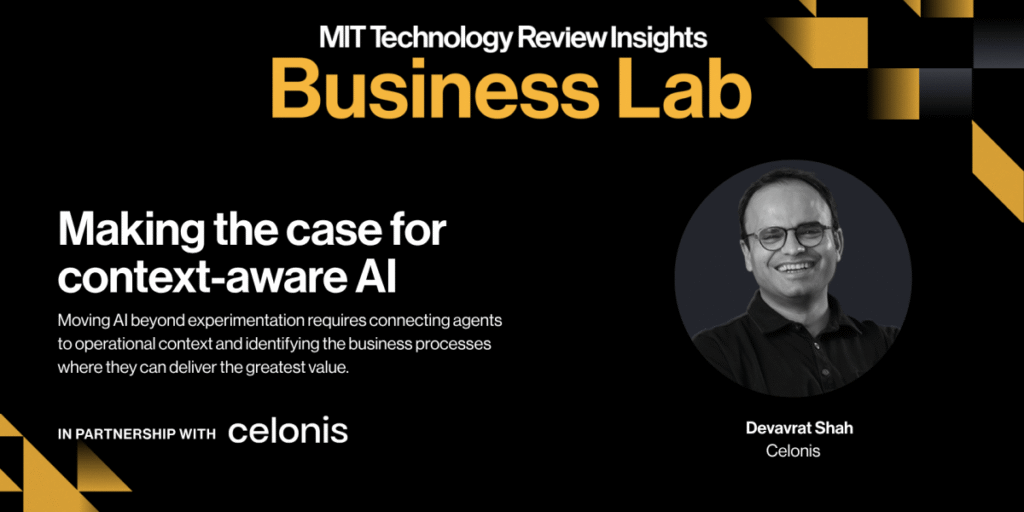
Enterprise AI models fail when they lack an understanding of how a business actually operates. Without that operational context, powerful algorithms miss the constraints and relationships that determine whether a decision is correct. As companies move from testing AI to using it daily, the priority is giving technology the background information to function within complex processes.
Devavrat Shah, chief scientist of enterprise AI at Celonis, calls this “decision intelligence.” He argues that AI agents must understand the role of each task and the conditions surrounding it to be useful. “You can’t just do that in a vacuum,” he says. Without the right operational context, agents risk overlooking important constraints, making costly mistakes, or consuming excessive computing resources as they try to figure out what they need to know.
The practical approach
The solution starts by connecting AI to the processes and data enterprises already use. A contextual layer helps agents understand workflows, operate within defined guardrails, and produce recommendations that people can review and approve. Shah advises organizations to start with a specific business decision, identify its most difficult steps, and test whether AI can improve them. Measuring gains in speed and value then determines whether an application is worth scaling.
This approach changes how employees spend their time. Automating repetitive, manual work and coordinating tasks across teams could free people to focus on more complex strategic decisions. Realizing that benefit, however, will require investment in workforce education, so employees can understand AI outputs and their implications instead of just handing decisions over to agents.
Future applications
Looking to the future, Shah sees opportunities extending from routine operational tasks to enterprise-wide planning in areas such as finance, workforce management, marketing, and sales. With the right context, AI could help organizations evaluate options and make consequential decisions more quickly. As Shah puts it, “Now, maybe [resource planning] should not take that much time, and people are actually making the right choices quickly.”
This episode of Business Lab is produced in partnership with Celonis.
What it means
The core issue is that current AI models apply generalized principles to specialized scenarios and come up short. They act without the operational context needed to be effective. Celonis addresses this by using a digital twin of an organization to provide that context. Their system sits between the underlying workflow tools and the AI agents. It manages to connect to existing data even if it is not perfect or clean. The goal is to enable agents to support specific roles within a process while keeping humans in the loop to review and approve outputs.