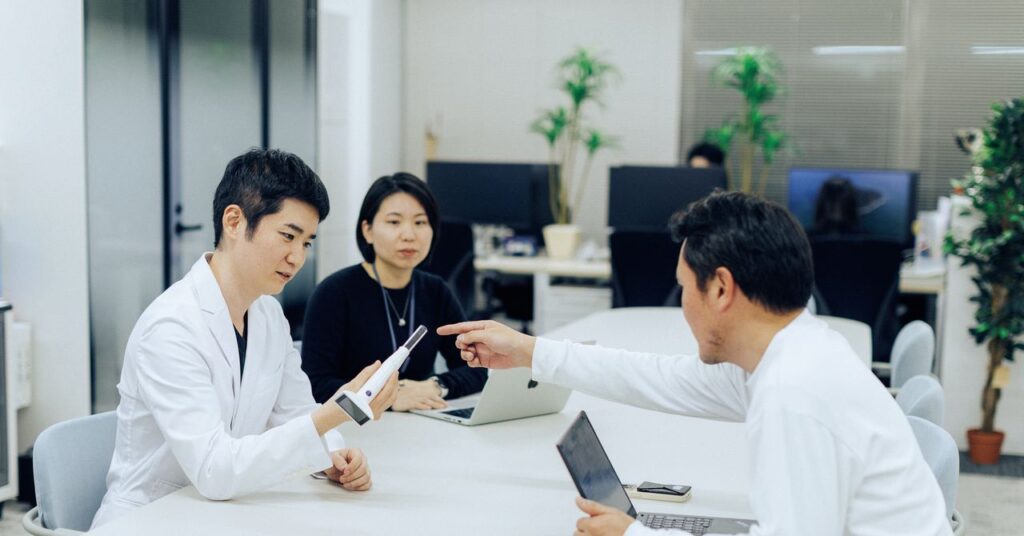
Doctors have used the throat exam since ancient times, yet a Japanese firm called Iris is now using artificial intelligence to extract hidden data from it. Sho Okuyama leads the company behind Nodoca, a system that captures images of the pharynx with a small camera. It combines these visuals with patient history and other data to deliver an influenza assessment in just over ten seconds. This removes the need for the standard swab test, which often causes discomfort by inserting a probe deep into the nose. The device also detects illness at an earlier stage than traditional methods.
In 2022, Nodoca became the first AI-equipped medical device in Japan to receive approval as a new medical device and gain coverage under the national health insurance system. More than 2,000 medical institutions across the country have since adopted it. In October 2025, the system received approval for an additional function related to Covid-19.
Okuyama worked as an emergency physician and treated patients on remote islands. Those locations often had only a few hundred residents and limited equipment, essentially a stethoscope. He relied on his own eyes and ears to diagnose conditions. When people hear the term medical AI, they often imagine diagnostic algorithms. Okuyama argues the real differentiator lies in sensing. His team developed their own hardware and ventured into pharyngeal imaging, an area no one had previously explored.
When the company founded in 2017, there was no training data for AI focused on the throat. Okuyama lent dedicated cameras to around 100 medical institutions. Over a period of about three years, he collected data with patient consent. This approach addressed three major uncertainties: the development of the hardware, the collection of training data, and whether AI-assisted diagnosis could work. The company opened the path to practical implementation by solving these problems.
Once Nodoca entered the market, its accuracy improved at an accelerating pace. Every time the system sees use in clinical practice, anonymized processed data accumulates. The number of throat images grew from hundreds of thousands before launch to several million. This network effect has become a barrier to entry for competitors, and no latecomers have emerged in the same field.
The potential of Nodoca extends beyond infectious diseases. Images of the throat capture patterns in the mucosa and blood vessels. The company is conducting research and development on AI capable of detecting lifestyle-related diseases such as diabetes and hypertension by identifying changes in those patterns.
Okuyama says the cost of AI inference is extremely low. He expects that in about 10 years, a single photograph of the throat will be used to perform a comprehensive range of tests. Even if the number of tests increases, the cost of providing them hardly changes.
The Goal Of Redesigning Health Care
Okuyama considers whether AI can serve as the foundation for redesigning health care itself. AI-powered medical interviews and online consultations have already become a reality. In-person care from primary care physicians and treatment at specialist hospitals follow. Okuyama envisions a future in which AI is implemented at every stage of that process.
To make this AI-driven redesign of health care a reality, Okuyama has actively proposed regulatory reform and lobbied government ministries. He states the future of health care does not include a single future technology. Everything can be achieved with technology that already exists today. The job is to close the gap that makes these things have to be talked about as the future.
Because the body’s mucous membranes are believed to be highly consistent, data and algorithms accumulated in Japan are expected to be transferable elsewhere. Preparations for overseas expansion are already underway, with clinical trials in the United States under consideration.
What it means
For people making things, the change is practical. The swab test is uncomfortable and requires a deep insertion into the nose. Nodoca replaces that with a quick photo and a ten-second wait for results. It also catches illness earlier, before symptoms become severe. This shift means less physical intrusion for patients and faster answers for doctors.