OpenBMB has launched MiniCPM5-2B, a 2.52 billion parameter model designed to run on local hardware. The model contains 2,516,756,480 parameters, with 1,981,982,720 located outside the embeddings layer. It features 42 layers, uses grouped-query attention with 16 query heads and 2 key/value heads, and supports a native context window of 131,072 tokens. The architecture follows the standard LlamaForCausalLM design, allowing mainstream inference engines to load it without custom kernels or code forks.
The weights are licensed under Apache 2.0. They run through vLLM, SGLang, Transformers, llama.cpp, Ollama, LM Studio, MLX and FlagOS.
Performance metrics
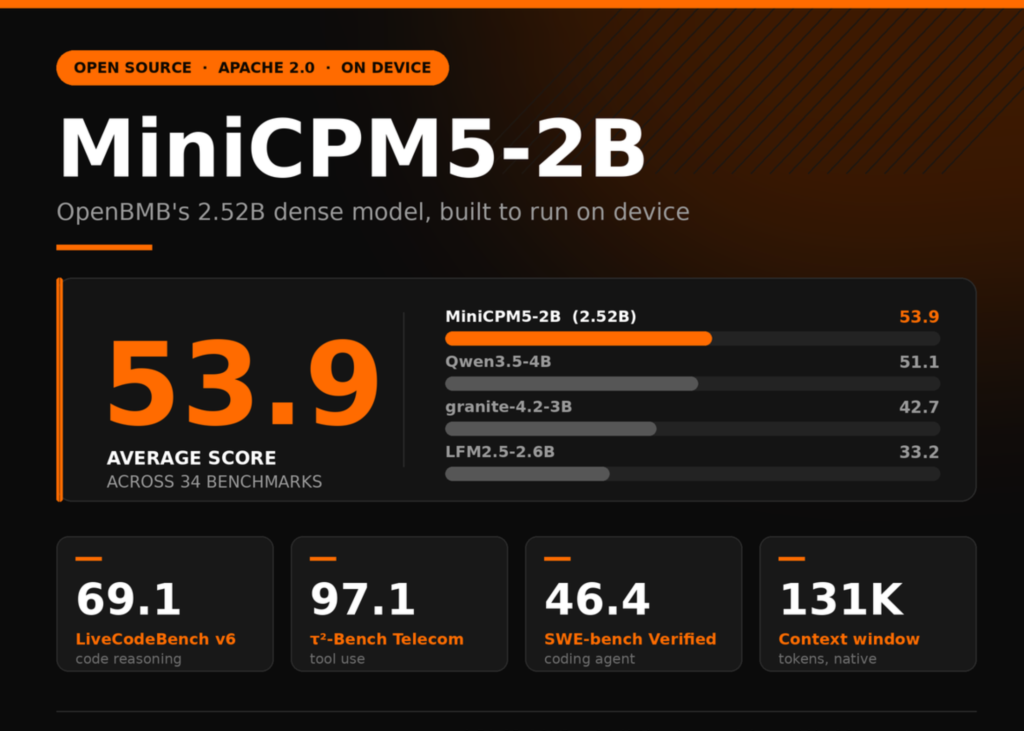
OpenBMB compares MiniCPM5-2B against LFM2.5-2.6B, Qwen3.5-2B and Gemma-4-E2B-it within the same size class. It lists Qwen3.5-4B, granite-4.2-3B, Nemotron-3-Nano-4B, Gemma-4-E4B-it and LFM2.5-8B-A1B for reference. Across 34 benchmark rows it averages 53.9. The best baseline in that set is Qwen3.5-4B at 51.1, then granite-4.2-3B at 42.7 and LFM2.5-2.6B at 33.2.
On code reasoning MiniCPM5-2B posts 69.1 on LiveCodeBench v6 against 56.4, and 46.4 on SWE-bench Verified against 33.6. Tool use is the widest margin: 97.1 on τ²-Bench Telecom, 66.6 on BFCL v4, and 20.8 on τ³-Bench Banking against 6.8. Long context is split, with 68.1 on NoLiMa against 43.5, but 59.0 on AA-LCR against 61.0 and 43.7 on LongBench v2 against 47.3. General knowledge is where the size gap shows: 70.8 on MMLU-Pro against 78.0, and 8.9 on Humanity’s Last Exam against 9.9. OpenBMB marks rows sourced from Artificial Analysis separately from internally reproduced ones.
Training recipe: SFT, then RL, then on-policy distillation
Training follows the UltraData tiered data management method described in original research. Base training runs stable and decay phases, then mid-training adapts the model to the target data distribution. Post-training starts with 400B tokens of deep-thinking SFT, then trains specialised RL teachers for math, code, agentic tasks and writing using the critic-based JustRL II algorithm.
The final step is on-policy distillation. OPD merges 16 RL experts, five of them agentic, into a single shipped model. At each response position it computes full-vocabulary reverse KL divergence between student and teacher logits as the advantage estimate, replacing the verification-based advantage. It reuses the RL prompts as distillation data, so no new corpus is built. OpenBMB measures the RL plus OPD stage at 10.96 average points on reasoning and general benchmarks and 6.96 points on agentic ones.
The data is open too
Alongside the weights, OpenBMB released Ultra-FineWeb, Ultra-FineWeb-L3, UltraX, UltraData-Code, UltraData-Math, UltraData-SFT-2605, UltraData-SFT-Agent-2609 with 500K agent samples, and UltraData-RL-2609 with more than 80K RL samples. Intermediate checkpoints are published as well, covering Base, Midtrain and SFT-only, so the contribution of each stage can be measured directly.
Summary
MiniCPM5-2B is a credible on-device option for agentic and tool-calling workloads, not a general knowledge model. Its advantage is clearest on tool use, coding agents and NoLiMa-style long-context retrieval, and it trails larger models on MMLU-Pro, GPQA-Diamond and MATH-500. The open data and intermediate checkpoints make the RL plus OPD claim checkable, which matters more than the headline average.
What it means
Developers can now run a model that handles tool calling and coding tasks locally without needing a large GPU cluster. The inclusion of all training datasets means researchers can verify how much each stage of the pipeline contributes to the final performance.