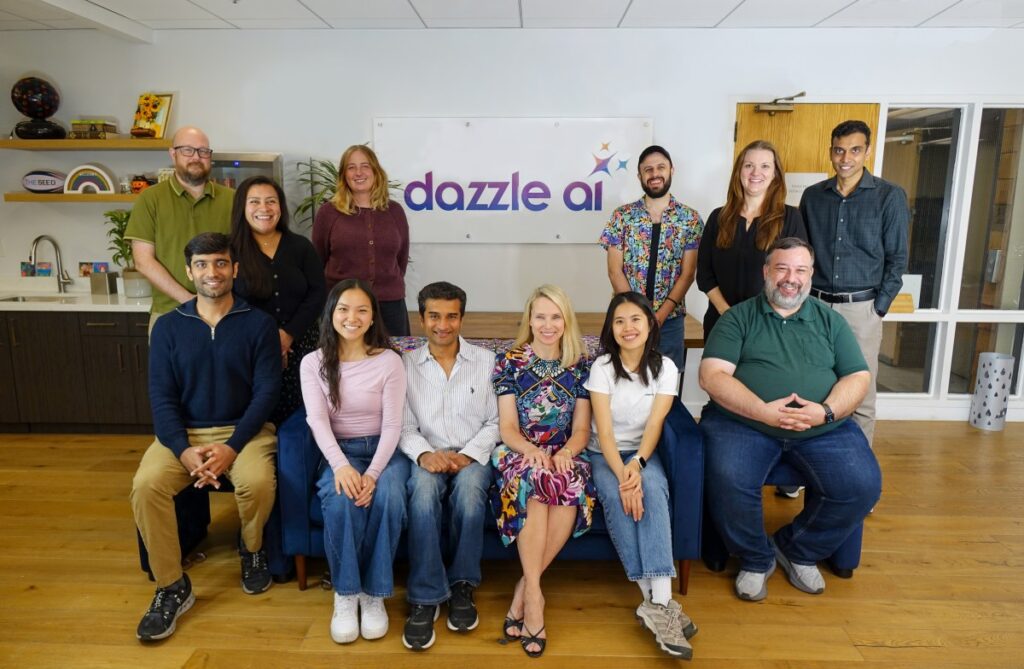
Marissa Mayer has launched Dazzle, a personal AI assistant that draws its entire profile from a user’s camera roll rather than their inbox or calendar.
The tool raised $8 million in seed funding last December. Mayer introduced the service earlier this month as a response to competitors like Meta’s Muse and Instinct.
Her demo showed a clear divergence from the standard approach. While other assistants build context from text-heavy apps, Dazzle relies on a single source: photos stored on a phone.
“I think that photos are an underappreciated source of information,” Mayer said. “You’ll be surprised what we can learn about you and how good a job we can do with your photos.”
The logic is that if a photo is worth a thousand words, a camera roll is worth millions. The AI scans images to identify hobbies, interests, food preferences, style choices, and social circles.
“We understand whether or not you like to ski, where your most recent trip was, what types of things your kids are into,” Mayer told me.
Mayer’s focus on photography is not new. Her previous startup, Sunshine, released Shine in 2024. That product failed to gain traction, suffered from an outdated design, and eventually shut down. Mayer noted that the project did generate some intellectual property.
Dazzle allows interaction through its app or via text. It operates on two main functions. First, it handles immediate requests by scanning recent images. This could involve extracting event details from a flyer to update a calendar or identifying a broken garage door to locate a repair service.
Second, the system mines the library to generate personalised suggestions for holidays, gifts, and other activities.
I tested the learning capabilities by asking the assistant to recall past events. Mayer used her own photos to brainstorm family outings. The tool identified a love for escape rooms and suggested several locations in the San Francisco Bay Area she had not previously considered.
When I asked for vacation ideas, it recommended Mediterranean destinations based on my history with Spain and Greece. It also suggested Sicily, despite my visit there occurring four years prior.
Further testing revealed gaps in the system. It failed to remember that my daughter already knows how to roller skate when I asked about buying her skates for her next birthday.
Despite these errors, the activity suggestions were useful. The assistant proposed visits to a local pottery studio and a bioluminescent kayak tour in Tomales Bay.
I am unsure if I will continue using the service, but the suggestions felt more personal than those from tools that only access calendars and emails.
Mayer argues that security concerns regarding products like Instinct and Muse might make users prefer handing over photo libraries instead of granting access to sensitive messages and emails.
She emphasised that Dazzle prioritises privacy. The system discards any personal information flagged as sensitive.
This surge of new AI assistants represents an interesting period for consumers. While Dazzle is not yet as broadly useful as other offerings, it shows a path where AI moves beyond task execution to actually know who a user is.
What it means
The shift to photo-based context changes how users interact with assistants. Instead of typing out preferences or manually updating calendars, the AI infers habits and relationships from visual data. This approach may reduce the friction of data entry but introduces new privacy questions regarding image storage and processing.