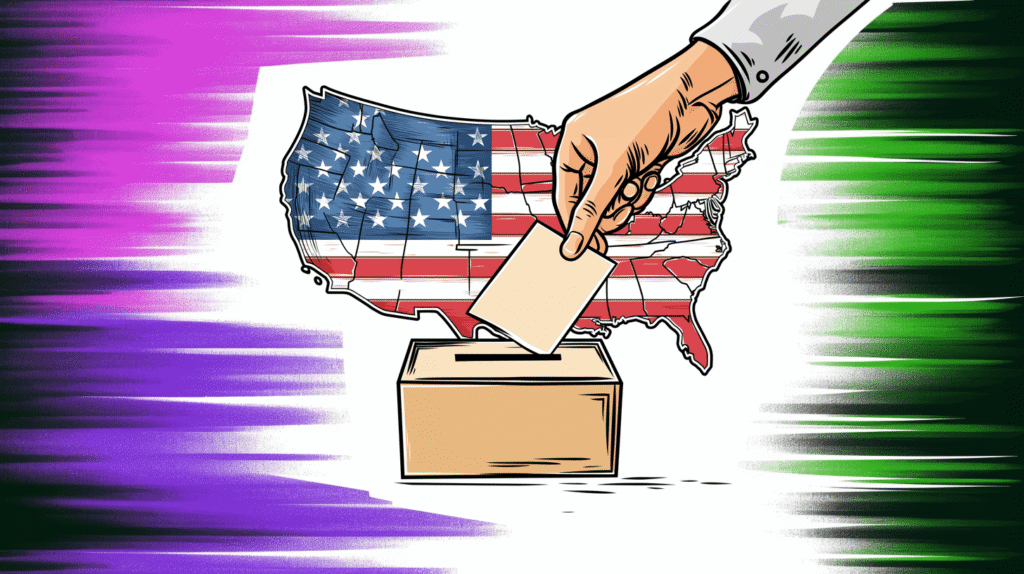
Republican and Democratic campaigns in the United States now deploy artificial intelligence at nearly every stage of their operations, from vetting opponents to micro-targeting voters. This shift comes as Europe moves to draw a harder line around the technology.
In Pennsylvania’s 10th Congressional District, 29-year-old Alex Bond recently told two canvassers from the Democratic group Swing Left that he thought AI was terrible. He did not know his comments were processed by an AI-powered app that synthesises hundreds of similar conversations and feeds actionable insights back to the campaign. “Everything a person is saying is a data point,” said Violet Kopp, organizing director at Swing Left, in an interview with the New York Times.
The New York Times report paints a picture of a deep shift in American campaigning. According to a survey by the newsletter Anchor Change, 87 percent of campaign strategists now use AI daily. Beyond the publicly visible layer of AI-generated images and videos, campaign managers have woven the technology into nearly every workflow. They are analysing voter data, producing campaign materials, and crafting tailored messages for micro-segments of the electorate. The Democratic opposition research group American Bridge 21st Century used AI to vet roughly 250 Republican candidates, according to the report.
Both parties are all in on AI, but they play by different rules
Despite the boom, AI remains a political risk, the New York Times reports. Polls show that Democratic voters are more skeptical of the technology than Republicans. Progressive groups report angry emails about AI use, and unionised staffers worry about their jobs. Republican strategists, by contrast, face less internal pushback.
“If voters don’t like A.I., they don’t want to know that their candidate’s campaign is using A.I. to do stuff like draft emails or create press releases or edit videos. So you’re just not going to see people bragging about it. But it is happening,” Republican strategist Eric Wilson, director of the Center for Campaign Innovation, told the New York Times. Wilson considers AI-generated videos of opponents acceptable as long as they reflect real statements. The National Democratic Training Committee, on the other hand, rejects such content outright because it “undermines democratic discourse and voter trust,” according to the report.
Republicans lean more heavily on privately funded companies, while Democrats prefer nonprofit models, the NYT reports. Democratic hesitation could slow adoption and give Republicans an edge in tight races. The November midterms are widely seen as a test run for the AI strategies that will shape the 2028 presidential campaign.
Europe’s rules for AI in campaigns are stricter
While US campaigns fold AI into their operations with little regulation, the EU is betting on transparency requirements and data protection. Since October 2025, new rules for political advertising apply across the EU. Political ads must be clearly labeled and disclose, among other things, who paid for them, which election they target, and how much money was spent. Political targeting requires explicit, separate consent from the people involved. Sensitive data like political views or ethnic background can’t be used for profiling.
The AI Act will also matter for future campaigns. Transparency requirements for generative AI take effect on August 2, 2026. After that date, deepfakes and AI-generated or AI-manipulated texts on topics of public interest must be clearly labeled in key cases. The European Commission published a voluntary code of practice for labeling AI-generated content in June 2026.
AI had already arrived in Germany’s 2025 federal election campaign, though on a smaller scale than in the US. According to ZDFheute, parties used AI for tasks like writing text, editing images, analysing data, and managing social media. The CDU in North Rhine-Westphalia, for example, deployed an AI bot called “Conrad” to help staffers draft press releases and social media posts. The SPD, Greens, and Left Party named AI as a writing aid, while the FDP and Left Party used it for image editing. The AfD used it for graphics and select video clips.
In Germany, self-regulation also played a more explicit role. In December 2024, the CDU, CSU, SPD, Greens, FDP, and Left Party signed a fairness agreement. They pledged to clearly label AI-generated images, video, and audio, and committed to not using deepfake technology to put words in opponents’ mouths.
The AfD and BSW did not sign on. The AfD was classified by Germany’s domestic intelligence agency in May 2025 as a “confirmed right-wing extremist” organisation, though the classification has been temporarily suspended pending a final court ruling. BSW, a left-wing populist party, combines left-leaning economic policies with a restrictive stance on immigration and a foreign policy that opposes arms deliveries to Ukraine, calls for negotiations with Russia, and is sharply critical of NATO.
What it means
For campaigners in the US, the practical change is that AI is no longer a tool for special effects but a core utility for data analysis and message drafting. The Democratic hesitation to use AI for generating opponent imagery creates a potential operational gap that Republicans are already exploiting. Meanwhile, European parties face a dual pressure: strict EU laws on political advertising and a voluntary code of practice that demands clear labeling of all AI output, a standard the AfD and BSW have refused to meet.