Anthropic introduces Claude Science, a research environment for scientists
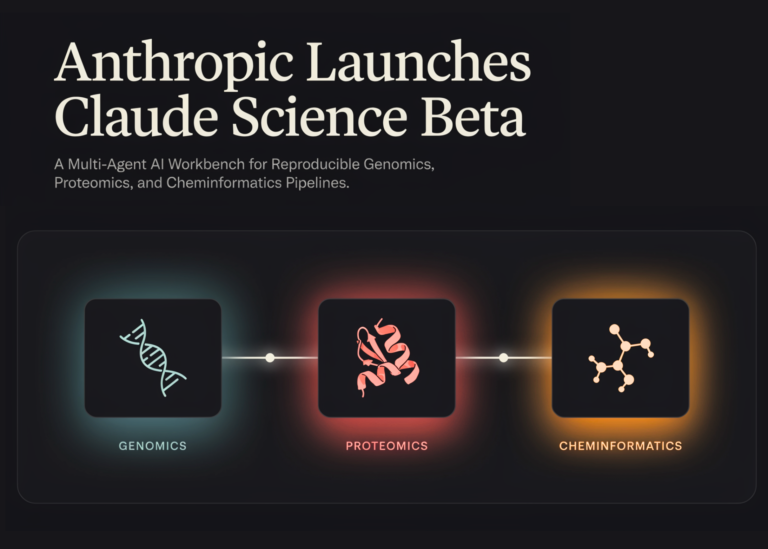
Anthropic launched Claude Science on Tuesday, a dedicated workspace designed to keep scientists in one place for computational research. The tool removes the need to jump between different databases, pipelines, and external applications.
The company states clearly that this is not a new or more capable AI model for biology. It runs the same Claude models available to everyone, including Claude Opus 4.8, with no special access or gating.
This workbench builds on the October 2025 release of Claude for Life Sciences, which improved the standard chatbot for life sciences tasks. Claude Science offers a specific location to perform that work.
The launch, announced at an AI for Science briefing, fits into Anthropic’s strategy to move beyond being just a model provider. The company aims to own the operating layer for specific industries, similar to how Claude Code has become the standard for software development. This shift toward vertical, workflow-level products could change how Anthropic competes and sets prices against rivals.
How the tool functions
A single main AI assistant acts as a project manager for scientists. It connects to more than 60 scientific databases and includes pre-built toolkits for fields like genomics, protein structure, and chemistry.
The assistant can create sub-assistants to divide tasks, mimicking a project lead delegating work to specialists. Users can also hand work to custom “expert” assistants they have built for their own research.
A separate fact-checker AI reviews citations and calculations before anything goes to publication. This step matters because more AI-assisted writing often leads to fabricated citations and unverifiable statistics in papers. However, the checking is still done by the same underlying model, not an independent source of truth.
Claude Science ensures reproducibility in other ways. The workbench can generate figures, such as 3D protein structures and chemistry drawers, alongside the code that created them. Each figure includes the exact code and environment used, a plain-language description of the creation process, and the full message history.
Scientists can edit figures using plain language prompts, instructing the agent to modify its own underlying code. This saves time on the editing process.
The tool can also run on the lab’s own infrastructure rather than sending data to Anthropic’s servers.
Early adoption and user cases
Sean Whalen, a principal scientist in machine learning and functional genomics at Gladstone Institutes, used Claude Science to build a genome browser from scratch in days.
Jérôme Lecoq, a neuroscientist at the Allen Institute, used the tool to build a multi-agent computational review pipeline. This process shaved off years of human work.
Competitor approaches
OpenAI addressed a similar problem in April with GPT-Rosalind, a specialized model fine-tuned for biological reasoning. Unlike Claude Science, Rosalind launched as a research preview limited to qualified enterprise customers in the U.S. Access required a qualification and safety review. Early partners included Amgen, the Allen Institute, Moderna, Thermo Fisher, and Novo Nordisk.
Google DeepMind plays a different game entirely. It owns foundational science models like AlphaFold and AlphaGenome, which the other two companies can only call as tools. Its Gemini for Science platform bundles those models with more than 30 life science databases into one skill set.
Availability and funding
Claude Science is available in beta to users on Pro, Max, Team, and Enterprise subscriptions. Anthropic has named Novo Nordisk and the Allen Institute as customer case studies, suggesting pharma organisations are already working with multiple AI vendors.
Anthropic will support up to 50 Claude Science projects with up to $30,000 in credits. Applications are open through July 15, 2026, with award notifications sent by July 31. Projects will run from September 1 to December 1, 2026.
What it means
Scientists now have a dedicated environment that handles the administrative burden of connecting disparate tools. The focus shifts from managing pipelines to managing the actual research questions. However, reliance on a single model for fact-checking introduces a specific risk that researchers must consider when validating data.