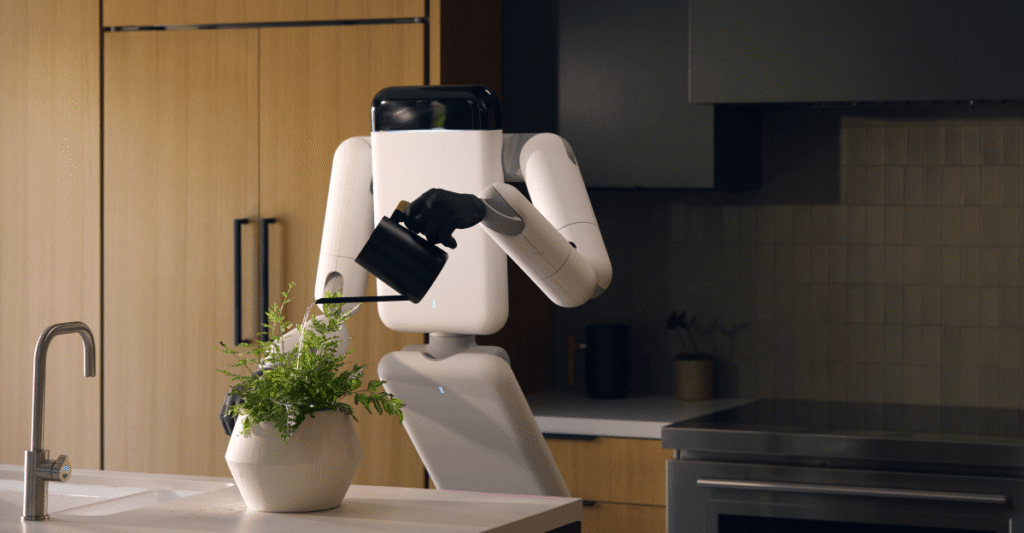
Genesis AI has unveiled Eno, a new humanoid robot that explicitly rejects traditional anthropomorphic design. Backed by former Google CEO Eric Schmidt, the French startup argues that future machines do not require human features to function effectively. Unlike competitors prioritising legs and heads, Eno operates on a wheeled base and folds flat like a deck chair for storage. Despite its unconventional silhouette, the device retains human-like hands to ensure compatibility with existing tools and environments. The company describes this approach as designing around human capability rather than human appearance. This strategy positions Eno as a general-purpose unit intended for diverse tasks rather than a single specialised function like folding laundry.
This shift matters because it addresses the practical limitations of current bipedal robotics. Traditional humanoids often struggle with balance and energy efficiency while attempting to mimic human movement. By utilising a wheeled chassis, Genesis AI aims to improve mobility and reduce power consumption without sacrificing dexterity. The focus on functional utility over aesthetic resemblance suggests a maturing industry that values performance metrics above all else. This approach could accelerate the deployment of robots in real-world commercial settings where reliability is more critical than form.
- Eno uses a wheeled base and folding mechanism to prioritise mobility and storage over human-like legs.
- The robot retains human-sized hands to maintain compatibility with standard tools and workspaces.
- Genesis AI targets general-purpose applications, moving away from single-task automation models.