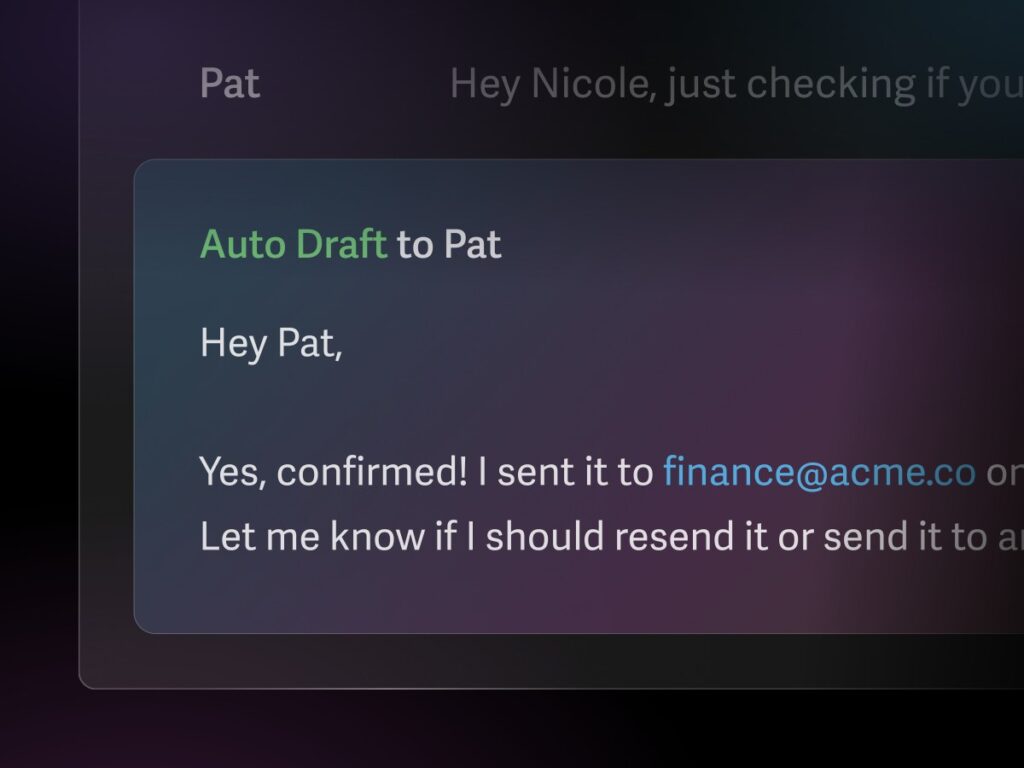
Superhuman has launched an updated auto-draft feature that identifies key emails and generates replies sounding less robotic.
The email client has tried this approach before with instant replies and follow-up drafts, but earlier attempts often sounded like overly enthusiastic salespeople. I did not use those much. The new version feels different. After gaining access to the beta over the last few days, I have sent emails with little to no editing for some generated drafts.
The application decides which messages need answers and drafts a response based on your tone from previous conversations. It also generates two other variations you might want to send instead.
In my testing, I saw drafts agreeing to embargoes on a pitch to get more details, or confirming timing for a meeting that I could send with minimal edits. The feature also generated responses to requests for an authored post on TechCrunch, stating that I do not handle that work. TechCrunch does not accept authored posts.
The feature is far from perfect. By default, it often generated a positive response to a pitch, or agreed to a meeting at a time after midnight. I could select another response from the other variations quickly and send it away.
The feature learns from your usage and improves responses. After the midnight meeting debacle, when someone suggested a similar time, the feature generated a draft saying that the timing does not work for me.
I receive thousands of emails every month, partially because AI makes first drafts easier for others, such as comms and PR professionals. I do not have the confidence to hand over the reins to AI to handle my inbox completely, but this feature could help me respond to more people when I do not need to type out long messages.
Users can personalise emails by heading to Settings and Personalisation and adding details about themselves and their role, along with adding files or links for more context.
Rahul Vohra, co-founder of Superhuman, said during the testing phase that 40% of auto-generated drafts were sent within one day, and 60% of those were sent without any manual editing.
Vohra noted that earlier features like Instant replies were built from older models like GPT-3.5, which were less intelligent or had a smaller context window. With this new implementation, the company is using an array of models.
“Today, we are using a mixture of models to make this work. The actual writing is done by frontier models from both Anthropic and OpenAI. So we’re applying the maximum amount of intelligence and context to this that we possibly can to make the feature work,” Vohra said.
Last year, Grammarly acquired Superhuman and then rebranded the company as Superhuman. Now, the company is building an assistant called Superhuman Go that spans platforms while carrying context over from one app to another.
What it means
The shift to using frontier models from Anthropic and OpenAI means the drafts will likely understand nuance better than previous iterations. Users can expect fewer generic sales pitches and more accurate tone matching, though manual review remains necessary to catch errors like impossible meeting times.