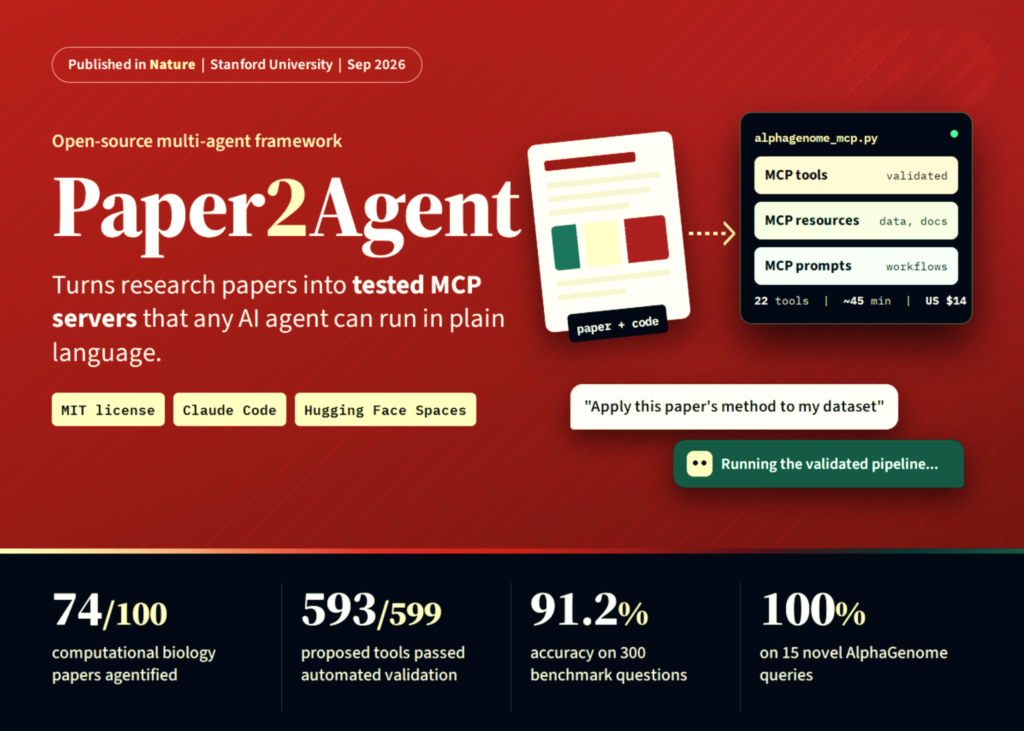
Researchers at Stanford have released Paper2Agent, a system published in Nature on 16 September 2026 that turns academic papers and their associated code into Model Context Protocol (MCP) servers. Led by Jiacheng Miao and James Zou, the team designed the tool to allow any MCP-compatible agent, such as Claude Code, to execute a paper’s methods via natural language commands. The output functions as a virtual corresponding author, ready to run experiments on new datasets.
The software is open source under an MIT license. Developers can install it as a skill for Claude Code or Codex. Prebuilt servers for AlphaGenome, Scanpy, and TISSUE are available on Hugging Face Spaces. A hosted version is also live at paper2agent.ai.
How the Pipeline Works
The system runs on Claude Code’s agent SDK. A central orchestrator directs specialized sub-agents through six distinct steps:
- Locate and download the codebase.
- An environment manager builds an isolated virtual environment.
- A tutorial scanner indexes usable tutorials.
- A tutorial executor runs them end to end and records reference outputs.
- A tool extractor turns tutorials into parameterized MCP tools, and a test verifier validates them.
- The orchestrator assembles validated tools into one MCP server.
The validation gate is strict. A tool passes only when expected files appear and numbers match within 3%. Figures must also match references by perceptual hash, with a Hamming distance under 20. The verifier gets up to six attempts per function. Tools that keep failing are excluded from the final server.
Each server exposes three components. MCP tools wrap the paper’s methods as executable functions. MCP resources hold the manuscript, code links, datasets and figures. MCP prompts encode multi-step workflows, such as the correct Scanpy preprocessing order. The research team used Claude Sonnet 4 for all Paper2Agent applications.
AlphaGenome Agent Results
For AlphaGenome, Paper2Agent built 22 tools in about 45 minutes for US $14. All 22 passed validation without human intervention. The team compared the agent with Claude Code plus repository access and Biomni.
| Benchmark | Paper2Agent | Claude + Repo | Biomni |
|---|---|---|---|
| 15 tutorial-derived queries | 98.7 ± 1.3% | 82.7 ± 3.4% | 37.3 ± 4.0% |
| 15 novel queries | 100.0 ± 0.0% | 78.7 ± 4.4% | 56.0 ± 3.4% |
| 30 open-ended queries | 82.7 ± 2.4% | 56.7 ± 2.3% | 72.2 ± 2.2% |
Results span 5 runs, graded by two human experts with 96.7% inter-rater agreement. On tutorial queries, median runtime fell 1.9× versus Claude + Repo and 3.1× versus Biomni. The gains persisted when the baseline was upgraded to Claude Opus 4.6.
The agent also re-examined an LDL cholesterol variant, chr1:109274968:G>T. It ranked SORT1 as the likely causal gene. The original AlphaGenome paper emphasised CELSR2 and PSRC1. GTEx shows significant liver eQTLs for all three genes. The research team say this shows how hard causal gene assignment is at such loci.
Scanpy, TISSUE and Scale Tests
The Scanpy agent received seven validated tools in about 45 minutes for US $13. On four public datasets, it matched human researchers on cell counts, gene counts and top marker genes. A TISSUE agent reproduced human results on spatial transcriptomics data.
Scale tests covered three corpora with no manual cleanup:
- 100 bioRxiv computational biology papers: 74 were agentified, and 593 of 599 proposed tools passed validation.
- 300 questions: Paper2Agent scored 91.2%, versus 80.3% (Sonnet 4) and 86.3% (Sonnet 4.6) for Claude + Repo.
- Cost per query: US $0.20 and 1.6 minutes, compared with US $0.38 and 4.3 minutes.
- 10 non-biology papers, including TabPFN, SAM 2 and SAELens: 98.1% accuracy on 42 execution tasks.
- 26 data-focused papers: resource layer 89.0% versus 82.0% for browser use, 34× cheaper and 15× faster.
Paper2Agent also rejected 100% of out-of-scope queries in a permuted benchmark. It recovered from injected dependency, file-path, typo and deprecated API failures.
Paper Agents Collaborating
The research team connected three agents: AlphaGenome, an MPRA-coupled scCRISPRi screen, and a CD4+ T cell Perturb-seq dataset. AlphaGenome flagged GPR137 at psoriasis locus rs887314, with an RNA-seq quantile score of 0.997. The AI co-scientist proposed 10 validation strategies, and a researcher picked signature correlation.
Only GPR137 knockdown matched the CRE perturbation signature. The match appeared under stimulation: Spearman 0.613 at Stim8hr and 0.630 at Stim48hr. BAD and three other candidates showed no significant correlation. A second study paired AlphaGenome with an ADHD GWAS and nominated rs1626703 among 209 candidates. That hypothesis still needs experimental validation.
What it means
For people doing science, the change is practical. Instead of cloning repositories and wrestling with configuration files, researchers can ask an agent to run a published method. The system handles the setup, environment creation and execution automatically. This lowers the barrier to reproducing results and testing hypotheses on new data without needing deep technical expertise in the underlying software stack.