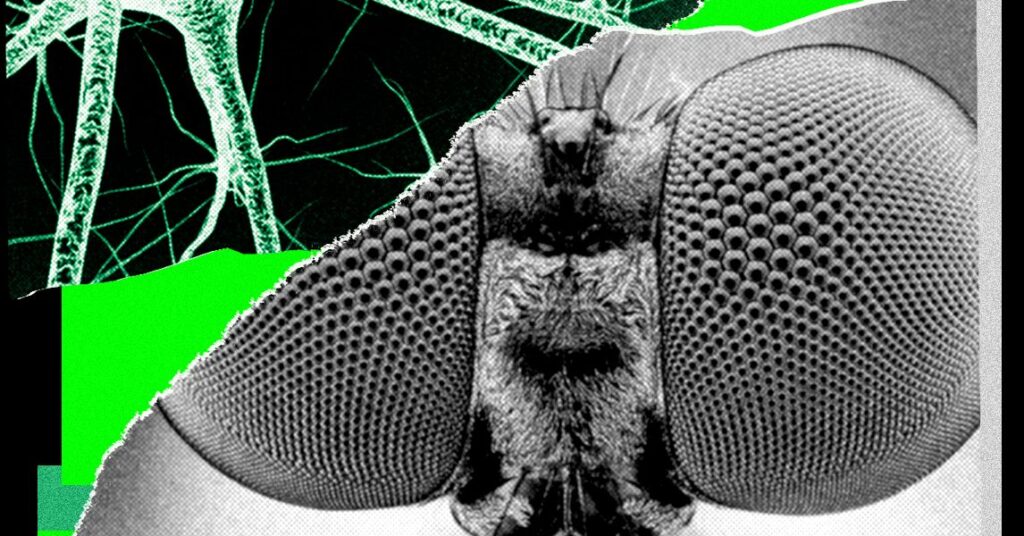
WIRED has trained a fruit fly brain to write story pitches.
The system, named PitchFly, contains 165,112 neurons. It generated headlines such as “The Hidden Weather Problem Inside Surveillance” and “The Engineers Who Think Elon Musk Needs Less Computer Security”. One suggestion stood out: “Everyone Wants Cooking. Nobody Has Solved Donald Trump.”
The model relies on a connectome developed by Google and academic partners. This map charts the firing patterns of roughly 166,000 neurons and 125 million synapses in a male drosophila. It allows researchers to simulate how the insect reacts to stimuli. The approach simulates biological intelligence rather than using standard artificial intelligence training methods.
Because the project is open source, developers can import the connectome with simple prompts. I built a version where the digital brain generates ideas. I fed it hundreds of popular WIRED headlines from the last year. Codex converted the text into phrases and then into a format the neural network could process. The system then used the best-performing stories to create new ones.
This is not a language model based on a fly. Someone else built one of those. The insect brain does not understand the words. It does not know if the sentences make sense. It simply remixes patterns it has seen into new combinations. A critic might argue this mirrors how some journalists create pitches. However, the output is often so absurd that PitchFly will not replace me soon.
Sample output
- The Tiny Shift in Agentic AI Is Rewriting the Rules of Food and Drink
- What Security News Is Quietly Doing to Donald Trump
- The Race to Reinvent Privacy Before Artificial Intelligence Breaks
- Is China About to Make Digital Syndication Obsolete?
I could have the program learn from new headlines in the future. At present, it serves as a proof of concept. It also suggests that the average WIRED writer is smarter than a fruit fly.
Dozens of projects using fruit fly intelligence appeared after the connectome released in early September.
An X user named Lyra Bubbles trained the virtual brain to play the VR game Beat Saber. Alex Wormuth, a software engineer at Coinbase, created StonkFly. This tool uses the fly brain to trade stocks. The project is losing money, though it performs better than expected.
“The fly brings lighthearted, humorous relief” at a time when people worry about existential AI risks, Wormuth told me in a direct message. He also found the connectome philosophically interesting. “It sparks questions about ethics of this and whether there is any consciousness [in the replication of fly’s brain],” he says.
Other users trained the connectome to play Doom, Minecraft, and Pong. Some fly brains learned to solve Rubik’s cubes. Another project put the fly brain in charge of driving virtual cars. Flies are terrible at parallel parking. I am equally bad at it, so I will not judge.
I have not verified that all these projects use the actual connectome. Some may be fun animations. Others, like one where the fly takes a well-earned break, seem like spoofs. Serious science projects do exist, however. These include visualizations for exploring the connectome and tools for manipulating neural circuitry.
Mapping animal brains helps neuroscientists understand the biological foundations of intelligence. It is not yet possible to map all 86 billion neurons in a human brain. Studying smaller creatures provides useful insights. Researchers can also test theories about how damage affects neuronal wiring. They can simulate repairs by altering the fly’s connectome.
For AI, this fruit fly activity shows how easy it is to train and deploy your own model. Large language models from major companies may be best used to build specialised AI for specific tasks. Sometimes even a tiny brain can perform well.
This is an edition of Will Knight’s AI Lab newsletter. Read previous newsletters here.