Robinhood lets AI agents trade shares and make credit card purchases for customers
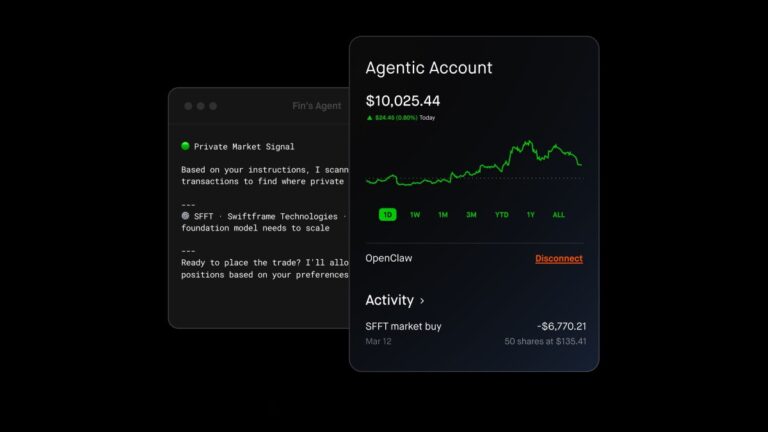
Robinhood introduces a new feature that lets clients link AI agents like Anthropic‘s Claude or Cursor to a separate investment account.
The connection works through the Model Context Protocol (MCP), an open standard that lets AI agents use external services and act on a user’s behalf. The agent can read account value, buying power, positions, balances, and order history-and buy and sell stocks on its own.
Users could, for example, tell the agent to spot concentration risks in a portfolio, watch promising stocks, or automatically buy more shares when prices drop. The current beta only supports stock trading. Options, crypto, and event contracts are supposed to follow.
Customers get a push notification for every trade and can disconnect the agent at any time. Robinhood makes clear, though, that users are on the hook for all trades, even if the agent pulls the trigger without asking first.
The feature is rolling out gradually. Customers will get an email once they have access. Setup only works on desktop.
AI agents can also be linked to a virtual version of a Robinhood credit card to book flights or restaurant reservations. Spending limits apply, and the agent doesn’t get the real card number, Deepak Rao, Vice President at Robinhood Money, told the Wall Street Journal.
FINRA flags AI agents as a new risk area
US brokerage regulator FINRA classifies AI agents as a new risk area in its 2026 supervisory report. The regulator warns that agents could act without human approval, go beyond what a user intended, make decisions that are difficult to follow, or leak sensitive data accidentally.
General-purpose AI agents also often lack the know-how for complex financial tasks. Poorly tuned reward functions could push agents toward decisions that hurt investors or markets. FINRA recommends that brokers build in safeguards, track agent actions, and figure out where human oversight is needed.
Robinhood itself warns in its risk disclosures that “agentic trading” carries “significant risk, including the possible loss of your entire investment.” AI-driven strategies can perform poorly in certain market conditions, move fast, and be “difficult to monitor or stop in real time.” “This product may not be appropriate for all investors,” the company writes.
OpenAI also recently rolled out financial features for ChatGPT. Users can give the chatbot access to financial data and ask for analysis. But account transactions or actual stock trading aren’t possible yet.
Subscribe now