A houseplant wired to a motorised stand moved itself toward a light source by sending electrical signals through its tissues. Justin Mast, who read about this research a few years ago, said the discovery opened a rabbit hole.
Mast partnered with neuroscientist Lee von Kraus to found Electric Plant. The team has spent three years gathering data to build Bombadil, an AI model that interprets electrical signals in plant stems to tell growers what the plants need.
Electric Plant raises $11.2 million
The company recently secured a seed round led by Onto Ventures and Climactic. Investors included Ponderosa, Endeavor Catalyst, Ludlow, Michigan Rise, The Fund, Schox VC, and Dug Song.
Mast told TechCrunch that listening is the first step toward letting people speak to plants.
Even in controlled greenhouses, growers lack full visibility into plant requirements. Traditional methods rely on coarse tools that react to demands for water, nutrients, or light. Soil probes, handheld spectroscopes, and satellite imagery are useful but leave much to be desired.
“That technology is sophisticated, but its ability to get at the inside of the plant isn’t very sophisticated. Most of that stuff still lags quite a bit behind the real-time needs of the plant,” Mast said.
The startup used existing devices to train Bombadil, which can interpret electrical signals in about 125 different species. Mast believes the model will surpass much of that equipment.
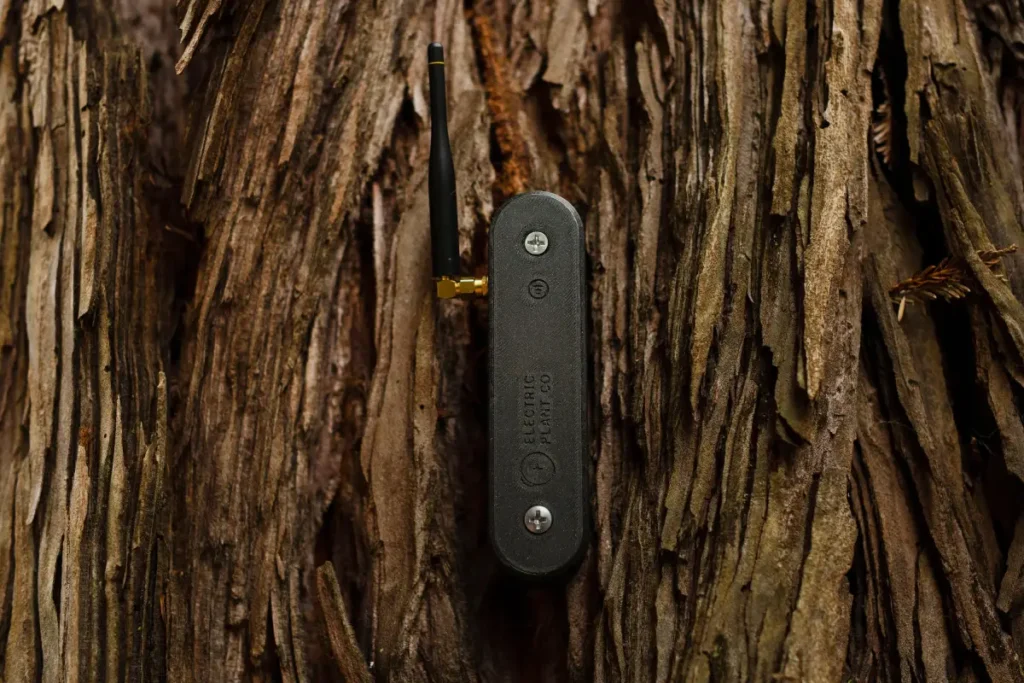
Electric Plant sensors cost tens of dollars, compared to the thousands required for existing tools. The devices are roughly the size of a regular iPhone folded lengthwise.
Stainless steel screws attach the sensors to a plant. These screws penetrate the cambium, the living tissue layer just under the bark, to connect with microvolt changes within the plant. Data travels from the sensors to a base station via a low-power wireless network.
A few sensors per acre provide accurate results. Bombadil processes the data in the cloud and sends results back to the customer. Growers can then adjust watering or fertiliser schedules. The company claims such a system can boost yields while reducing water use by 20% or more.
Mast would not disclose initial customers, though applications in agriculture and forestry are clear.
The first hundred-plus species in Bombadil range from ferns and redwoods to tomatoes and dahlias.
“This is the most diverse model ever created on biological electrical signals,” Mast said. “No one’s ever done anything equivalent to this in the animal world.”
What it means
Farmers will receive real-time feedback on plant health without expensive equipment. The shift moves decision-making from coarse estimates to specific, internal plant data.