
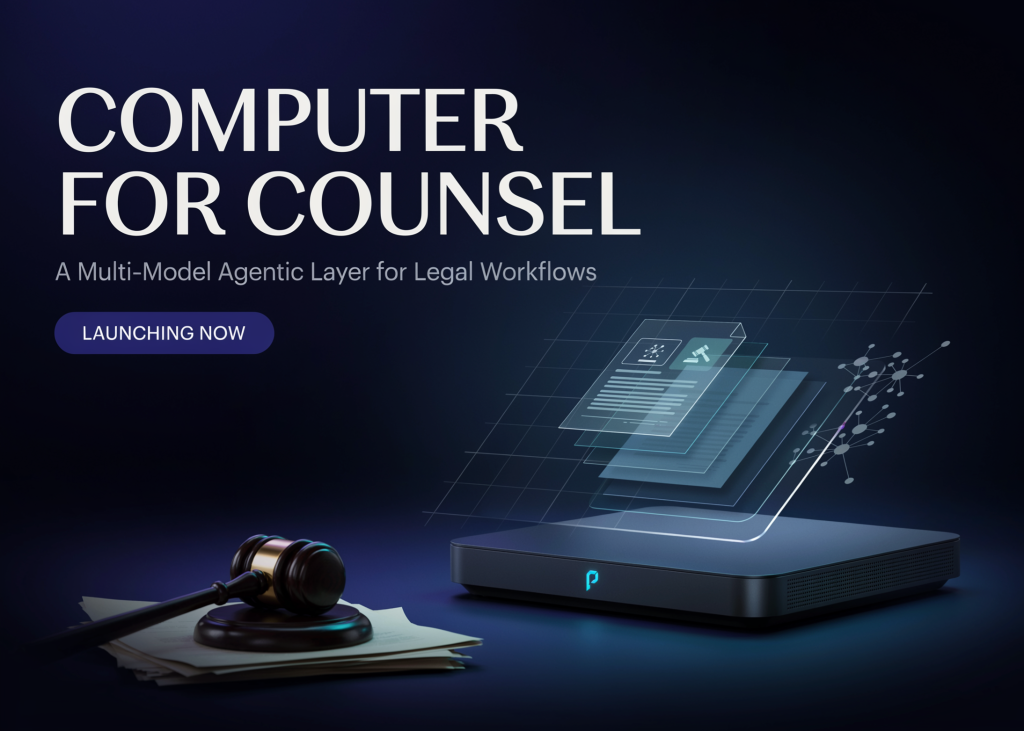
Perplexity launched Computer for Counsel on June 24, 2026. It is an agentic AI system built for legal teams. The product extends Perplexity Computer, the company’s LLM-agnostic agentic system. It is available now to Perplexity Enterprise and Max subscribers.
Lawyers lose hours to administrative work. Computer for Counsel targets that work directly. Nearly 75% of lawyers call administrative tasks a major time challenge, a Thomson Reuters survey found. The story is mostly architectural. It is an orchestration layer wired into the tools lawyers already use.
TL;DR
- Perplexity launched Computer for Counsel on June 24, 2026, for Enterprise and Max subscribers.
- It routes 20+ frontier AI models per subtask, with no single-vendor lock-in.
- Premium sources include Midpage (case law + citator), Deel, and LegalZoom; 400+ tools connect via MCP.
- Every output links back to its source, so lawyers verify each citation before use.
- It is a workflow layer, not a Westlaw replacement; good-law checks still depend on Midpage.
What is Computer for Counsel?
It is not a new legal research database. Perplexity is explicitly not trying to replace Westlaw, LexisNexis, or Bloomberg Law. Instead, it sits as a research, drafting, and workflow layer. That layer reasons over the open web, firm systems, and specialized legal sources.
The mechanics are agentic. The system decomposes a legal task into subtasks. It routes each subtask to a model and a data source. It then assembles the results into a brief, memo, or deal summary. Every output links back to its source. Attorneys verify a citation in seconds before it enters client work. Judgment and strategy stay with the lawyer.
The Multi-Model Orchestration Layer
Computer is powered by 20+ frontier AI models. It selects the best model for each subtask automatically. Research, reasoning, and contract work can each use a different model. Perplexity keeps the model pool current through ongoing evaluation. For legal teams, this removes the pressure to bet on one AI vendor.
Connectors run on the Model Context Protocol (MCP). MCP is an open standard for linking AI systems to external tools and data. Administrators can also install custom MCP connectors for internal systems.
The Data Layer: Sources and Connectors
Premium legal sources ground the answers. The connector list spans research, contracts, and document management.
| Source / Connector | Type | What it provides | Access at launch |
|---|---|---|---|
| Midpage | Legal research | US case law (federal + state appellate), statutes, regulations, a citator to check if a case is still good law | Uncapped for all Computer users; activate with @midpage |
| Deel | Compliance data | Worker classification, EOR rules, immigration, cross-border payroll across 150+ countries | Free, limited |
| LegalZoom | Contract templates | Customer agreements, employment contracts, NDAs via a template flow | Limited, coming soon, exclusive to Perplexity |
| Docusign | Contracts / e-signature | Agreement history and automated contract workflows | Available |
| NetDocuments / Box | Document management | Secure file systems and a legal context graph | Available |
| DeepJudge | Institutional intelligence | Grounds outputs in a firm’s prior work and accepted positions | Available |
| Clio (Vincent) | Legal research | Cited answers across 1B+ legal sources in 100+ jurisdictions | Coming soon |
| Carta / Ironclad | Equity / contracting | Cap tables, 409A data; AI contract repository search | Carta available; Ironclad coming soon |
App Connectors also reach Microsoft 365, Google Workspace, and 400+ other tools. Inside Microsoft 365, Computer drafts in Word and retrieves files from SharePoint. It references context from Outlook or Teams conversations.
How Legal Teams are Using It
Three current workflows show the agentic pattern in practice:
- Third-party NDA intake: Computer reviews third-party NDAs for red flags. It fills in entity and signatory information. It prepares clean copies. It routes them for approval and signature via Docusign.
- Regulatory monitoring: Computer builds a shareable dashboard for US state privacy and adtech laws. It shows which states have laws in effect. It cites Midpage for relevant cases.
- Case research with citation review: Computer researches non-compete enforceability after the FTC’s 2024 ban. It summarizes key cases and flags unsettled ones. It exports a PDF with citations.