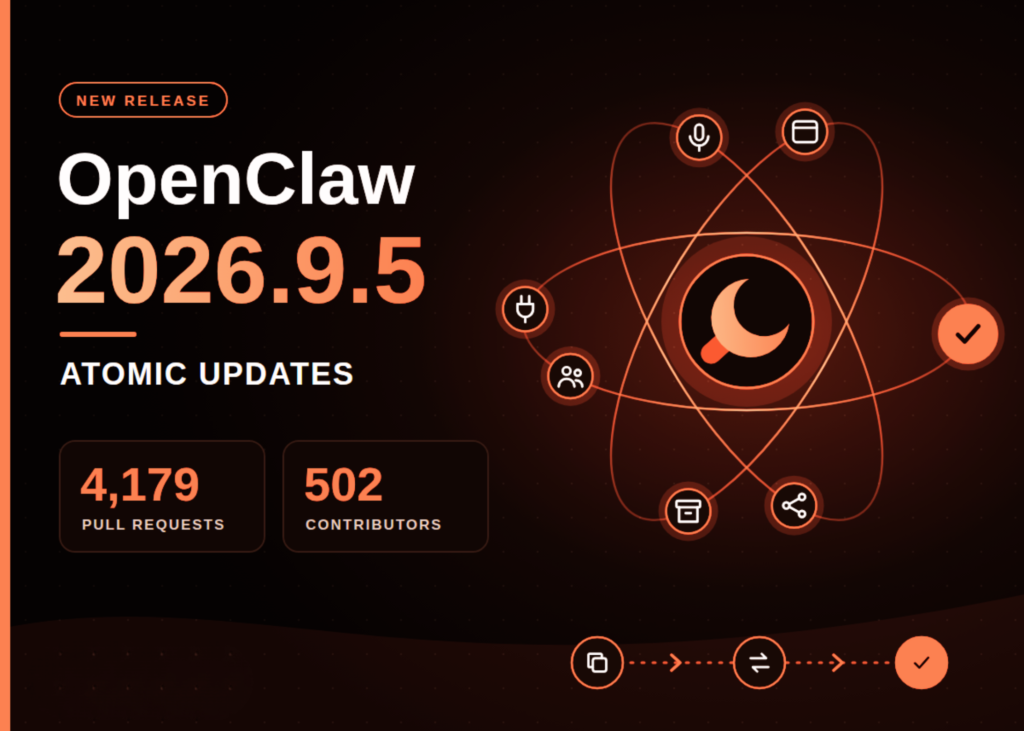
OpenClaw has released version 2026.9.5, a major update for its open-source personal AI agent that addresses long-standing issues with broken upgrades and introduces new features for collaboration and live audio.
The software runs on local machines using an MIT license. Its Gateway connects various models to chat channels like Telegram, Slack, and Discord. The release bundles 4,179 pull requests and 64 direct commits from 502 contributing accounts.
The primary focus is Atomic Updates, a system designed to stop updates from breaking a working agent.
Why OpenClaw Updates Kept Breaking
Project maintainer Jason Sy explained the problem in a blog post. Previously, an update had two outcomes: an incremental improvement or a catastrophic failure. In the failure case, the old version went down as well. That left no agent online to help with the repair.
Two factors made this difficult. First, OpenClaw has thousands of config options, so testing every permutation is near impossible. Second, maintainers rarely felt the pain themselves. They are developers who ask Claude or Codex to update their claw. For many users, the claw is their only agent. The OpenClaw 2.0 launch in early September made the issue too large to ignore.
How Atomic Updates Work
According to the Claw team, the needed pieces already existed in the upgrade process. They were in the wrong order. The new flow works like this:
- The existing Gateway keeps running while the update is prepared.
- The next version is checked against a private copy of your setup.
- OpenClaw switches over, then verifies the updated installation.
- If the update fails, it rolls back to the last working configuration.
OpenClaw always preserves a working agent, so it can help diagnose a failed upgrade. The team also added an issue reporting button for updates.
The release notes list clear limits. Atomic Updates apply on supported update paths only. Rolling back the application cannot undo database migrations. The private validation copy is not a backup, so keep a verified backup before upgrading. If an interactive update fails, AI repair starts only after you choose Yes. It uses your account and tokens, and a 30-second timeout skips it.
Other New Features
Plugin hot reload allows you to install or reload supported plugins without restarting the Gateway. It works from the CLI or an authorized chat command. The CLI also accepts several plugins in 1 command.
Conversation sharing gives teammates on another paired installation read-only access to selected conversation groups. Recipients see conversation text and eligible forks. They do not see subagents, tool activity, or reasoning. Revocation cannot recall what was already received.
Expanded GPT Live lets you speak while GPT Live replies in supported Meet, Teams, and Zoom meetings. It can consult your OpenClaw agent during meetings or phone calls. Live is audio-only, so the notes point to gpt-realtime-2.1 for camera use.
A shared Browser dashboard lets you and your agent use the same page. It runs on a local OpenClaw-managed browser profile, not your laptop cookies.
Conversation archiving compresses older, inactive history. It is off by default and archives after 30 days once enabled. Reopening a conversation restores it and makes it searchable again.
Specialist-agent setup can create a chief of staff, researcher, writer, and reviewer. You can also pick a single specialist. Nothing is created before you approve the proposal.
One upgrade warning applies to everyone. This release changes the conversation database even with archiving off. Going back requires the matching older build and a backup.
Installation and Upgrade
New installs can use the official script:
curl -fsSL https://openclaw.ai/install.sh | bashIf you already manage Node.js, install the published package:
npm install -g openclaw@latest --allow-scripts=openclaw
openclaw onboard --install-daemon
Existing users can run openclaw update. See the updating guide for manual paths. The release also adds a FreeBSD CLI install route using system Node and npm.
What it means
For people running these agents, the biggest change is safety. You can now update the software without losing your current connection. If something goes wrong during the switch, the system reverts automatically. This means your agent remains available to help you fix the problem rather than leaving you stranded. The new sharing tools also allow teams to view specific chat histories without exposing the underlying reasoning or tool calls.