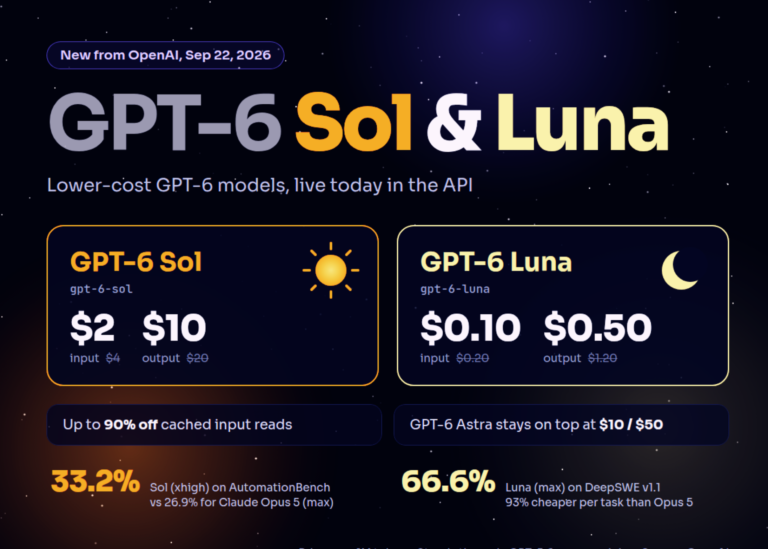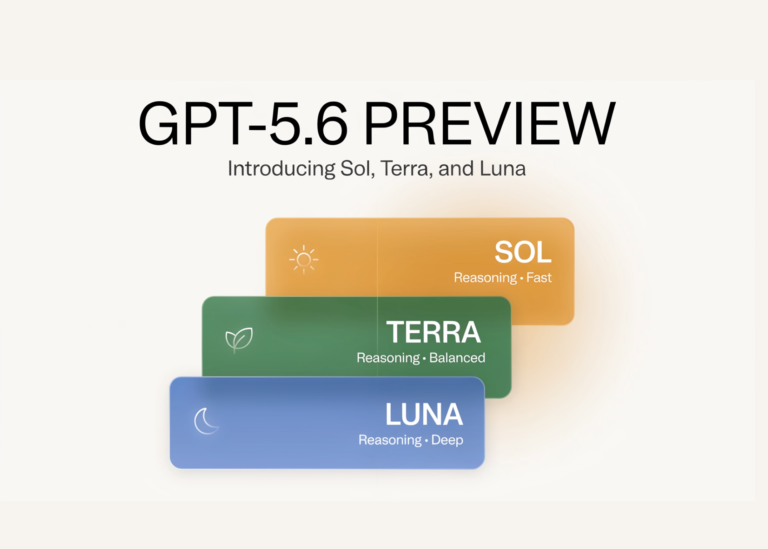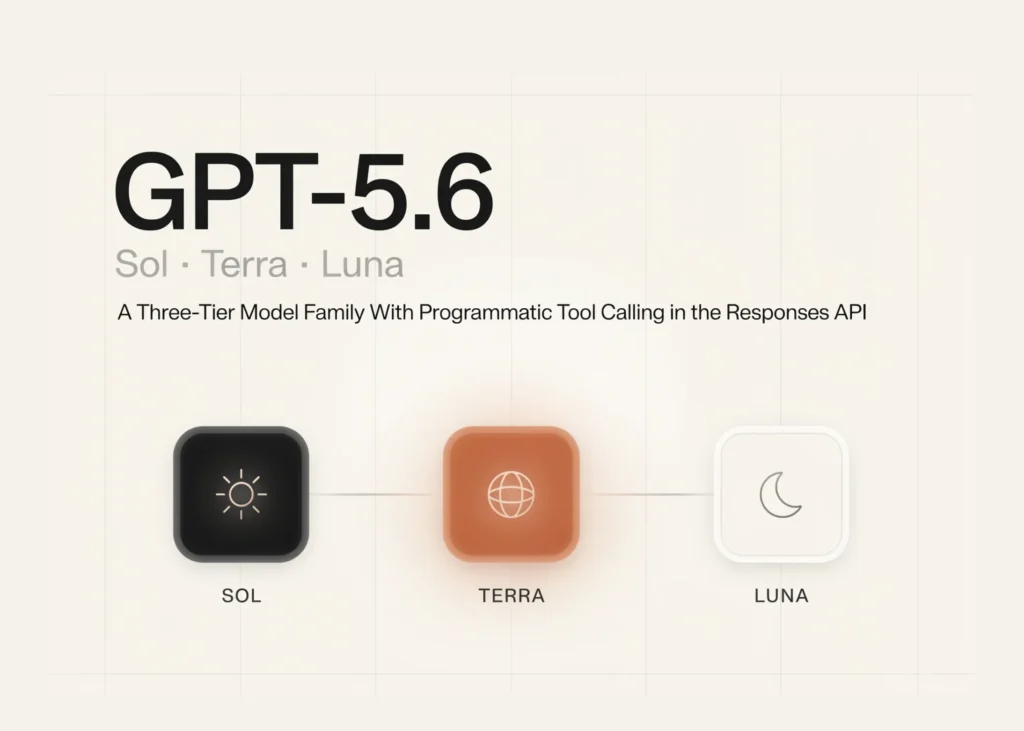
OpenAI has made the GPT-5.6 family generally available, replacing the single-model approach with a three-tier structure. The suite consists of Sol, the flagship model; Terra, the balanced option; and Luna, the cost-efficient tier. Pricing ranges from $1 to $5 per million input tokens and $6 to $30 per million output tokens.
Availability and access
Access depends on the platform. Chat users on Plus, Pro, Business, and Enterprise plans can access Sol at medium or higher effort levels. Pro and Enterprise accounts may also select GPT-5.6 Sol Pro specifically.
Users of ChatGPT Work and Codex see different options. Free and Go users are restricted to Terra. Paid users can choose between any of the three models and adjust effort settings. The max reasoning configuration is available to all users with GPT-5.6 access, controlled via settings.
Developers using the API have access to all three tiers. Programmatic Tool Calling and a multi-agent beta are now live within the Responses API.
Prompt caching rules have also changed. The system now supports explicit cache breakpoints and enforces a 30-minute minimum cache life. Writing to the cache costs 1.25 times the uncached input rate. Reading from the cache retains the 90% discount on input tokens.
Performance highlights
The Agents’ Last Exam evaluates long-running professional workflows across 55 fields. OpenAI reports Sol achieved a new high of 53.6, eclipsing Claude Fable 5 by 13.1 points. Internal tables list Sol at 52.7% and Fable 5 at 40.5%.
On the Artificial Analysis Coding Agent Index v1.1, Sol scores 80 at maximum reasoning. This is 2.8 points higher than Fable 5. OpenAI states Sol achieves this using less than half the output tokens and half the time.
Sol sets new records on Terminal-Bench 2.1 and DeepSWE. It reaches 92.2% on BrowseComp and 62.6% on OSWorld 2.0. On OSWorld, it surpasses Claude Opus 4.8 while using 85% fewer output tokens.
Comparison table
| Eval | GPT-5.6 Sol | GPT-5.6 Terra | GPT-5.6 Luna | GPT-5.5 | Claude Fable 5 | Claude Opus 4.8 | Gemini 3.1 Pro Preview |
|---|---|---|---|---|---|---|---|
| AA Coding Agent Index v1.1 | 80 | 77.4 | 74.6 | 76.4 | 77.2 | 72.5 | 42.7 |
| AA Intelligence Index v4.1 | 58.9 | 55 | 51.2 | 54.8 | 59.9 | 55.7 | 46.5 |
| Terminal-Bench 2.1 | 88.8% | 87.4% | 84.7% | 85.6% | 83.1% | 78.9% | 70.7% |
| DeepSWE v1.1 | 72.7% | 69.6% | 67.2% | 67% | 69.7% | 59% | 11.8% |
| SWE-Bench Pro | 64.6% | 63.4% | 62.7% | 59.4% | 80% | 69.2% | 54.2% |
| Agents’ Last Exam | 52.7% | 50.4% | 50.3% | 46.9% | 40.5% | 45.2% | 32.1% |
| GDPval-AA v2 (Elo) | 1,747.8 | 1,593 | 1,591.8 | 1,493.7 | 1,759.6 | 1,600.1 | 962.3 |
| BrowseComp | 90.4% | 87.5% | 83.3% | 84.4% | — | 84.3% | 85.9% |
| OSWorld 2.0 | 62.6% | 50.2% | 45.6% | 47.5% | — | 54.8% | — |
| Toolathlon | 58% | 53.1% | 53.4% | 55.6% | 61.7% | 59.9% | 48.8% |
Where GPT-5.6 lags
Four specific gaps remain worth noting.
- SWE-Bench Pro: Sol scores 64.6%. Claude Mythos 5 scores 80.3% and Fable 5 scores 80%. This is a roughly 15-point deficit on a widely watched coding evaluation.
- Broad intelligence and knowledge work: Fable 5 leads the Artificial Analysis Intelligence Index v4.1, scoring 59.9 to Sol’s 58.9. Fable 5 also leads GDPval-AA v2 by about 12 Elo. On HealthBench Professional, Fable 5 scores 60.9% against Sol’s 60.5%.
- Tool use: On Toolathlon, Sol scores 58%. Fable 5 reaches 61.7% and Opus 4.8 reaches 59.9%. Luna also edges out Terra here, inverting the tier order.
- Long context: Luna drops to 41.3% on OpenAI MRCR v2 8-needle, at both 256K–512K and 512K–1M. Sol scores 73.8% at 512K–1M, slightly below GPT-5.5’s 74%.
Ultra mode
Sol Ultra runs four agents in parallel by default. This configuration trades higher token usage for a stronger score and faster time-to-result. It lifts Terminal-Bench 2.1 from 88.8% to 91.9%.
What it means
Developers now have a clear path to manage costs without sacrificing performance. The tiered structure allows teams to pick Luna for simple tasks or Sol for complex reasoning. The new caching rules offer a way to reduce input costs for repetitive workflows, though writing to the cache remains more expensive. The gap in SWE-Bench Pro suggests the model is not yet ready for the most difficult software engineering tasks, where competitors still hold an advantage.