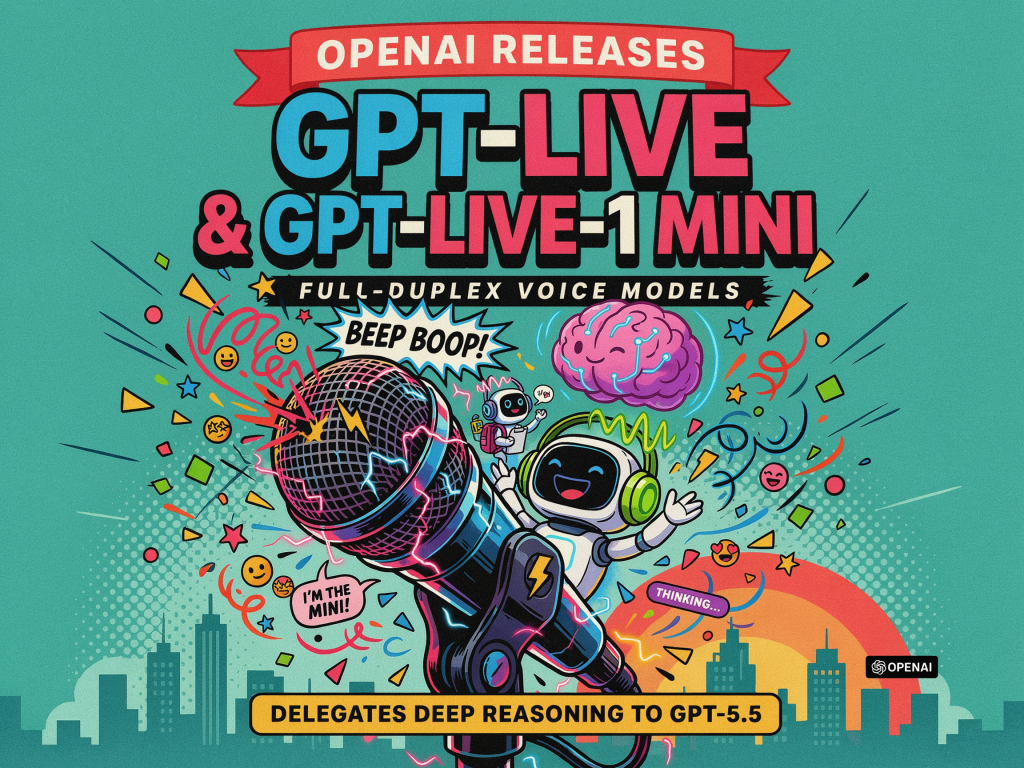
OpenAI has released GPT-Live, a new family of voice models that power ChatGPT Voice. The system handles full-duplex conversation, allowing the AI to listen and speak simultaneously. Two versions are available now: GPT-Live-1 and GPT-Live-1 mini. Both roll out globally to ChatGPT users today.
TL;DR
- GPT-Live is a full-duplex voice model family that listens and speaks at the same time.
- It delegates complex tasks like search and reasoning to GPT-5.5 while maintaining the conversation flow.
- Human tests show GPT-Live-1 and mini are strongly preferred over Advanced Voice Mode.
- These models ship today to ChatGPT users; the API is planned for later.
- Video, screen sharing, and full multilingual parity are not available at launch.
What is GPT-Live
GPT-Live uses a full-duplex architecture. This means the model can listen and speak simultaneously. During a conversation, it adds short cues like ‘mhmm’ or ‘yeah’. It engages in quick back-and-forth exchanges or stays quiet when the user thinks. For questions requiring web search, deeper reasoning, or complex work, GPT-Live delegates the task to a frontier model. The result returns to the conversation when ready. At launch, that background model is GPT-5.5. While the frontier model works, GPT-Live keeps the conversation going.
Why Cascaded and Turn-Based Voice Fell Short
Earlier voice systems moved toward natural conversation but faced tradeoffs. Cascaded voice systems chained three separate models per turn. A speech-to-text model transcribed speech first. A large language model then produced a response. A text-to-speech model converted that text back into audio. This allowed people to talk to frontier models for the first time. However, information could be lost across models, and responses were slow and stilted.
Turn-based voice models, like ChatGPT Advanced Voice Mode, processed audio inside one model. This reduced latency and made conversations smoother. They still operated through discrete turns, waiting for the user to stop speaking. Turn detection relied on silence. A brief pause or background noise could be mistaken for the end of a turn. This caused the model to interrupt at unnatural times.
| Dimension | Cascaded (original ChatGPT Voice) | Turn-based (Advanced Voice Mode) | Full-duplex (GPT-Live) |
|---|---|---|---|
| Pipeline | STT → LLM → TTS, three models | Single model handling audio | Single model, continuous processing |
| Turn handling | Discrete turns | Discrete turns, silence-based | Continuous, decisions many times/sec |
| Listen while speaking | No | No | Yes |
| Backchannels (“mhmm”) | No | No | Yes |
| Latency feel | Slow, stilted, long pauses | Faster, smoother, still rigid | Fast, natural, expressive |
| Interrupt handling | Not supported | Can misfire on pauses/noise | Can pause, interrupt, resume |
| Deeper work | In-line LLM | In-line model | Delegates to GPT-5.5 in background |
The Two Architectural Changes
GPT-Live addresses these limits with two changes:
- Continuous interaction using full-duplex processing: The model processes input while generating output at the same time. It can make interaction decisions many times per second. Those decisions include whether to speak, continue listening, pause, interrupt, or invoke a tool. This supports more natural back-and-forth and a better sense of time. It also enables live translation.
- Delegation for deeper work: OpenAI decoupled continuous interaction from heavier reasoning. When a task needs search, reasoning, or more agentic capabilities, GPT-Live delegates it. Another model, such as GPT-5.5, handles that work in the background. Meanwhile, GPT-Live keeps the conversation flowing. This design also lets GPT-Live adopt newer frontier models as they ship.
What OpenAI’s Evaluations Show
OpenAI built new human evaluations for pleasantness and conversational flow. Evaluators compared models in matched five-to-ten-minute conversations. In these head-to-head tests, GPT-Live-1 and GPT-Live-1 mini were strongly preferred over Advanced Voice Mode. The comparisons measured overall preference, turn-taking, interruptions, flow, and how natural each interaction felt.
On automated benchmarks, GPT-Live-1 also showed gains over Advanced Voice Mode:
- GPQA: GPT-Live-1 substantially outperforms it on expert-level science reasoning.
- BrowseComp: GPT-Live-1 shows strong gains on agentic web search.
- τ³-Voice Telecom (internal variant): GPT-Live-1 outperforms it on multi-turn telecom support tasks.
OpenAI team notes it used a customized user model for the τ³-Voice Telecom eval. That user model was powered by its latest reasoning models. GPT-Live-1 (instant) and GPT-Live-1 mini use GPT-5.5 Instant in the background. GPT-Live-1 Medium and GPT-Live-1 High use GPT-5.5 Thinking with medium and high reasoning effort.
GPT-Live: Full-Duplex Voice Explorer
Use Cases With Examples
- Hands-free help: ask for cooking steps or directions without touching a screen.
- Language practice: hold a back-and-forth chat with gentle corrections.
- Live translation: full-duplex timing supports translating speech during a conversation.
- Research on the go: ask a hard question on your commute; GPT-5.5 searches in the background.
- Support workflows: multi-turn telecom-style tasks map to the τ³-Voice Telecom evaluation.
- Visual lookups: see weather, stocks, or sports as cards while you talk.
A Conceptual Look at the Full-Duplex Loop
The API is not available yet. So this is a runnable, illustrative simulation of the decision loop. It is a teaching model of the architecture, not the actual GPT-Live API. You can run it as plain Python to see the flow.
"""Illustrative simulation of the GPT-Live full-duplex decision loop.
Teaching model of the described architecture, NOT the real API."""
import random
random.seed(7)  # reproducible output

class BackgroundModel:                      # stands in for GPT-5.5
    def run(self, query):
        return f"answer to '{query}'"

class GPTLive:
    def __init__(self, background):
        self.background = background
        self.pending = None                 # a delegated task, if one is running

    def decide(self, user_speaking, needs_deep_work):
        # A real model makes this choice many times per second.
        if self.pending is not None:
            return "await_delegate"
        if needs_deep_work:
            return "delegate"
        if user_speaking:
            return random.choice(["listen", "backchannel"])
        return "speak"

    def step(self, frame):
        action = self.decide(frame["user_speaking"], frame["needs_deep_work"])
        if action == "delegate":
            self.pending = frame["query"]                 # hand off, keep talking
            return 'speak      -> "one sec, still with you"'
        if action == "await_delegate":
            result = self.background.run(self.pending)     # background result
            self.pending = None
            return f'speak      -> "{result}"'
        if action == "backchannel":
            return 'backchannel-> "mhmm" (while user talks)'
        if action == "listen":
            return "listen     -> (quiet, attending)"
        return "speak      -> (normal reply)"

# A short scripted stream of audio frames the loop consumes in order.
stream = [
    {"user_speaking": True,  "needs_deep_work": False, "query": None},
    {"user_speaking": True,  "needs_deep_work": False, "query": None},
    {"user_speaking": False, "needs_deep_work": True,  "query": "weather at 6pm"},
    {"user_speaking": False, "needs_deep_work": False, "query": None},  # result returns
    {"user_speaking": False, "needs_deep_work": False, "query": None},
]

live = GPTLive(BackgroundModel())
for i, frame in enumerate(stream):
    print(f"frame {i}: {live.step(frame)}")
Running it prints the loop making one interaction decision per frame:
frame 0: backchannel-> "mhmm" (while user talks)
frame 1: listen     -> (quiet, attending)
frame 2: speak      -> "one sec, still with you"
frame 3: speak      -> "answer to 'weather at 6pm'"
frame 4: speak      -> (normal reply)
What Changes in ChatGPT Voice
More than 150