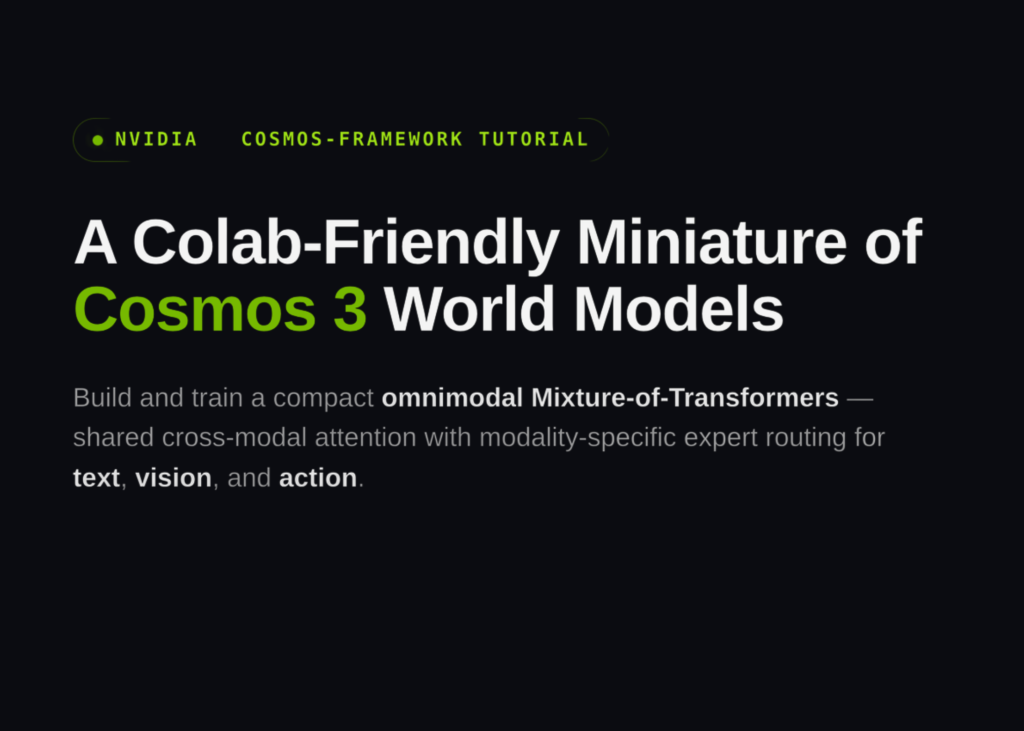
A tutorial for NVIDIA’s Cosmos framework explains why running the full 16-billion parameter world model on Google Colab is impossible, then demonstrates how to build a functional miniature version instead. The guide walks through checking local hardware constraints, cloning the source code, and training a small omnimodal Mixture-of-Transformers model that mimics the core architecture of the larger system.
Checking hardware constraints
The first step involves verifying whether the current machine can physically support inference for the full Cosmos 3 checkpoints. The code inspects Python, PyTorch, CUDA availability, GPU memory, compute capability, and free disk space. It compares these figures against the actual requirements for the 16-billion parameter Nano model, which needs at least 80 GiB of VRAM and an Ampere-class GPU or newer.
The script outputs a clear verdict. If the machine lacks the necessary compute capability or memory, it flags the environment as unsuitable for the real model. In most standard Colab instances, the verdict will be that full inference is not possible, though the tutorial proceeds to show an educational path using a smaller model.
Inspecting the source code
The next phase clones the official cosmos-framework repository from GitHub to access the real package structure. The script checks for the existence of the `cosmos_framework` directory and lists the subpackages, noting how many Python files reside in each.
It also locates example input specifications, such as a JSON file for text-to-video tasks, to show the expected data format. The output displays the official command-line interface patterns for launching inference on single or multi-GPU systems. This includes specific flags for parallelism presets, checkpoint paths, and seed values.
Building the miniature model
The tutorial then defines the architecture for a compact world model. The design uses a Mixture-of-Transformers approach where text, vision, and action tokens share a single interleaved sequence. Self-attention is applied across all modalities, allowing vision to condition on text and actions to condition on vision.
Each token is processed by a modality-specific expert feed-forward block rather than a single monolithic network. The model supports physical AI modes such as text-to-video, image-to-video, forward dynamics, inverse dynamics, and policy generation. The miniature version trains on synthetic physical-world data using a simple mean squared error objective for predicting future latent states.
While the full Cosmos 3 model uses flow-matching and diffusion for continuous vision streams, this implementation uses a next-latent objective that trains in seconds. The key structural elements remain identical: shared causal self-attention with RoPE and routing tokens to their respective expert blocks.
What it means
Developers do not need a supercomputer to understand the mechanics of world models. By stripping away the massive parameter count and training on synthetic data, the tutorial proves that the core logic of shared attention and expert routing works on standard hardware. This approach allows researchers to experiment with multimodal dynamics without waiting for massive GPU clusters.