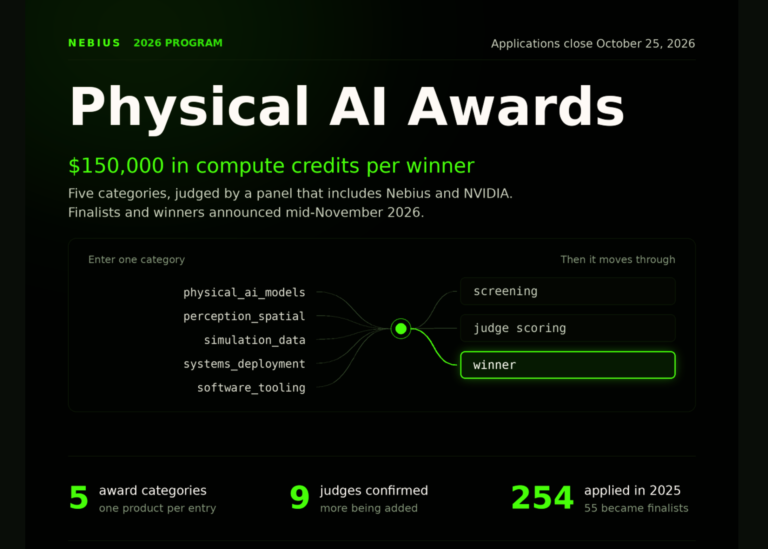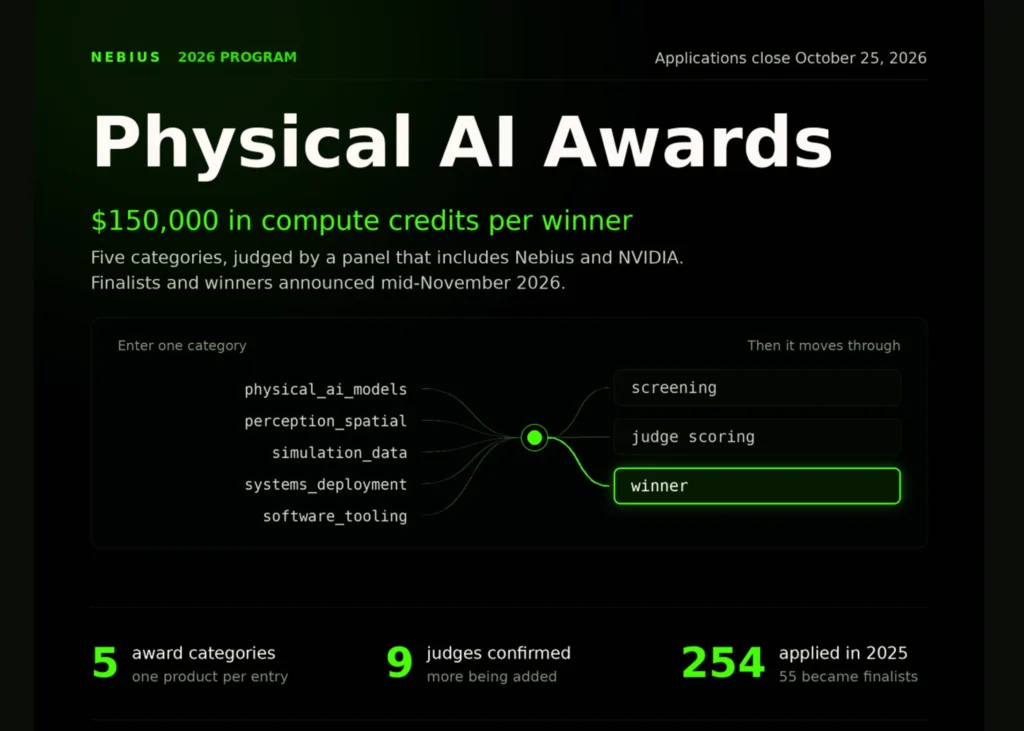
Nebius and NVIDIA are accepting applications for their 2026 Physical AI Awards, with a deadline of October 25, 2026. The competition offers five $150,000 compute credit prizes for teams that have moved beyond research and into product deployment.
The awards target startups with a demonstrable product and a plan to scale. Finalists and winners are announced in mid-November 2026. There is no entry fee and no sponsored categories.
Prize breakdown
Each of the five categories awards $150,000 in Nebius compute credits. These credits apply directly to the next training run. Winners also receive:
- Joint promotion from Nebius and NVIDIA across both companies’ channels
- Executive mentorship sessions with a Nebius C-level leader
- A Winners Circle feature published by Nebius
- Two seats at an exclusive executive dinner next year with leaders from the Physical AI ecosystem
Nebius publishes its GPU-hour rates, allowing applicants to calculate the concrete value of the prize. At current on-demand rates, $150,000 buys roughly:
| GPU (HGX node) | On-demand $/GPU-hr | GPU-hours from $150K | 8-GPU node-days |
|---|---|---|---|
| H100 | $3.85 | ~38,960 | ~203 |
| H200 | $4.50 | ~33,330 | ~174 |
| B200 | $7.15 | ~20,980 | ~109 |
| B300 | $7.85 | ~19,100 | ~99 |
For a team running multi-node training, $150K on H200s is about 521 hours on a 64-GPU cluster. That is roughly three weeks of continuous work. At preemptible H200 rates ($2.45/GPU-hour) it stretches to about 61,200 GPU-hours, which suits checkpointable RL and data-generation jobs. vCPU and RAM are bundled into the GPU rate, so the main figure is not diluted by separate instance charges.
Categories
Nebius asks applicants to enter the category that best fits their product. Companies with several products may apply to additional categories, but the guidance is to lead with the strongest product in the single most relevant category rather than spread entries across several.
- Physical AI Models: VLAs, VLMs, world models, reinforcement learning
- Perception & Spatial Intelligence: computer vision, SLAM, sensor fusion, scene understanding
- Simulation & Synthetic Data: physics simulation, digital twins, sim-to-real transfer, synthetic data
- Systems & Deployment: humanoids, industrial robots, AMRs, warehouse automation
- Software, Tooling & Orchestration: middleware, MLOps, benchmarking, fleet management, deployment tooling
The stated eligibility criteria are a clear Physical AI use case, an MVP in active use or testing, a registered legal entity, and a live public website. Each application covers one product.
Judges
Applications are first screened in-house for quality and completeness. A panel selected by Nebius and NVIDIA then scores each entry on four criteria: depth of innovation, breadth of implementation, market potential, and real-world impact. Finalists go to a jury vote to decide category winners.
The 2026 judging committee as listed on the awards page:
- Evan Helda, Head of Physical AI, Nebius
- Anu Maheshwari, Head of Venture Ecosystem, Nebius
- Sumay Parikh, Robotics & Physical AI Startup Lead, NVIDIA
- Amber Yang, Partner, Lightspeed
- Adrian Macneil, CEO, Foxglove
- Brian Moore, Co-founder and CEO, Voxel51
- Ulrik Stig Hansen, Co-Founder and Co-CEO, Encord
- Harry Mellsop, Co-founder, Antioch
- Calvin Zhou, Co-founder and VP of Engineering, RoboForce
Nebius expects to add more judges before the deadline. The panel is weighted toward operators: Macneil, Moore, and Hansen run companies that sell data and tooling infrastructure to physical AI teams (Foxglove, Voxel51, and Encord), and Zhou co-founded RoboForce, which won the Industrial Robotics category in 2025. Applicants will be scored by people who have built the same data pipelines they are describing, and by one team that came through this program a year ago.
The 2025 cohort
The program’s first edition, run in 2025 as the Nebius Robotics & Physical AI Awards, drew 254 applications. Judges picked 55 finalists who shared $1.5 million in Nebius compute credits. The judging panel that year included executives and investors from Nebius, NVIDIA, OpenAI, Physical Intelligence, ABB, Khosla Ventures, Accel, Radical Ventures, Next47, and Shanda Grab Ventures.
Several winners have since scaled. RoboForce, the Industrial Robotics winner, raised a $52 million round led by YZi Labs in March 2026 and reports more than 11,000 robot orders via letters of intent. Gather AI, the Vision AI and Analytics winner, closed a $40 million Series B led by Smith Point Capital in February 2026. Virgo, runner-up in Foundation Models, went on to win at the 2026 Nebius AI Discovery Awards. (Note: Nebius does not attribute these outcomes to the award, but they describe the kind of company the program recognizes.)
What it means
For teams building models that interact with the physical world, this prize removes a specific bottleneck. Once a model is deployed, fleet data arrives faster than a team can label it. Retraining cycles must be validated before shipping to hardware. The sim-to-real loop stops being a research exercise and becomes a release process. The $150,000 in credits provides the compute necessary to handle that volume of data without the immediate pressure of cash flow.