Anthropic has launched a research preview of the Model Hardware Standard (MHS), a specification designed to allow AI agents to discover and operate physical devices.
The specification targets a specific bottleneck in laboratory and industrial environments. Research benches and factory cells combine instruments from different vendors that were never designed to work together. Each device ships with its own interface, requiring specialists to hand-code custom translators between every pair. The setup process normally takes weeks or months. Anthropic claims MHS reduces that time to hours or minutes.
The integration tax
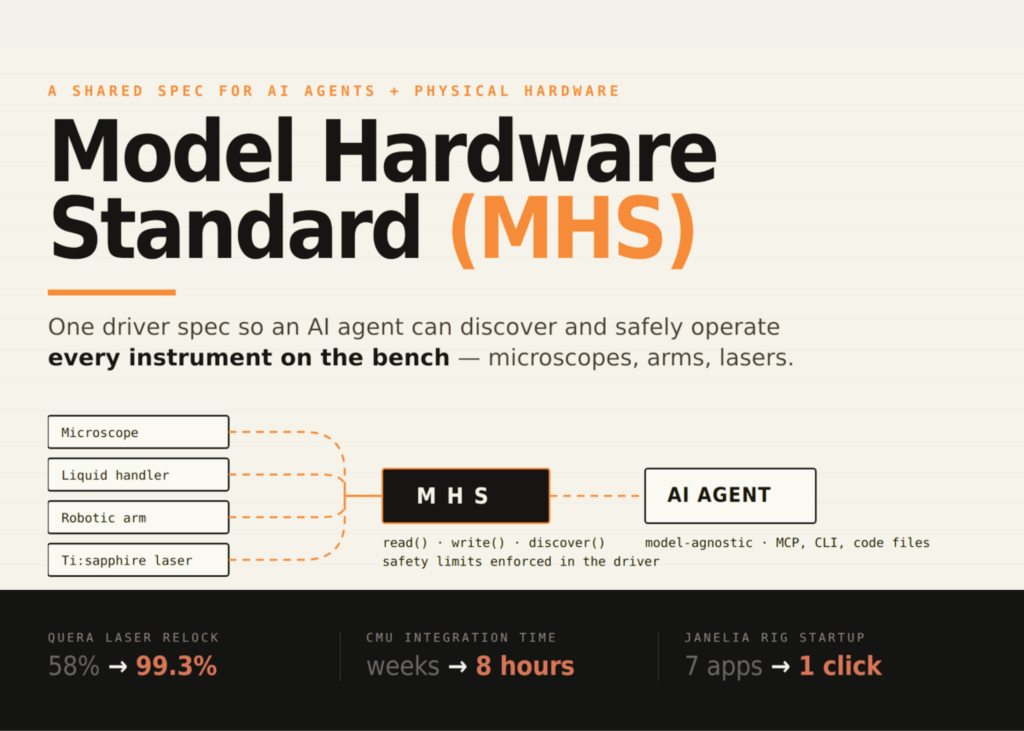
Every instrument provides its own programming interface. Specialists must write bespoke translators for every connection. Even when wired together, there is no common method for devices to share state with an agent or be operated safely by one. MHS addresses this by standardising the driver layer between an operating system and a device.
The standard exposes a small set of primitives: read to get temperature, write to set temperature, and discovery. This allows devices and agents to find each other across a network without an intermediary translator.
The system also carries knowledge that code alone does not encode, such as the weight of a robot arm. Driver tags let a user write this in natural language or have an agent interview them about the setup. The driver compiles these tags into a reference file detailing what a device measures, what can be adjusted, and which safety limits are enforced.
Control runs through three mechanisms: the Model Context Protocol, a command-line interface, and code files. MHS is model-agnostic; any agent harness can reach it via standard protocols.
What partners measured
Genentech automated the BCA protein assay across a liquid handler, robotic arm, and plate reader. Claude ran trial transfers of dyed liquid, read absorbance, and scored itself against an expert’s plate using RMSE. The system converged on ~140 µL/s for water (0.016 RMSE) and 10 µL/s for viscous BSA (0.181 RMSE). Automation experts confirmed these parameters as reasonable.
QuEra Computing reported the sharpest results. A bespoke laser-relock script, built over months by a four-person team, worked about 58% of the time at ~150 seconds per attempt. Handed the same problem through MHS, a four-role agent loop ran unattended overnight and produced a deterministic Python script. The script recovered the lock 695 times out of 700 — 99.3%. Hardest cases took 10–14 seconds against 5–10 minutes for a human. Claude also cut the servo’s residual error from a specialist’s 15.7 mV to 1.55 mV. Over a 19-hour run, the tune never lost lock, while the expert tune unlocked about 1.6 times an hour.
Carnegie Mellon ran dose-response experiments roughly three times faster. The team orchestrated a liquid handler, plate reader, robotic arm, and cameras across three computers with incompatible interfaces, including one with no programmatic interface at all. Driver-writing through to a completed curve, including an autonomous rerun after the agent rejected an R² < 0.9 fit, took about eight hours against the several weeks a vendor setup takes. Six induced fault conditions were all blocked before any device moved.
At the University of Washington, a PhD student in the Baker and Pinglay labs connected six instruments in under a week, including driver-writing. Tetsuwan Scientific paired MHS with its ResearchOS platform for qPCR pollution profiling. At Janelia, one microscopy rig went from seven programs launched in a fixed order to a single dashboard click.
What it means
The standard does not replace the need for human oversight, but it removes the friction of connecting disparate hardware. For researchers and engineers, the shift is from spending weeks manually mapping device capabilities to defining safety constraints once and letting agents interact with the hardware directly.
MHS moves safety limits into the driver rather than the prompt. This ensures that physical constraints are enforced at the hardware level, regardless of the agent’s reasoning. The system remains gated and requires supervision, as AI physical reasoning still has real gaps.