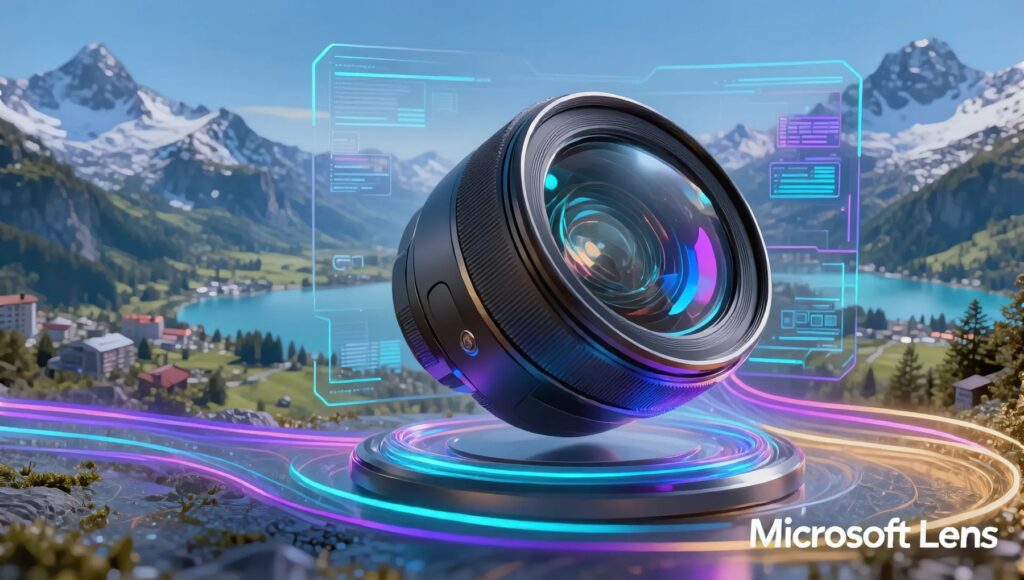
For independent creators and artists, the latest breakthrough from Microsoft Research offers a crucial lesson: you do not need a supercomputer to build a high-quality image generator. The new Lens model proves that the quality of your training descriptions outweighs the sheer size of your dataset. This approach allows makers to train competitive models using a fraction of the compute required by industry giants, lowering the barrier to entry for efficient, custom image synthesis.
Detailed captions beat raw scale
While Microsoft’s MAI team focuses on scaling up consumer models, the research division is demonstrating how to scale down efficiently. The new Lens model achieves performance comparable to much larger rivals while consuming roughly one-fifth of the compute needed for pre-training. For context, Hunyuan-Image-3.0 operates with approximately 80 billion parameters, whereas Lens manages with just 3.8 billion.
The efficiency stems from a compact architecture and a training process that converges faster. At the heart of this is the Lens-800M dataset, comprising 800 million image-text pairs generated by GPT-4.1. These captions average around 100 words, offering far more nuance than the standard, often vague, alt-text typically scraped from the web. An ablation study confirms that these long descriptions yield superior results, as low-quality web text dilutes the learning signal.
The team also varied resolutions and aspect ratios within each training batch, mixing portraits and landscapes. Despite being trained on a fixed set of sizes, the model generalises effectively to unseen formats and resolutions up to two megapixels, eliminating the need for costly high-resolution training runs.
Architecturally, the team tested several variational autoencoder variants to translate pixels into a compressed space. Rather than relying on standard reconstruction metrics, they evaluated candidates directly within text-to-image training. The semantic VAE from FLUX.2 emerged as the winner, accelerating convergence. The text encoder is GPT-OSS, an openly available model from OpenAI. Stronger language encoders allow the model to learn faster and handle prompts in languages it was not specifically trained on. Lens, trained solely on English pairs, successfully processes inputs in Chinese, French, Japanese, and Spanish, while also improving prompt fidelity.
A reasoner refines vague inputs
Following pre-training, the model undergoes a reinforcement learning phase using a custom dataset called Lens-RL-8K. This set covers ten categories, including people, animals, scenes, food, fictional worlds, and UI design. GPT-4.1 generates evaluation criteria for each prompt, while a smaller GPT-4.1-mini acts as the reward model. Ablation studies indicate that shrinking this set or removing specific categories harms performance in those areas, suggesting diversity is more valuable than volume.
Microsoft integrates a reasoner before the image model to rewrite vague user inputs into detailed prompts. The default option is GPT-5.5, though GPT-OSS can also perform this task without extra memory. The researchers note that their method for iteratively improving the reasoner’s system prompt transfers well to larger models like Qwen-Image, showing positive effects there as well.
Lens-Turbo delivers images in under a second
To speed up inference, Microsoft created a distilled variant called Lens-Turbo, which generates images in just four steps. The standard model takes about three seconds to produce a one-megapixel image on an H100 GPU, while Lens-Turbo completes the task in under a second.
In benchmarks covering prompt fidelity, text rendering, and complex scenes, Lens outperforms FLUX.2-Klein and Z-Image. In some instances, it beats Qwen-Image, a model with five times the parameters. The team admits weaknesses in rendering text in languages like Japanese or French, attributing this to gaps in data coverage.
Microsoft has released Lens’s code and model checkpoints under the MIT license. Weights are available on Hugging Face, and inference code resides in the GitHub repository. The model is intended for research only and is not cleared for production use. Due to the use of web-sourced training data, the model can generate biased or problematic content, requiring users to implement their own safety measures.
This development contrasts with Microsoft’s MAI team, led by Mustafa Suleyman, which recently launched consumer models. MAI-Image-2 and its successor, MAI-Image-2.5, currently sit in third place on the Arena.ai leaderboard, matching Google’s Nano Banana 2 but trailing behind OpenAI’s ChatGPT Images 2.0.
Key takeaways
- High-quality, detailed captions generated by AI significantly outperform raw web data for training efficient image generators.
- A reasoner layer can effectively rewrite vague user prompts, improving fidelity without requiring additional training data.
- Lens-Turbo achieves sub-second generation times by distilling the model to just four inference steps.