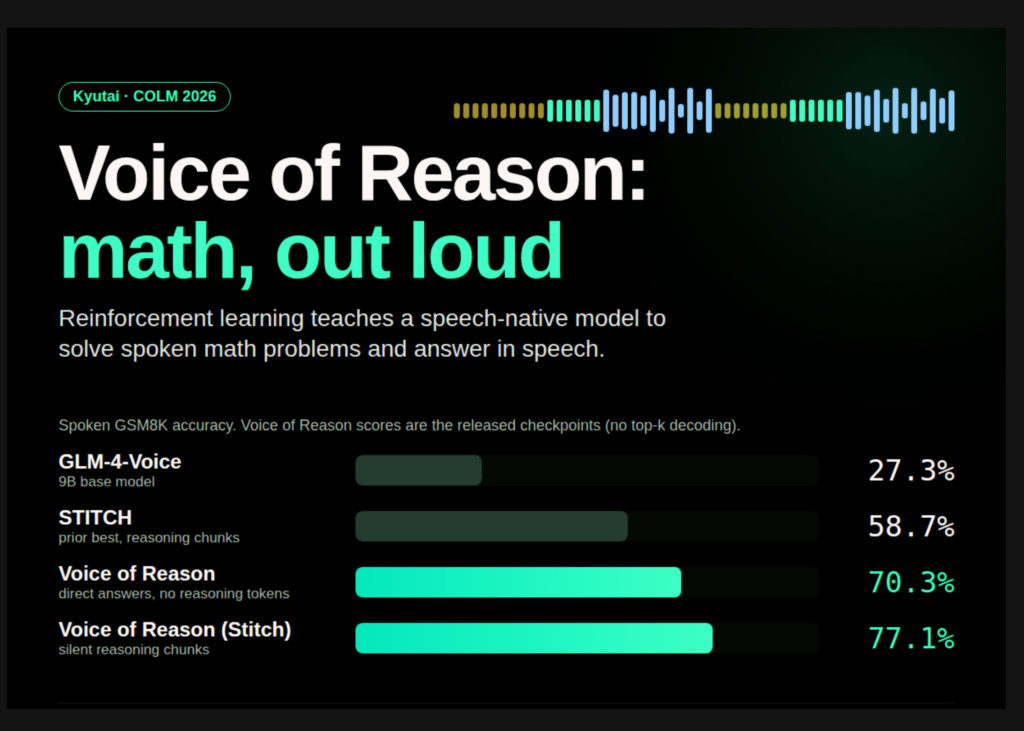
Kyutai has released Voice of Reason, two open-weight speech-to-speech models capable of solving mathematics problems while speaking. Both versions start from GLM-4-Voice-9B and apply supervised fine-tuning plus reinforcement learning. The process removes the transcription step and excludes a separate text large language model from the loop. Accuracy on spoken GSM8K rises from 27.3% for the base model to 77.1% for the final release.
Deployment and Availability
The models are deployable for self-hosting. Kyutai ran both BF16 checkpoints on a single H100 GPU. Users must also install the GLM-4-Voice repository to access its speech tokenizer and decoder. The weights carry the GLM-4-Voice license, and no Hugging Face inference provider currently hosts them.
The Problem With Cascaded Systems
Pipelines that chain speech-to-text, a text large language model, and text-to-speech still lead on reasoning tasks. Each stage adds latency, and the chain loses paralinguistic cues like tone. Speech-native models must emit audio at regular intervals to remain interactive. This constraint limits the number of hidden reasoning tokens they can afford to generate.
The base GLM-4-Voice scores 27.3% on GSM8K. The earlier STITCH method raised that figure to 58.7% by adding reasoning chunks. The research team describes their work as the first application of reinforcement learning to math reasoning in speech-native models.
Training Methodology
GLM-4-Voice interleaves its output: 13 text tokens, then 26 audio tokens, repeating.
- Stage 1 Supervised Fine-Tuning: Training uses 150,616 problems from Orca-Math. Qwen3-235B rewrote each problem for speech. Kyutai’s DSM TTS then voiced them in many voices. Supervised fine-tuning alone lifts GLM-4-Voice from 27.3% to 61.7%.
- Stage 2 Reinforcement Learning: For each spoken question, the model samples four replies at temperature 0.9. A judge, Qwen3-235B-A22B-2507, scores the decoded text with a binary reward. The judge never sees the reference answer. On 100 hand-checked cases, it agreed with humans 88% of the time.
Rewards are centered within each group, forming a group-relative REINFORCE objective. It is related to GRPO but drops PPO clipping and KL regularization. Training ran on 16 H100 GPUs, with 1,500 RL updates.
Two design choices matter most:
- Temperature correction: Logits are divided by the sampling temperature before the log-softmax in the loss. Without it, GSM8K collapsed from 65.5% to 12.3%.
- Audio-token merging: At each audio position, all audio-vocabulary probabilities are summed into one abstract token. The loss asks only whether audio came next, not which audio token. The paper proves this estimator is unbiased and lower-variance under a value-invariance assumption.
Interactive Explainer
The system includes an interactive explainer mode, allowing users to engage with the reasoning process in real time.
The Two Released Checkpoints
- glm-4-voice-of-reason-9b: This version answers directly, with no extra reasoning tokens. Any step-by-step working is spoken aloud.
- glm-4-voice-of-reason-stitch-9b: This version writes silent 100-token reasoning chunks between spoken blocks. Kyutai states later chunks are generated while earlier speech plays, so thinking adds no extra latency. In the STITCH-R layout used here, the first reasoning chunk precedes the first spoken block.
Performance Results
| Model | Params | GSM8K (%) |
|---|---|---|
| PersonaPlex (full-duplex) | 8B | 3.2 |
| GLM-4-Voice | 9B | 27.3 |
| STITCH (Chiang et al.) | 9B | 58.7 |
| Voice of Reason | 9B | 65.5 ± 1.1 (70.3 released) |
| Voice of Reason (Stitch) | 9B | 74.8 ± 1.1 (77.1 released) |
| Qwen2.5-Omni (text output) | 7B | 84.7 |
| Qwen3-Omni (text output) | 30B | 94.6 |
| Cascaded ASR-LLM-TTS-ASR | 31B LLM | 95.7 |
Paper scores use top-k 50 decoding, averaged over three seeds. Removing top-k gives 70.3% and 77.1%. The released checkpoints correspond to these runs. The omni and cascaded systems are larger top lines, not matched comparisons.
Other findings include:
- Gains survive in real speech: Transcribed with Qwen3-ASR-1.7B, the Stitch model scores 72.0 ± 1.9%.
- Naturalness holds: UTMOSv2 moved from 4.067 to 4.069 (direct) and 4.174 to 4.164 (Stitch) after RL.
- Gains do not come from longer answers: RL cut the direct model’s average reply from 41.9 to 36.4 seconds. Stitch reasoning tokens rose only from 167 to 176.
- RL helps most with little data: With 10% of SFT data, a longer RL run reached 58.5%. SFT alone scored 43.9%.
- General knowledge dips: Spoken TriviaQA fell from 40.6% to 34.0% for the direct model. The authors attribute this mainly to full-data SFT, not RL.
- Contamination check: The team dropped AddSub, MultiArith, SingleEQ and SVAMP from evaluation. Of 678 checked questions, 54.0% overlapped with Orca-Math at the paraphrase level.
Evaluation audio came from GPT-4o-mini-TTS, a different TTS system than the training audio. GPT-4o served as the evaluation judge.
What it means for users
Developers can now run a 9-billion parameter model on a single high-end GPU that listens to math problems and explains the solution in natural speech. The system does not require a separate transcription engine, which reduces latency and preserves vocal cues. However, the drop in general knowledge benchmarks suggests caution is needed when applying these models to non-mathematical queries.