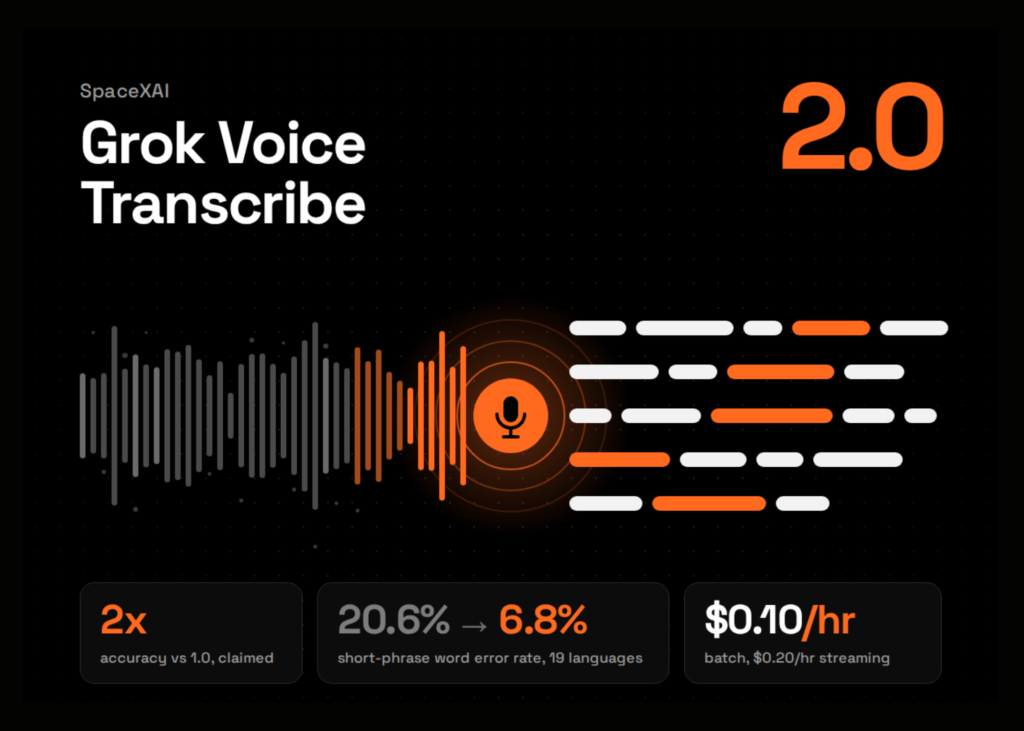
SpaceXAI has launched Grok Voice Transcribe 2.0, a speech-to-text API the company claims delivers twice the accuracy of its predecessor for the same price. The model targets difficult audio conditions, such as noisy phone lines, overlapping voices, and local accents, and processes data in both batch and real-time streaming modes.
The tool is available immediately as a hosted service under the model ID grok-voice-transcribe-2.0. SpaceXAI has not announced open weights, meaning developers cannot self-host the model.
What is Grok Voice Transcribe 2.0?
The system builds on the audio foundation model powering Grok Voice. SpaceXAI states that this underlying model already handles tens of thousands of customer-support calls daily, transcribes millions of hours of video narration, and runs the Grok assistant inside Tesla vehicles.
Training data consists of live, noisy, multilingual audio recorded across diverse environments. SpaceXAI then refined the model using post-training techniques.
Benchmarks: What SpaceXAI Reports
SpaceXAI reports a first-place accuracy rank among 32 streaming models on the public Artificial Analysis leaderboard. That benchmark, AA-WER Streaming, uses approximately 8 hours of audio. It weights AA-AgentTalk at 50%, VoxPopuli at 25%, and Earnings22 at 25%. See the methodology for details.
SpaceXAI also measures word error rate (WER) on four internal sets drawn from production traffic:
- Telephony (8 kHz): English customer support calls
- Conversational: English conversations with Grok
- Credentials: phone numbers, emails, and addresses in English
- Short phrases: voice-assistant utterances in 19 languages
Version 2.0 improves on 1.0 across all four sets. On telephony, SpaceXAI says it leads every model the company tested. These internal results are vendor-reported and not independently reproduced.
Multilingual Transcription and Language Switching
The model transcribes dozens of languages and detects the language automatically. It also follows mid-recording language switches in a single pass. SpaceXAI team calls multilingual accuracy the largest improvement over 1.0.
Short phrases, such as in-car commands, give a model little context to identify the language. On that set, WER drops from 20.6% to 6.8%. That works out to roughly 67% fewer word errors.
The docs list 25 languages for written-form formatting of numbers, currencies, and units.
Key Features for Developers
Every feature below ships in the same API:
- Batch and streaming: transcribe files and URLs, or stream audio over WebSocket at
wss://api.x.ai/v1/stt - Word-level timestamps: start and end times plus confidence scores for each word
- Speaker diarization: speaker labels at no additional cost
- Multichannel transcription: up to 8 channels transcribed independently
- Key term biasing: up to 100 domain terms per request, each up to 50 characters
- Text formatting: numbers, dates, currencies, phone numbers, and emails returned in written form
- Filler word removal: “um” and “uh” are removed by default
- Smart turn detection: an ML model predicts end of turn for voice agents
The batch endpoint accepts files up to 500 MB across 12 audio formats. Streaming also accepts Opus at roughly 4 KB/s, versus 48 KB/s for raw PCM at 24 kHz.
Pricing
Pricing is identical to version 1.0. Batch transcription costs $0.10 per hour of audio. Streaming costs $0.20 per hour. Diarization, timestamps, and key terms are included. That equals about $1.67 and $3.33 per 1,000 minutes.
How to Call It
curl -X POST https://api.x.ai/v1/stt \
  -H "Authorization: Bearer $XAI_API_KEY" \
  -F model=grok-voice-transcribe-2.0 \
  -F format=true \
  -F language=en \
  -F file=@audio.mp3
Atlassian Loom Adopts Grok Voice Transcribe 2.0
Atlassian Loom now uses Grok Voice Transcribe 2.0 to transcribe every video. Atlassian found it more accurate than its existing solution.
The workflow SpaceXAI describes is record, transcribe, then code. A user records an action plan in Loom. The transcript is piped into Cursor, which makes the code updates. Sanchan Saxena, SVP of Teamwork Collection at Atlassian, described it as ‘closing the loop from context to code.’
What it means
Developers can switch to the new model simply by setting model=grok-voice-transcribe-2.0 in their API calls. Existing workflows do not require code changes, though users should note the model ID has changed from the previous version.