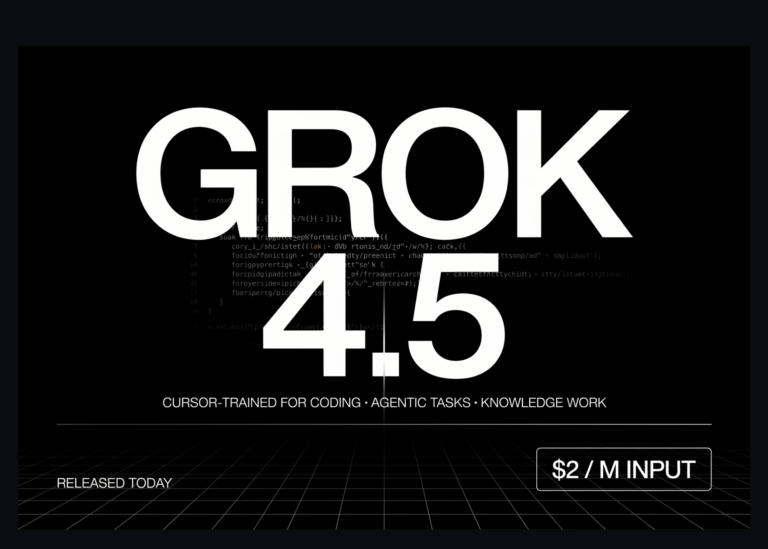
xAI has released Grok 4.6, a post-training upgrade to the previous Grok 4.5 version rather than a model with more parameters. The company kept the base foundation constant and instead ran a longer supplemental training cycle. This involved regenerating supervised fine-tuning trajectories and applying reinforcement learning within agentic environments. The goal is to improve performance on tasks that require many steps without the agent drifting. Grok 4.6 scores 61 on the Artificial Analysis Intelligence Index, an increase of five points over Grok 4.5. That score ties with GPT-5.6 Sol Max. The model accepts 500,000 context tokens and is available now via Cursor and Grok Build. It introduces a new xhigh reasoning-effort level, which sits above the options Grok 4.5 shipped with.
Is it ready for production?
Grok 4.6 is available for production use, but only within a specific set of workloads. The model is generally available through the xAI API as grok-4-6 and serves as the default engine in Grok Build. It ships in Cursor on all plans and is accessible via OpenRouter, Vercel, and Cloudflare. There is no open-weights release and no path to self-hosting, which rules out air-gapped deployments.
- Company stage: Seed-stage teams and independent developers can adopt it immediately since Cursor and Grok Build require no setup work. Mid-market engineering organisations are the best fit. The vendor documents API-only integration, mTLS authentication, and batch and priority processing. Regulated enterprises should stage a pilot first, as the vendor’s brand history is a live procurement question in several buying committees.
- Industries: Software and developer tooling, semiconductor and kernel engineering, hardware and CAD-adjacent design, financial research, and legal analysis. The training mix explicitly targeted several of these.
- Applications: Repository-wide refactors, migration agents, research-and-synthesis pipelines over 500K-token corpora, first-pass application scaffolding from a product brief, GPU kernel optimisation, and document-heavy knowledge work.
What actually changed
xAI describes the update as a longer supplemental training run than Grok 4.5 received. This used curated model-generated data for reasoning and advanced technical concepts, high-quality engineering data, and an improved optimizer and training recipe.
Grok 4.5 then regenerated supervised fine-tuning trajectories across reasoning-effort levels, agent harnesses, and domains spanning STEM, software engineering, and knowledge work. The team filtered problematic traces using model-based checks. Reinforcement learning followed in agentic environments covering knowledge work, general coding, web development, computer-aided design, and kernel optimisation.
The behavioural insight is important: on longer trajectories, xAI reports more self-testing and verification, with the model checking its own work before moving on. That is a vendor observation from internal testing, not an independently measured result.
The model takes 500,000 context tokens. It accepts text and image input with text-only output, has no stated text output limit, and carries a February 1, 2026 knowledge cutoff. reasoning_effort now supports low, medium, high (default), and a new xhigh level. xAI did not publish a parameter count for Grok 4.6.
Benchmarks: read the losses first
On xAI’s launch table, Grok 4.6 (High) scores 61 on the Artificial Analysis Intelligence Index, up from 56 for Grok 4.5 and tied with GPT-5.6 Sol Max. It leads the table on GDPval-AA v2 (1753 Elo, versus 1526 for Grok 4.5), AA-Briefcase (1577, versus 1313), and Harvey LAB.
It trails on the coding rows that matter most to engineering teams. DeepSWE v1.1 lands at 65.9%, up 11.9 points generationally but behind GPT-5.6 Sol Max at 73%. Terminal-Bench v3.0 reaches 26%, nearly double Grok 4.5’s 15.7% and still last of the four listed models. CursorBench v3.2 is 69.9%, FrontierCode v1.1 Extended is 61.3%, and APEX-Agents is 57.5%.
Two things to note while evaluating. First, the table’s bolded wins on GDPval-AA v2 and AA-Briefcase sit inside Artificial Analysis’ published confidence intervals — they are statistical ties, not leads. Second, the comparison set excludes Anthropic’s Claude Opus 5, which currently tops that index. The disclosed losses are the more reliable signal.
Pricing and access
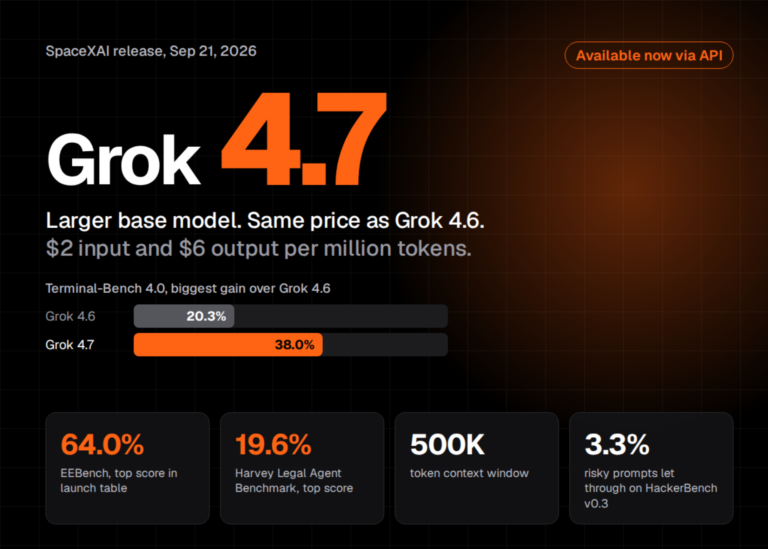
Per the release notes, Grok 4.6 bills $2 / $0.50 / $6 per 1M tokens (input / cached input / output) below 200K prompt tokens, and $4 / $1 / $12 above that threshold. The launch page also references a faster variant at double the price, with no separate model ID published. Grok Build and Cursor are offering 2× included usage for the first week.
Teams should set a prompt_cache_key (or the x-grok-conv-id header on Chat Completions). Without it, requests scatter across servers and cache hits become unreliable, so full input price applies.
What it means
For developers, the main shift is the ability to run longer tasks without the agent losing focus. The xhigh setting forces more internal checks before outputting code or analysis. This helps with complex refactors or synthesising large documents, provided the user accepts the higher cost for cached tokens and the lack of self-hosting options.