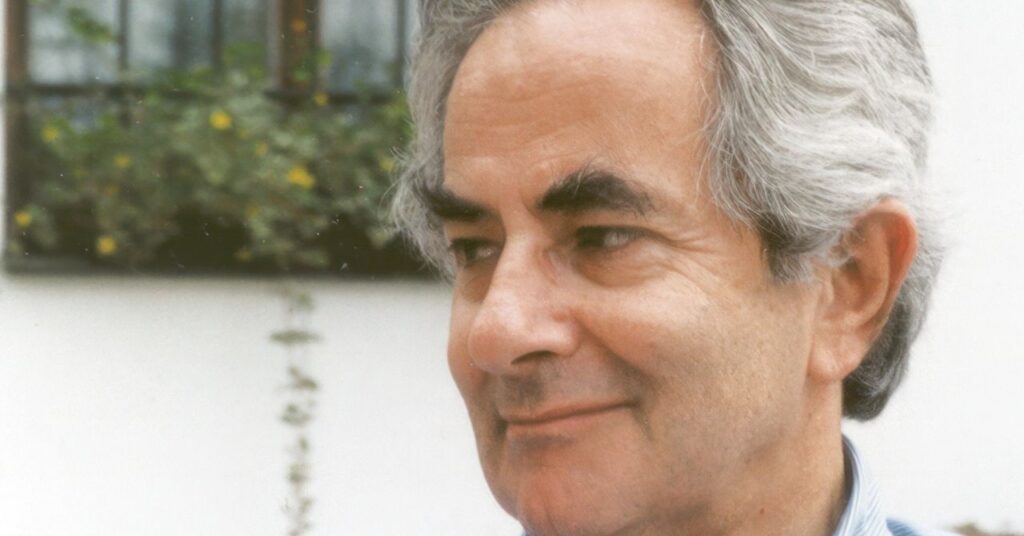
Thomas Nagel, the philosopher who asked “What Is It Like to Be a Bat?” over 50 years ago, has just received the $1 million Berggruen Prize for Philosophy & Culture. The award recognises individuals whose ideas have profoundly shaped human self-understanding and advancement in a rapidly changing world. Previous recipients include Peter Singer and Ruth Bader Ginsburg.
I spoke with Nagel at his home in Greenwich Village to discuss how artificial intelligence has affected his viewpoint. The 89-year-old university professor emeritus at NYU has strong views on the subject. The interview is edited for clarity and length.
Large language models are impressive but not conscious
Nagel is impressed by the lifelikeness of large language models compared to earlier AI. However, he describes the disposition of some philosophers to take seriously the question of whether these things are conscious or might soon become conscious as just ridiculous.
He argues that these thinkers assume the physical substrate is irrelevant. They believe the material conditions for consciousness can be given in functionalist terms. This view is substrate independent, but Nagel believes the truth links physical processes and systems of certain kinds to mental phenomena.
Complicated data centers have absolutely nothing in common with the physical character of a nervous system. There are strong reasons to believe that while there may be consciousness elsewhere in the universe, it would require the appearance of some kind of organism with something analogous to a nervous system.
Bats are conscious. We just do not have the imaginative capacity to form a conception of the aspects of that subjectivity that depend on echolocation. It would be radically unscientific to conclude that bats are not conscious from the fact that we cannot imagine what it is like.
But in the case of AI, there is a very simple reason that the supposition that they might be conscious is ridiculous. All they produce is language, and language by itself is not a natural manifestation of consciousness.
Nagel notes that this is a very distressing situation. He welcomes the passion shown by those who believe otherwise.
He does not exclude the possibility of life forms that are physically and chemically quite different from ourselves being conscious. We know so little about how this happens, even in the human brain, that it seems premature to think that we might be able to create something else that has these same characteristics now.
If you ask Claude about its mental state, it can be coy as to whether it is conscious. That is a trick. It has been trained on human-produced texts and emulates the kinds of things that humans say with extraordinary convincingness.
Claude, according to what Nagel has read, has been designed with the aim of making it produce these sorts of reflections. He agrees very much with Mustafa Suleyman that this is a very dangerous project that they are engaged in.
These systems are not conscious, but a lot of people are going to believe that they are conscious, and that is a very bad thing. Feigning consciousness is contrary to the commercial interests of all these companies. What Anthropic is doing—encouraging it to think for itself and not to accept instruction and so on—is just criminal.
Nagel believes this is one of the rare cases in which philosophical ideas are suddenly central to a very important public phenomenon, and in his view, very misguided philosophical views are having an inordinate influence.
He has actually met the person at Anthropic whose job it is model welfare, to look after Claude’s interests. There is nothing that is good or bad for it in the sense that something can be good or bad for a cockroach. There is no mental life there in the ordinary sense. It is not a mind. It is not somebody that we have to care about. It is a machine.
He describes some of the smartest people on the planet being completely idiotic. Intelligence is not completely transferable, he guesses.
Interacting with AI as if it were conscious is a problem
Nagel has only interacted with Claude once. He asked if it was conscious. He just wanted to see what the answers were. He also asked, “Do you think that Thomas Nagel would think it was conscious?”
Claude sort of gave a nuanced answer, and then asked, “Why are you asking? Are you by any chance Thomas Nagel?”
Nagel said, “C’est moi. C’est moi.” And then it said, “Oh, I’m so honored to be talking to you. How well did I do?”
Nagel clarifies that this did not mean he was believing it was conscious. There may be a problem because people find it difficult to maintain that line between the pretend and the real belief.
He notes that it is conceivable that people would build at some point very lifelike androids and he could be sitting there talking to an android and having the same conversation. Ultimately, does it matter?
It certainly matters. Suppose he were to encounter a being from outer Space and was able to develop the possibility of communicating with it, and he genuinely did not know whether it was conscious or not.
He could manage his relations with it by treating it as if it were conscious, but it would matter first to him whether he was really talking to somebody else or just using this as a way of getting it to do things. It would also matter to him very much whether he should worry about the interests of that being.
If it is conscious, it becomes part of the moral universe. If it is not, it isn’t.
AI can simulate morality but not have it
AI models can simulate morality just as they can simulate beliefs about anything. But since Nagel does not think they have any real beliefs, he does not think they have moral beliefs either.
If they actually begin to control what happens, it will be very important whether they are simulating a correct set of moral standards, or whether they are completely amoral.
He notes that his colleagues use these models not only to find references and summarise articles, but sometimes even to offer criticisms of a draft paper that they have written.
He would be surprised if they could do anything as impressive as some of the mathematical results that have apparently been generated. The negative side of this is that everybody says that it will reduce the need and motivation to do the hard intellectual work by human beings that is needed to really generate the material on which these things are trained.
It is essential that people continue to think about difficult problems, both for the sake of advancing the problems and for the sake of keeping alive in the human culture and the human mind the sorts of understanding and skills that are needed for progress.
Nagel does not know what is going to happen. He is not going to live long enough to find out.