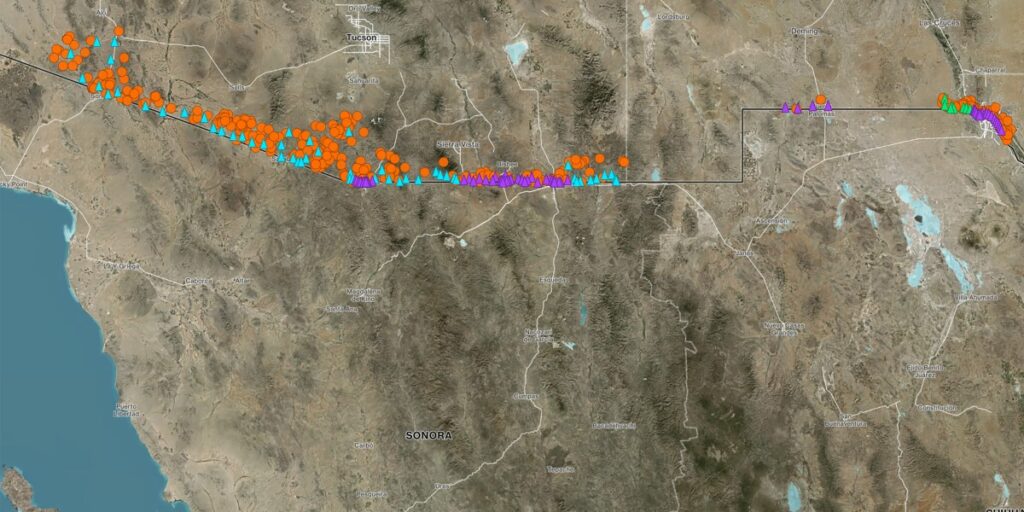
MIT Technology Review and the Times of San Diego have released the first comprehensive map and analysis of deaths near government surveillance towers along the US-Mexico border.
The investigation
The project began with a specific question: why did so many people die near towers meant to track and apprehend them? Journalists in both newsrooms spent the past year examining the failures of border surveillance technology and uncovering the stories of those who died in the borderlands.
To answer this, the team reviewed thousands of pages of government documents, visited the border multiple times, and interviewed more than 45 people. This group included current and former White House advisors, presidential appointees, Border Patrol agents, medical examiners, sheriffs, humanitarian volunteers, and employees of tech companies.
Our data
The investigation relied on knowing where migrants have died and where and when US Customs and Border Protection towers were installed. We analyzed cases dating back to 2015, allowing us to cover different border policies, presidential administrations, and tower technologies.
Migrant deaths
The US-Mexico border has been called the world’s deadliest land border, and Border Patrol estimates that more than 10,000 people have died during crossings since 2000. This figure is widely considered an undercount.
The amount of information available publicly on where and when these people died, and who they were, varies widely. Some remains are never discovered, and for those that are, there is no national protocol for how the records are handled.
We considered a case for further analysis if we could confirm three basic things: whether the person was believed to have been crossing the border, where the remains were found, and roughly when the person died.
We created our dataset by merging existing ones that had been compiled and shared by other organizations, including No More Deaths, Humane Borders, and the Electronic Frontier Foundation, with new records we obtained ourselves from more than a dozen agencies.
Public records requests in Texas
Texas was the biggest missing link in most existing databases of migrant deaths. Unlike Arizona, it has no initiative to share records online, and unlike New Mexico, it leaves individual counties to handle their own death investigations.
We identified 17 counties in Texas that would be relevant to our investigation: Culberson, Jeff Davis, Presidio, Terrell, Val Verde, Kinney, Maverick, Dimmit, Webb, Zapata, Jim Hogg, Starr, Hidalgo, Cameron, Kenedy, Brooks, and Duval. There are other counties in which migrants have died, but they do not have areas covered by surveillance towers and were therefore excluded.
In most of these counties, locally elected administrative judges called justices of the peace collect the most comprehensive information on local deaths. But records requests submitted to these individual judges can stall for years. Some of our requests to justices of the peace remain unfilled more than a year after we filed them.
Reports from justices of the peace sometimes leave out the scene or location details we needed. Some justices never even visit the place where a migrant died, instead formally declaring the person deceased over FaceTime with the first responders on scene.
MIT Technology Review instead filed records requests to the sheriffs of these 17 counties beginning in July 2025. These agencies are often first on the scene when a death is discovered, and their reports can have more detailed information on where remains were found.
But relying on sheriffs’ records means our analysis undercounts migrant deaths in Texas, as it does not include any deaths handled by local or state police.
After we filed a request, it took periods of near daily calls to the offices to receive the records, if we received them at all. Some were provided with no charge. Other counties charged between $300 and $1,300 to fill our request.
Counties warned that their records were incomplete, with an unknown number lost during a move, damaged, destroyed, or misplaced during transitions between sheriffs.
Those delays were compounded because most agencies do not record whether a person is believed to have been crossing the border when they died. That is despite provisions in some counties that allow officers to track far more granular details about other situations. Zapata County reports have a checkbox to indicate whether jewels were stolen in a burglary, for example, while Cameron County reports have one for whether a burglar entered through a chimney.
Without a way to readily identify migrant deaths, offices had to pull records by hand, making the process slower, more costly, and more prone to error.
We received usable records from 14 of these counties. Records have yet to be received from Dimmit or Duval, and Maverick’s office charged a per-record fee that was cost prohibitive.
Agencies generally sent us police reports for each individual case, amounting to over 4,000 pages of records in total. Some were handwritten documents.
Except for the reports from Kenedy, Webb, and Hidalgo Counties, we pulled out the relevant information by hand. For those three counties, which sent large volumes of records, we used Anthropic’s Claude, accessed via API, to inspect each case report and pull out coordinates of the spots where remains were found. Then we checked batches of those cases by hand to verify the AI’s accuracy.
Agencies sent us records on a rolling basis from July 2025 to February 2026, and most did not specify the date through which their records were current.
We generally trusted that agencies sent us cases they believed involved migrant deaths, since they had the most information about each case. But some records clearly suggested otherwise, indicating, for example, that someone died at home, and we excluded those cases.
Several hundred cases were removed from our analysis because they did not include enough information for us to be certain where the remains were found. In fewer than 100 cases, coordinates were not listed but the description was specific enough for us to locate a point within 0.25 miles of where they were found, so we kept those in.
Compared with agencies in other states along the border, those in Texas provide far fewer details regarding how long ago someone may have died before remains were found or how far the decomposition of those remains had progressed. Some reports included this information, but many did not.
While autopsy records sometimes have more details, many migrant autopsies in south Texas are done through the Webb County Medical Examiner, which charges a fee for each report. That was cost prohibitive given the scale of our analysis.
MIT Technology Review consulted with Greg Hess, director of Arizona’s Pima County Office of the Medical Examiner, on a framework for translating descriptions of the scenes, bodies, and causes of death available in many of these records into rough estimates for when a person may have died.
In total, we included more than 1,500 cases from our Texas records requests in our final analysis.
Accessing Arizona records directly
The Pima County Office of the Medical Examiner (PCOME) in Arizona handles death investigations for all border counties in the state except Yuma. We sourced Yuma’s records from the organization No More Deaths, as detailed below.
The office determines which cases it believes to be border crossers. It publishes a data portal for these migrant deaths that is updated monthly and shares its data with the organization Humane Borders, which then publishes it in a map and database. We included the data from 2015 through April 2026.
Humane Borders notes for each case how precise the location description is. We included only cases with GPS coordinates precise to within 300 feet. Collecting these coordinates has been standard practice since around 2012.
The records also include an estimate of when the individual died, ranging from less than a day to at least six to eight months before remains were found.
In total, we included more than 1,700 cases from Humane Borders in our analysis.
Data collected by No More Deaths
To obtain data on deaths in California, New Mexico, Arizona’s Yuma County, and El Paso and Hudspeth Counties in Texas, we turned to the nonprofit organization No More Deaths, which has tracked migrant deaths since 2004. It publishes information about its records requests and its methodology.
Many of the cases in its database include GPS coordinates, sometimes with notes that the location is only approximate, for example, accurate to within half a mile or one mile. We included only cases where the location was known to within a quarter-mile.
No More Deaths’ database includes, when available, information on the level of decomposition in which each set