For makers and artists relying on AI to accelerate their workflow, the instinct is often to throw every available tool at a problem. But in the world of agentic systems, blind delegation is a trap. Ask Copilot CLI to make a simple edit, and without intervention, it might spawn a helper agent to search the codebase, wait for results, and stall the process. A one-step task becomes a three-step chore. While specialist subagents are invaluable for exploring unfamiliar code or running long commands in parallel, they are not free. Every handoff introduces coordination overhead, extra tool calls, and latency. When an agent delegates too eagerly, the intended help turns into friction.
Smarter delegation is now live
We have rolled out an upgrade to our agentic harness called smarter subagent delegation. This feature makes Copilot CLI more discerning, ensuring the main agent:
- Remains focused when it can execute tasks faster on its own.
- Delegates only when a specialist agent creates genuine leverage.
- Parallelises work when tasks are truly independent.
This update is now active for all production traffic. To apply it immediately, run the /update command in your terminal to bring GitHub Copilot CLI to version 1.0.42 or later.
Internal A/B testing revealed significant gains. The change reduced tool failures per session by 23%, driven by a 27% drop in search failures and an 18% drop in edit failures. User wait times improved by 5% at the P95 mark and 3% at P75, with zero quality regression. P95 measures the wait time for the slowest 5% of sessions, while P75 reflects the slower end of typical sessions. The result is fewer unnecessary handoffs, reduced repeated searches, and less waiting during long-running coding tasks.
The problem: Delegation is powerful, but not free
Subagents are a cornerstone of agentic CLIs, allowing Copilot to break complex work into parallel investigations. For large codebases, this distinction between linear and parallel workflows is vital. However, delegation introduces specific failure modes:
- Unnecessary handoffs for simple tasks the main agent could handle faster.
- Excessive use of exploration subagents when the handoff already contains sufficient context.
- Repeated or overlapping searches between the main agent and subagents.
- Sequential delegation where the main agent idles while waiting for a subagent, rather than working in parallel.
- Failure-prone subagent paths caused by stale file paths, moved files, or workspace mismatches.

Our objective is clear: enable developers to use subagents when they add leverage, avoid them when they add overhead, and parallelise work where independent execution is beneficial.
From problem signals to shipped improvement
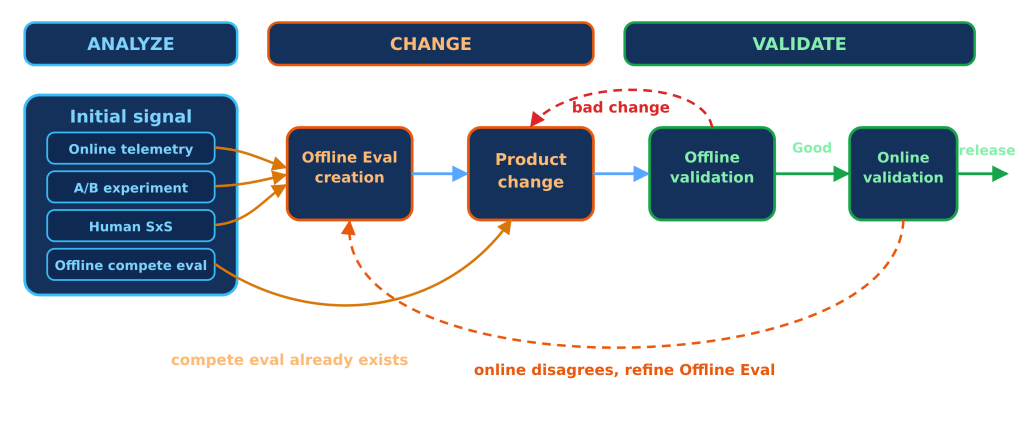
We treated the entire lifecycle-analysis, product changes, evaluation, and rollout-as a single feedback loop. We observed agent behaviour, isolated the orchestration bottleneck, implemented targeted changes, validated them offline, measured them online, and shipped only after the end-to-end workflow improved.
1. Analyse: Let LLMs identify the delegation bottleneck
Instead of manually reviewing agent sessions, we used LLMs to analyse full trajectories. This highlighted a consistent pattern: subagents were being invoked for tasks that were already narrow, obvious, or fully described in the handoff. In these cases, the subagent wasted time re-searching the repository even though the main agent possessed enough context to act directly. This clarified our target: keep simple discovery-and-edit tasks within the main agent and reserve subagents for broader, cross-cutting, or naturally parallelisable work.
2. Change: Refine the orchestration policy
We used LLMs to translate this diagnosis into a more selective orchestration policy. Copilot CLI should handle focused work directly: locate a file, read it, make a targeted change, and verify it. Delegation is reserved for work requiring independent context, broad exploration, or parallel execution.
In practice, this means starting with the narrowest effective path, escalating only when complexity or uncertainty creates value, and stepping back down when the task becomes focused again. Subagents are a parallelism tool, not a pause button. When Copilot launches a subagent, the main agent must continue making progress on independent work rather than waiting for the result.
Furthermore, any subagent handoff must be specific: defining what the user asked, what is already known, what the subagent owns, and the specific result the main agent requires.
3. Validate: Test offline, confirm online, then ship
Before a broad rollout, we validated the change using automatically generated regression cases and existing benchmarks. This confirmed that the new delegation guidance reduced avoidable overhead without breaking cases where subagents genuinely add value.
We then proceeded through staff and public A/B testing, analysing production metrics across reliability, responsiveness, subagent workload, and quality. The gains did not come from making individual LLM calls faster. Instead, we reduced orchestration overhead by avoiding unnecessary subagent paths and lowering the subagent workload per user.
Outcomes
After rolling smarter subagent delegation to production traffic, we observed measurable percentage improvements across reliability and responsiveness:
| Dimension | Metric | Delta |
|---|---|---|
| Reliability | Tool failures per session | 23% reduction |
| Reliability | Search tool failures | 27% reduction |
| Reliability | Edit tool failures | 18% reduction |
| Responsiveness | Total user wait time at P95 | 5% lower |
| Responsiveness | Total user wait time at P75 | 3% lower |
| Quality | Quality metrics | No regression |
| Metric | Delta vs. control | Interpretation |
|---|---|---|
| Failed raw subagent search calls | 15% reduction | Reliability – fewer failure-prone subagent search paths. |
| Average subagent LLM duration per user | 12% lower | Responsiveness – reduced orchestration overhead per user. |
| P95 subagent LLM duration per user | 18% lower | Responsiveness – better worst-case subagent overhead. |
These results demonstrate that better orchestration improves the developer experience even when the visible feature surface remains unchanged. By teaching Copilot CLI when to delegate, when not to delegate, and how to parallelise effectively, we reduced friction in the agent loop itself.
This is the power of GitHub Copilot as a system: the experience improves not because developers are given more switches to manage, but because Copilot becomes better at allocating models, tools, and subagents behind the scenes.
How this benefits developers today
For developers using Copilot CLI, this translates to a smoother day-to-day experience. Straightforward tasks are more likely to be handled directly, complex tasks still receive specialist help when it adds value, and long-running sessions keep moving with less unnecessary waiting. In practice, Copilot CLI becomes more efficient and less noisy without requiring developers to change their workflow.
The change is intentionally behind the scenes. Your workflow stays the same, but Copilot CLI is better at coordinating the work: fewer unnecessary handoffs, less repeated search work, fewer failed tool paths, and faster progress on long-running or multi-step tasks.
What’s next
This work is one step toward our larger goal of improving how Copilot CLI chooses the right model, agent, and tools across your workflow. While having more agents and models available expands what Copilot can do, the value to developers depends on how well Copilot applies them across the work they are already doing, such as reading files, running commands, and moving from an issue toward a pull request.
As tasks become more complex, the quality of that orchestration matters more. The best system is not the one that delegates the most, but the one that knows