NVIDIA and Hugging Face release tools for scaling diffusion model training
NVIDIA and Hugging Face have released an open-source integration that allows users to fine-tune video and image models at scale without converting checkpoints or rewriting code. The collaboration connects the NVIDIA NeMo Automodel library with the 🤗 Diffusers ecosystem, enabling production-grade distributed training for models hosted on the Hugging Face Hub.
Training and fine-tuning diffusion models are increasing in complexity, requiring utilities that handle memory-efficient sharding, latent caching, and multiresolution bucketing. These tools must scale gracefully from a single GPU to hundreds of devices.
To meet these technical demands, the partners offer the NVIDIA NeMo Automodel open-source library. The integration is documented in the Diffusers training guide and is fully open source under Apache 2.0.
Table of contents
- What is NeMo Automodel?
- Supported diffusion models
- What this collaboration unlocks
- A look at the fine-tuning workflow
- Other Finetuned/LoRA examples
- Try it today
- Coming next: Pythonic recipe APIs
- Resources
What is NeMo Automodel?
NeMo Automodel is an open-source PyTorch DTensor-native training library, part of the NVIDIA NeMo framework, built around two design principles that matter for the Diffusers ecosystem:
- Hugging Face native. Point
pretrained_model_name_or_path
at any Diffusers model ID on the Hub and start training. NeMo Automodel uses Diffusers model classes (e.g.
WanTransformer3DModel
) for loading and Diffusers pipelines (
WanPipeline
) for generation. Checkpoints round-trip cleanly back into the Diffusers ecosystem.
- One program, any scale. The recipes and training scripts can be easily modified to suit training at any scale. Parallelism is a configuration choice, not a code rewrite — switch between FSDP2, tensor parallel, expert parallel, context parallel, and pipeline parallel by declaring configurations, not rewriting models.
AutoModel currently supports flow-matching models only. Under the hood, it uses flow matching as the training objective, with latent-space training (via pre-encoded VAE outputs) and multiresolution bucketed dataloading to accelerate throughput.
Supported diffusion models
NeMo Automodel integration ships with ready-to-use fine-tuning recipes for the open diffusion models below. The list reflects the recipes currently in
examples/diffusion/finetune
.
| Model | Hugging Face ID | Task | Parameters | LoRA recipe |
|---|---|---|---|---|
| Wan 2.1 T2V 1.3B / 14B | Wan-AI/Wan2.1-T2V-1.3B-Diffusers Wan-AI/Wan2.1-T2V-14B-Diffusers | Text-to-Video | 1.3B (fits on a single 40GB A100) / 14B | Yes |
| Wan 2.2 T2V A14B | Wan-AI/Wan2.2-T2V-A14B-Diffusers | Text-to-Video | 27B total (MoE), 14B active per step | No |
| FLUX.1-dev | black-forest-labs/FLUX.1-dev | Text-to-Image | 12B | Yes |
| FLUX.2-dev | black-forest-labs/FLUX.2-dev | Text-to-Image | 32B | Yes |
| HunyuanVideo 1.5 | hunyuanvideo-community/HunyuanVideo-1.5-Diffusers-720p_t2v | Text-to-Video | 13B | Yes |
| Qwen-Image | Qwen/Qwen-Image | Text-to-Image | 20B (MMDiT) | Yes |
What this collaboration unlocks
For Diffusers users, the practical gains break down into a few concrete capabilities.
No checkpoint conversion. Pretrained weights from the Hub work out of the box. There’s no separate “training format” to convert to, then convert back. Your fine-tuned checkpoint loads directly into a
DiffusionPipeline
for inference, or back to the Hub for sharing. Downstream tools — quantization, compilation, LoRA adapters, custom samplers — all keep working.
Fast path to new model support. When a new diffusion model lands in Diffusers, enabling it in NeMo Automodel takes a small, contained code addition — a data preprocessing handler and a model adapter — rather than a full custom training script. The rest of the recipe stack (FSDP2, bucketed dataloading, checkpointing, generation) carries over unchanged, and the same YAML-driven workflow applies.
Full and parameter-efficient fine-tuning. Both full fine-tuning and LoRA-style PEFT are supported, so you can choose between maximum quality (full FT on a large cluster) or maximum efficiency (LoRA on a single node). The same recipe structure handles both.
Scalable training that goes beyond what built-in scripts offer. NeMo Automodel adds sharding schemes such as FSDP2, tensor, context, and pipeline parallelisms, multi-node orchestration (SLURM today, Kubernetes coming), and multiresolution bucketing. These capabilities make training larger models like FLUX.1-dev (12B) and HunyuanVideo (13B) possible.
A look at the fine-tuning workflow
In this section, we walk through the typical workflow for fine-tuning any of the supported models. The recommended way to install Automodel is the NeMo Automodel Docker container (
nvcr.io/nvidia/nemo-automodel:26.06
), which ships with PyTorch, TransformerEngine, and other CUDA-compiled dependencies pre-built. Alternatively, install with
pip3 install nemo-automodel
or from source (
pip3 install git+https://github.com/NVIDIA-NeMo/Automodel.git
); see the installation guide for all options.
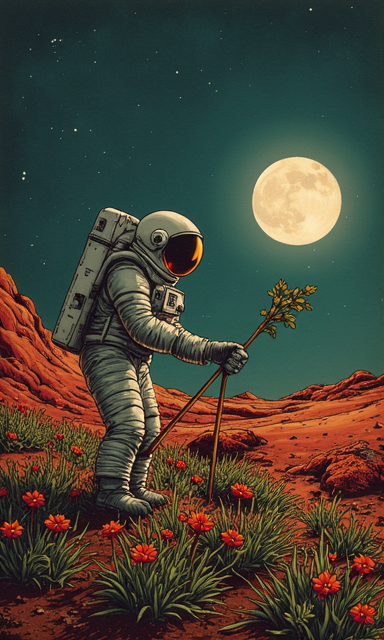
This guide walks through a full-transformer fine-tune of FLUX.1-dev on the 78-card Rider–Waite tarot dataset, then generating from the resulting checkpoint. It reuses the checked-in YAML configs and applies run-specific settings as command-line overrides, so no new config files are required.
1. Pre-encode the dataset
The diffusion recipe consumes cached VAE latents and text embeddings instead of encoding source images during every training step. Stream the 78 Rider–Waite images directly from Hugging Face and distribute preprocessing across all visible GPUs:
uv run --locked --no-default-groups \ --extra diffusion \ --extra diffusion-media \ python -m tools.diffusion.preprocessing_multiprocess image \ --dataset_name multimodalart/1920-raider-waite-tarot-public-domain \ --dataset_media_column image \ --dataset_caption_column caption \ --dataset_streaming \ --max_images 78 \ --output_dir /cache/flux_tarot \ --processor flux \ --model_name black-forest-labs/FLUX.1-dev \ --max_pixels 245760The captions already contain the
trtcrdtrigger token. With this pixel budget and the dataset’s portrait aspect ratio, preprocessing assigns the samples to the 384×640 bucket used by the showcase run.
For image training, preprocessing produces
.ptcache files and sharded metadata:
/cache/flux_tarot/ ├── 384x640/ │ ├── <hash1>.pt │ └── ... ├── metadata_shard_0000.json ├── metadata.json └── _hf_dataset/ └── images/2. Launch training with the existing FLUX YAML
Use
examples/diffusion/finetune/flux_t2i_flow.yamldirectly. The YAML already selects FLUX.1-dev, full transformer fine-tuning, the FLUX flow-matching adapter, an effective batch size of 32, and eight-way FSDP2.
Supply the tarot-specific paths and settings as command-line overrides:
uv run --locked --no-default-groups --extra diffusion \ torchrun --nproc-per-node=8 \ examples/diffusion/finetune/finetune.py \ -c examples/diffusion/finetune/flux_t2i_flow.yaml \ --model.transformer_engine_fp8 false \ --data.dataloader.cache_dir /cache/flux_tarot \ --data.dataloader.base_resolution '[384,640]' \ --lr_scheduler.lr_decay_style constant \ --lr_scheduler.lr_warmup_steps 20 \ --step_scheduler.max_steps 200 \ --step_scheduler.ckpt_every_steps 50 \ --checkpoint.checkpoint_dir /tmp/flux_tarot/checkpoints/full \ --checkpoint.save_consolidated true \ --seed 2026The run produces checkpoints at steps 50, 100, 150, and 200. The final checkpoint is labeled
epoch_66_step_199; the label is zero-based even though it represents the completed 200th optimizer step.
3. Generate from the fine-tuned checkpoint
Use the existing FLUX generation YAML and point
model.checkpointat the complete training checkpoint:
Source Read original →