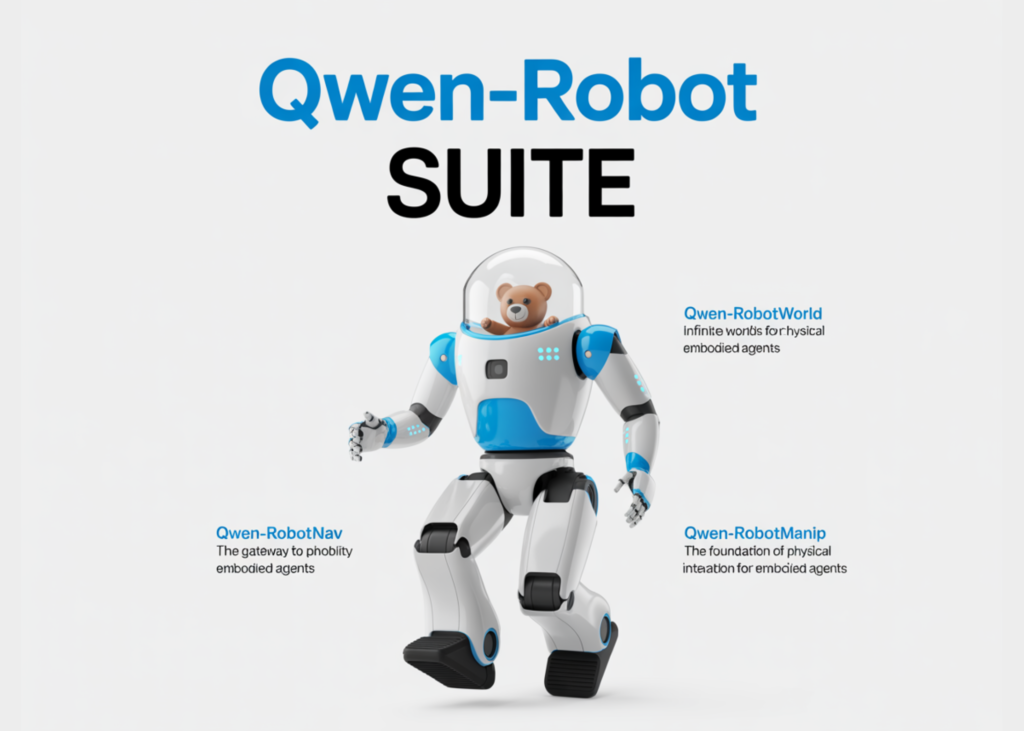
For makers and artists building embodied systems, the Qwen team has just dropped a toolkit that stops the constant headache of rewriting code for every new robot. They have released Qwen-RobotSuite, a collection of three distinct models designed to tackle the messy reality of physical robotics: moving objects, predicting how the world changes, and navigating through it.
Each model leans on the Qwen vision-language backbone but solves a specific problem. Qwen-RobotManip handles physical dexterity using a 4B parameter base. Qwen-RobotWorld acts as a video world model, predicting future scenes based on language commands. Qwen-RobotNav focuses on movement, available in 2B, 4B, and 8B configurations.
Qwen-Robot-Suite
This is not a single monolithic model. It is a suite of three independent foundation models. Two of them, RobotManip and RobotNav, are available via public GitHub repositories.
The robotics landscape is currently fragmented. Hardware varies wildly, and observation or action formats are often incompatible. A policy trained on one robotic arm rarely transfers to another.
These research reports address that fragmentation in different ways. RobotManip aligns action representations so manipulation data can truly scale. RobotWorld uses language as a unified interface for video prediction. RobotNav provides a controllable observation interface specifically for navigation tasks.
The core split between the three releases is as follows:
| Model | Problem | Backbone | Output |
|---|---|---|---|
| Qwen-RobotManip | Robotic manipulation | Qwen3.5-4B | Continuous robot actions |
| Qwen-RobotWorld | Embodied world modeling | Frozen Qwen2.5-VL | Predicted future video |
| Qwen-RobotNav | Mobile navigation | Qwen3-VL | Waypoint trajectories |
Qwen-RobotManip: Alignment Unlocks Scale for Manipulation
Qwen-RobotManip is a Vision-Language-Action model built on Qwen-VL that predicts continuous robot actions.
A VLA model takes camera views and a language instruction to output low-level robot actions. The challenge here is that manipulation data is naturally heterogeneous.
Different robots record states and actions in incompatible formats. When demonstrations arrive with mismatched representations, scaling the data produces interference. RobotManip solves this with a unified alignment framework.
The Unified Alignment Framework
The framework relies on three complementary mechanisms. First is a canonical state-action representation. It is an 80-dimensional vector with per-dimension binary masking.
This vector holds two 29-dimensional per-arm blocks plus 22 reserved dimensions. Each block stores joint positions, end-effector pose, gripper state, and dexterous hand joints. Robots populate only the dimensions they have.
Second is a camera-frame delta pose parameterization. End-effector actions are expressed as deltas in the camera frame. This makes visually similar motions numerically proximate across different embodiments.
Third is an in-context policy adaptation mechanism. It reads recent execution history as an implicit embodiment identifier. The policy adjusts behavior at deployment time without parameter updates.
A dual-stream co-training strategy runs alongside this. It jointly optimizes manipulation data and a vision-language stream. This prevents the backbone’s perception and reasoning from eroding.
The Data Engine
RobotManip assembles roughly 38,100 hours of manipulation data. It uses only open-source datasets and human videos. No proprietary data collection was used.
A human-to-robot synthesis pipeline produces most of this scale. It converts egocentric hand demonstrations into robot trajectories. The pipeline renders across 15 robot platforms.
This synthesis alone yields about 24,808 hours of demonstrations. The egocentric source data is about 1,933 hours. Open-source robot datasets contribute over 11,000 hours.
The pipeline separates action alignment from visual alignment. Action alignment retargets hand keypoints to gripper poses. Visual alignment uses SAM3 masking, ProPainter inpainting, and MuJoCo inverse kinematics.
A five-stage curation pipeline then filters the combined corpus. It catches sudden changes, temporal misalignment, and extreme values. One check found 81% of episodes in a subset failed state-action alignment.
Benchmark Results
The research report argues standard benchmarks fail to measure generalization. Models without robot pretraining match pretrained ones on in-distribution tests. RobotManip therefore focuses on out-of-distribution (OOD) settings.
| Benchmark (OOD) | Prev. SOTA (π0.5) | Qwen-RobotManip |
|---|---|---|
| LIBERO-Plus | 84.4 | 91.4 |
| RoboTwin-C2R Hard | 47.9 | 69.4 |
| EBench | 27.1 | 45.6 |
| RoboCasa365 | 16.9 | 35.9 |
| RoboTwin-IF | 49.6 | 72.2 |
The largest reported gap is on cross-embodiment transfer. RobotManip reaches 23.9% using camera-frame EEF actions. That is 3.2× the 7.5% achieved by π0.5.
The model also ranks 1st on the RoboChallenge Table30-v1 generalist track. It scores a 20% relative improvement over the prior best. Real-robot validation covers AgileX ALOHA, Franka, UR, and ARX platforms.
Qwen-RobotWorld: Language as a Universal Action Interface
Qwen-RobotWorld is a language-conditioned video world model. It predicts future visual trajectories from a current observation. Natural language serves as the unified action interface.
A world model learns environment dynamics. Given a current state and an action, it predicts the next state. RobotWorld represents states as video frames and actions as text.
This is important because language is embodiment-agnostic. One instruction encodes the action sequence, goal, and constraints. It works across a Franka gripper, an Aloha dual-arm system, or a humanoid.
The Double-Stream MMDiT Architecture
The model uses a 60-layer double-stream Multimodal Diffusion Transformer. An understanding stream processes a frozen Qwen2.5-VL encoder’s features. A generation stream processes video-VAE latents.
The two streams interact via joint attention at every layer. Using an MLLM as the action encoder gives two advantages. It parses compositional instructions and constrains physically plausible transitions.
The MMDiT has 20B parameters. The VAE adopts the Wan-VAE architecture. The context length supports up to 48,360 video tokens.
A Scene2Robot mechanism reuses this backbone for cross-embodiment synthesis. It processes scene, robot reference, and generation segments together. This enables human-to-robot video transfer without robot-specific prompting.
The Embodied World Knowledge Dataset
Training uses the Embodied World Knowledge (EWK) dataset. It contains roughly 8.6M video-text pairs. That spans over 200M observation frames.
The corpus covers four embodied domains plus general video. Manipulation provides about 5.9M samples across 20+ morphologies. Driving, navigation, and human-to-robot transfer fill out the rest.
An action-language mapping framework standardizes everything. It converts 20+ embodiment types and 500+ action categories into language. A hierarchical five-layer annotation pipeline produces the captions.
Benchmark Results
RobotWorld was evaluated on four established benchmarks. It ranks 1st overall on two of them:
| Benchmark | Result | Ranking |
|---|---|---|
| EWMBench | 4.60 | 1st overall |
| DreamGen Bench | 4.952 | 1st overall |
| WorldModelBench | 8.99 | 1st open-source (3rd overall) |
| PBench | 0.804 | 1st open-source |
On EWMBench it leads motion fidelity with an HSD of 0.566. That is a 33% gain over the runner-up. Scene consistency reaches 0.914.
On WorldModelBench it scores 1.00 on four physics-adherence categories. These are Newton’s laws, mass conservation, fluid dynamics, and gravity. Penetration scores 0.94, and instruction following scores 2.33 out of 3.0.
Qwen-RobotNav: A Controllable Interface for Navigation
Qwen-RobotNav is a scalable navigation model built on Qwen3-VL. It reframes multi-task navigation as observation context modeling. The model exposes a parameterized interface for external control.
Navigation is