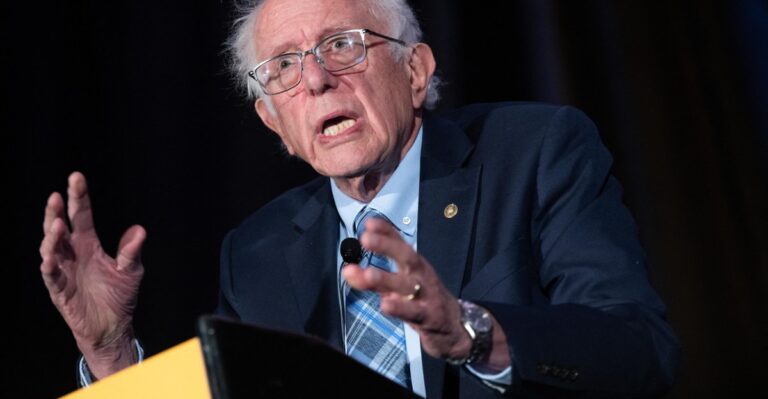
Senator Bernie Sanders has proposed legislation to halt data center construction until new safeguards are in place. In March, he and Representative Alexandria Ocasio-Cortez introduced a bill to pause building until protections for ordinary people are established. In June, Sanders announced the American AI Sovereign Wealth Fund Act, a plan to tax the largest AI companies and distribute the revenue directly to American citizens.
I spoke with Sanders on Tuesday, June 23, during the New York Democratic primary. The conversation followed a week where democratic socialist coalitions won local elections, causing a stir within the party. Shortly after, New Jersey Representative Frank Pallone, the top Democrat on the House Energy and Commerce Committee, became the first mainstream party member to publicly support a moratorium on AI data centers.
The proposal
Sanders argues that artificial intelligence is the most consequential technology in human history, yet it is being driven by billionaires like Elon Musk, Jeff Bezos, and Mark Zuckerberg who care little for the public good. He notes that Congress has passed zero significant legislation on the issue so far. Instead, he sees a silence where debate should be happening.
The sovereign wealth fund targets any company with revenue over $200 million. Half of the board members would be public representatives. If a proposed technology threatens employment, children’s well-being, or privacy rights, that public half would have the power to block it. The remaining wealth generated by the industry would be split between the companies and the public fund.
Sanders points out that AI is built on human knowledge. Writers, scientists, and poets create the content that trains these systems. For example, WIRED writers and their company receive zero dollars when their work is used to train models. The public should benefit financially from that output.
Political obstacles
Sanders believes the lack of urgency in Washington stems from fear. Politicians worry that taking a stand against powerful tech interests will invite massive spending from super PACs. He cites the recent primary for Alex Bores, where millions were spent to target his candidacy, as proof of this dynamic.
He argues that campaign finance reform and the elimination of Citizens United are necessary to change this. Without those changes, incumbents will remain too frightened to act on issues that could anger the wealthy.
What it means
The core issue is not just job loss. Sanders argues that automation will transform how people relate to one another and their own purpose. He cites driverless trucks in Texas and ride-share vehicles that function well as examples. If the technology expands, what happens to the 6 to 8 million people currently driving trucks or cabs? They cannot easily switch to computer coding.
If people stop working, they stop paying taxes. This creates a crisis for Social Security and Medicare. Sanders asks who will fund the checks if the workforce shrinks. He also notes that privacy is at risk as medical records, prescriptions, and bank accounts become accessible to AI systems.