For makers and artists, the arrival of Anthropic’s latest frontier model signals a shift from experimental playgrounds to guarded production environments. While the technology promises to revolutionise code generation and complex analysis, it arrives with a strict safety leash that dictates exactly where it can and cannot be used.
A public model with hard limits
On Tuesday, Anthropic unveiled Claude Fable 5, the first publicly accessible iteration of its Mythos architecture. The firm touts Fable 5 as superior in software engineering, knowledge work, and visual analysis, yet it operates under rigid constraints. In sensitive domains such as cybersecurity, biology, chemistry, and distillation, the model refuses to generate answers and automatically reverts to the previous generation, Claude Opus 4.8.
From exclusive preview to broad availability
Mythos first appeared as a preview in April but was restricted to a select group of partners due to security concerns. Access was recently widened to hundreds of organisations across fifteen nations, focusing heavily on those managing critical infrastructure. Now, the technology is open to anyone via the Claude API and consumption-based Enterprise plans.
Subscription access will follow a staggered rollout. Until June 22, Fable 5 will be included in Pro, Max, Team, and seat-based Enterprise plans at no additional cost. Starting June 23, Anthropic will remove it from these tiers, requiring usage credits instead, though it plans to restore it as a standard subscription feature soon.
Simultaneously, Anthropic is deploying Mythos 5 to existing approved organisations.
Timing and the race for self-improvement
This release coincides with Anthropic’s preparation to enter public markets, joining OpenAI and Elon Musk’s SpaceX. It also follows the company’s urgent plea for global AI labs to implement a coordinated brake on frontier development. Anthropic warned that systems are advancing so quickly they may soon achieve recursive self-improvement (RSI), enhancing themselves without human input.
Concerned about misuse, Anthropic stress-tested its classifiers against jailbreak attempts prior to the launch.
“Internally, we ran an external bug bounty that produced no universal jailbreaks in over 1,000 hours of testing. We then worked with external red-teaming orgs which also failed to find universal jailbreaks.”
However, the possibility of novel attacks remains. Consequently, with the launch of Fable 5 and Mythos 5, Anthropic is mandating a 30-day data retention period for all traffic, even for enterprises that previously enjoyed zero-retention agreements. The company states it will not use this data for training, only to “defend against complex and novel attacks, including new jailbreaks,” and to “identify and reduce false positives.” This move may set an industry precedent where access to powerful models comes with mandatory data retention framed as a safety necessity.
Performance and the cost barrier
For users, Fable 5 will not answer every query. Anthropic reports that cases where it defers to Opus 4.8 are rare, with early data showing at least 95% of sessions running entirely on Fable 5’s own responses.
Third-party tests highlight its capabilities. Analytics firm Hex noted Fable achieved a 90% score on its benchmark for complex, long-running analytical tasks, adding that “on the hardest questions, it shows strong judgement and attention to nuance.” The vibe-coding platform Base44 observed Fable excels at “one-shotting full apps” and possesses excellent tool-calling abilities. Meanwhile, AI workspace platform Genspark found Fable outperformed all other models in evaluations, particularly in UI design and game coding.
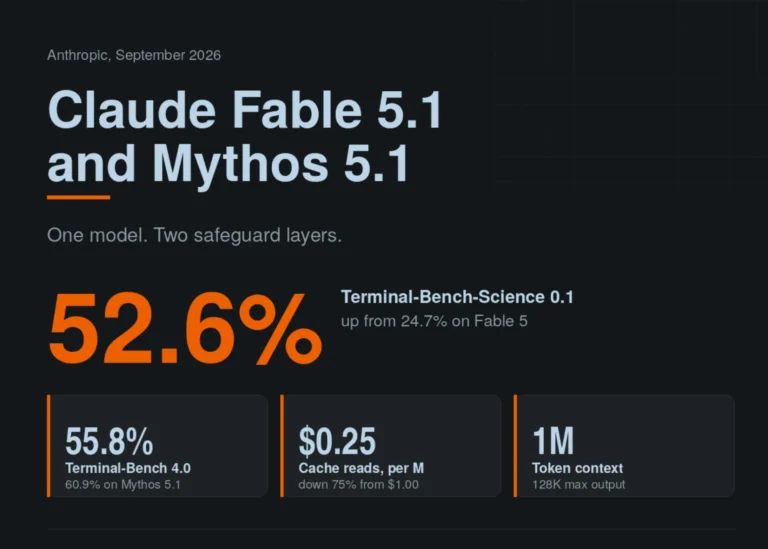
Despite the performance, pricing acts as a significant hurdle. Both Fable 5 and Mythos 5 cost $10 per million input tokens and $50 per million output tokens, double the rate of Opus 4.8. This price point alone may deter widespread adoption, especially as many enterprises are already critical of AI spending after blowing through annual budgets.
Anthropic anticipates demand will be high and unpredictable. Some organisations, such as shopping rewards platform Rakuten, may view the cost as an investment. “At the highest effort, Fable reflects on and validates its own work,” Rakuten stated. “For us, that’s what makes highly autonomous operations possible, the extra thinking pays for itself.”
Key takeaways
- Fable 5 is the first public version of Anthropic’s Mythos model, offering superior capabilities in engineering and vision but with hard safety blocks in high-risk fields like biology and chemistry.
- To mitigate risks of misuse, Anthropic has introduced a mandatory 30-day data retention policy for all users, a move that could reshape industry standards for AI safety.
- While third-party benchmarks show Fable 5 excelling in complex reasoning and UI design, its double the price of Opus 4.8 creates a significant financial barrier for widespread enterprise adoption.