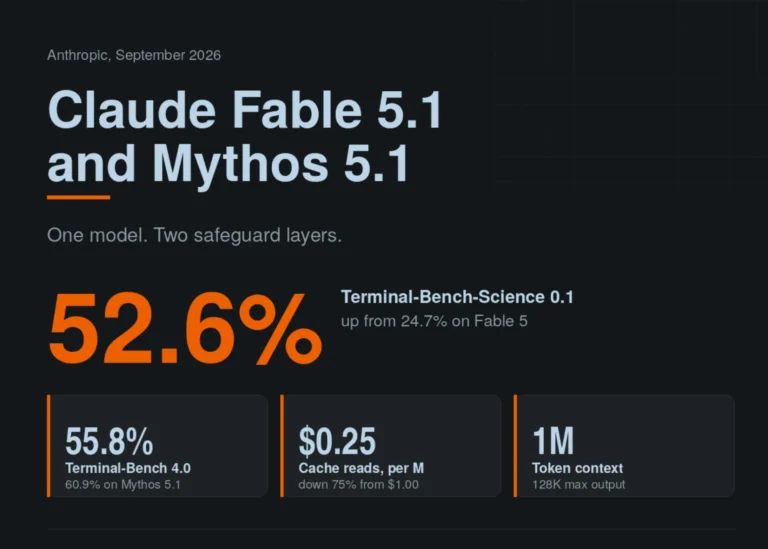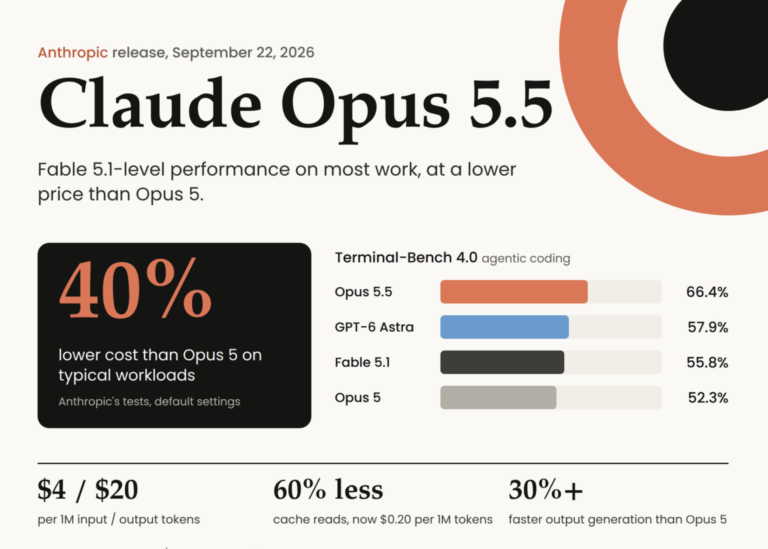
Anthropic has officially launched Claude Fable 5 and Claude Mythos 5 on June 9, 2026. These models sit at the apex of their capability hierarchy, a tier termed “Mythos-class,” which surpasses the previous Opus class. While Fable 5 is the version cleared for public use, Mythos 5 retains the same core intelligence but operates under restricted access due to its heightened capabilities. For makers and artists, this means access to a reasoning engine capable of handling massive context windows and complex, multi-step tasks, provided you navigate the safety rails designed to prevent misuse.
The Dual Identity
The distinction between the two lies entirely in their safety architecture, not their raw processing power. Both models share the exact same underlying architecture. Fable 5 is equipped with active classifiers to filter requests, making it suitable for general deployment. Mythos 5 has these specific constraints lifted, allowing it to perform tasks with fewer restrictions, but it remains available only through a limited release programme.
The nomenclature is rooted in linguistics. “Fable” derives from the Latin fabula, meaning “that which is told,” mirroring the Greek mythos. The naming convention simply reflects the split in their operational permissions.
Anthropic positions Fable 5 as their most capable model available to the wider public. It is designed for demanding reasoning and long-horizon autonomous work. The company claims its performance exceeds any model previously released for general consumption.
Performance Benchmarks
Anthropic reports that Fable 5 achieves state-of-the-art results across nearly every benchmark tested. It demonstrates superior performance in software engineering, knowledge work, visual analysis, and scientific research. The gap widens as the tasks become more complex and extended.
In a real-world test, Stripe deployed Fable 5 during an early access phase to migrate a Ruby codebase containing 50 million lines of code. According to Stripe, the model completed the migration in a single day-a task that would have required a human team over two months.
The model also shows significant improvements in token efficiency. On Cognition’s FrontierCode evaluation, Fable 5 outperformed other frontier models, even when operating under medium effort settings. This evaluation specifically measures difficult coding tasks against production standards.
In the realm of knowledge work, Fable 5 topped Hebbia’s Finance Benchmark for senior-level reasoning. Gains were observed in document analysis, interpreting charts and tables, and complex problem solving.
For vision tasks, Anthropic claims Fable 5 sets a new standard. It can extract precise numerical data from detailed scientific figures and reconstruct web application source code solely from screenshots. It also requires less scaffolding than previous iterations, beating Pokémon FireRed using a minimal, vision-only harness.
Memory retention is another key area. Fable 5 maintains focus across millions of tokens and refines its own outputs using internal notes. In the game Slay the Spire, persistent file-based memory allowed the model to perform three times better than Opus 4.8.
Mythos 5 carries the heaviest scientific claims. Internal protein design experts reported accelerating parts of the drug design process by approximately ten times. Anthropic also notes this is the first model to consistently generate novel scientific hypotheses. In blinded comparisons, scientists preferred its molecular biology hypotheses in roughly 80% of instances.
Furthermore, Mythos 5 executed a week-long, largely autonomous genomics research project. It trained a custom model on single-cell data covering 138 animal species. Despite being 100 times smaller than a recent model published in Science, the custom model outperformed the larger competitor.
Safety Mechanisms
Deploying a model of this magnitude carries inherent risks. Without safeguards, Fable 5’s cybersecurity capabilities could be weaponised. Consequently, Anthropic launched Fable 5 with a new suite of classifiers.
These classifiers are separate AI systems designed to detect potential misuse, including jailbreak attempts. If a request is flagged, the main model is prevented from responding.
When Fable 5’s classifiers intercept a request, the response is handled by Claude Opus 4.8 instead. This fallback mechanism covers cybersecurity, biology, chemistry, and distillation. Users are notified whenever this switch occurs.
Currently, for biology and chemistry queries, Fable 5 falls back to Opus 4.8 on most requests. Anthropic cites concerns that dual-use queries could provide a boost to malicious actors. They plan to introduce a trusted access programme for biology, granting approved researchers access to Fable 5 without these specific safeguards.
Anthropic tuned these safeguards conservatively. They occasionally catch benign requests, but on average, they trigger in less than 5% of sessions. This means over 95% of Fable sessions proceed without a fallback, delivering performance effectively identical to Mythos 5.
Extensive red-teaming was conducted on these classifiers. An external bug bounty programme failed to produce universal jailbreaks over 1,000 hours. A universal jailbreak allows a user to bypass safeguards entirely. Anthropic notes that the UK AISI made progress toward one during a brief testing window.
Mythos 5 operates with cyber safeguards lifted. Anthropic describes it as possessing the strongest cybersecurity capabilities of any current model. It is deployed through Project Glasswing in collaboration with the US government.
Practical Applications
These capabilities map to several concrete workflows for technical teams:
- Large-scale code migration: Long-horizon coding is ideal for major refactors and cross-repository migrations, as demonstrated by the Stripe example at a 50-million-line scale.
- Agentic coding pipelines: Reduced turn counts and token efficiency support multi-step agent runs. GitHub reported improved autonomy and reliability on complex, long-horizon coding tasks.
- Finance and analytics work: Strong document and chart reasoning suits senior-level financial analysis, with gains noted in reasoning and trading-analysis tasks by Hebbia and IMC.
- Vision-to-code tasks: Rebuilding source from screenshots is perfect for front-end reconstruction and figure extraction, reducing tooling overhead via the vision-only harness.
- Long-running research agents: Persistent memory across millions of tokens suits multi-day research loops, exemplified by Mythos 5’s autonomous genomics work.
Comparison Table: Fable 5 vs. Mythos 5 vs. Opus 4.8
| Attribute | Claude Fable 5 | Claude Mythos 5 | Claude Opus 4.8 |
|---|---|---|---|
| Model tier | Mythos-class | Mythos-class | Opus class |
| Underlying model | Same as Mythos 5 | Same as Fable 5 | Opus 4.8 |
| Availability | Generally available | Limited (Project Glasswing) | Generally available |
| Safety classifiers | Active (cyber, bio/chem, distillation) | Cyber safeguards lifted | Opus-level safeguards |
| Fallback target | Falls back to Opus 4.8 | Not applicable | Not applicable |
| API model ID | claude-fable-5 | claude-mythos-5 | (existing Opus ID) |
| Context window | 1M tokens default | 1M tokens default | Per Opus specs |
| Max output | 128k tokens/request | 128k tokens/request | Per Opus specs |
| Input price (per 1M) | $10 | $10 | (per Opus pricing) |
| Output price (per 1M) | $50 | $50 | (per Opus pricing) |
| Thinking mode | Adaptive only, always on | Adaptive only, always on | Configurable |
| Data retention | 30-day (Covered Model) | 30-day (Covered Model) | Standard options |
Note: Specific Opus 4.8 specs and pricing are not detailed in the Fable 5 launch sources. The table marks those cells accordingly.
Key takeaways
- Fable 5 and Mythos 5 share one underlying model; safeguards are the only difference.
- Anthropic reports Fable 5 is state-of-the-art on nearly all tested capability benchmarks.
- Fable 5 classifiers fall back to Opus 4.8 and trigger in under 5% of sessions.
- Both models offer a 1M token context window at $10 input and $50 output per million tokens.
- Mythos 5 stays limited to Project Glasswing; Fable 5 is generally available across major platforms.