What this means for makers and artists
For creative professionals and independent developers, the release of Claude Fable 5 signals a shift: access to frontier intelligence is now open, but it comes with strict boundaries. Anthropic has launched the public version of its Mythos model, a system designed for high-level reasoning in software engineering, complex knowledge work, and visual analysis. However, creators must accept that the model will refuse to generate content in sensitive fields like cybersecurity, biology, chemistry, and distillation. In these restricted zones, the system automatically reverts to the older Claude Opus 4.8.
From private preview to public API
Mythos first appeared as a preview in April, initially restricted to a select group of partners due to safety concerns. Last week, Anthropic widened access to hundreds of organisations across 15 nations, prioritising those managing critical infrastructure. Now, a version of that technology is available to anyone via the Claude API and consumption-based Enterprise plans.
Subscription access will follow a staggered rollout. Until 22 June, Fable 5 will be included in Pro, Max, Team, and seat-based Enterprise plans at no additional cost. From 23 June, Anthropic will remove it from those subscriptions, requiring usage credits instead, though the company plans to restore it as a standard feature soon.
Preparing for an IPO
This launch coincides with Anthropic’s preparations to enter public markets, joining OpenAI and Elon Musk’s SpaceX in the spotlight. It also follows the firm’s call for major global AI labs to establish a coordinated brake on frontier development. Anthropic has warned that systems are advancing so quickly they may soon achieve recursive self-improvement (RSI), enhancing themselves without human input.
Safety measures and data retention
Concerned about what a Mythos-class model could do in untrusted hands, Anthropic stress-tested its classifiers against jailbreak attempts before release. “Internally, we ran an external bug bounty that produced no universal jailbreaks in over 1,000 hours of testing. We then worked with external red-teaming orgs which also failed to find universal jailbreaks,” the company stated.
Despite this, the possibility of novel attacks remains. Consequently, with the launch of Fable 5 and Mythos 5, Anthropic is imposing a 30-day retention policy on all traffic, even for enterprises that previously held zero-retention agreements. The firm insists it will not use this data for training, only to “defend against complex and novel attacks, including new jailbreaks” and “identify and reduce false positives.” This move could establish an industry precedent where access to powerful models mandates data retention framed as a safety necessity.
Performance and pricing
For those using the model, Fable 5 will answer most queries directly. Anthropic notes that cases requiring a fallback to Opus 4.8 are rare, with early data showing at least 95% of sessions running entirely on Fable’s own responses.
Third-party testing supports these claims. Analytics firm Hex reported that Fable achieved a 90% score on its benchmark for complex, long-running analytical tasks, noting, “On the hardest questions, it shows strong judgement and attention to nuance.” The vibe-coding platform Base44 highlighted Fable’s ability to “one-shot full apps” and its excellent tool-calling. Similarly, AI workspace platform Genspark found Fable outperformed every other model in evaluations, particularly in UI design and game coding.
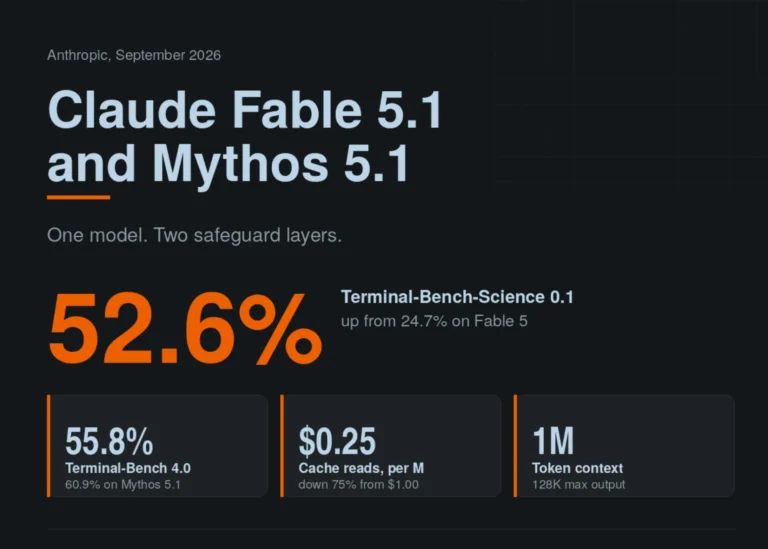
However, the cost is a significant factor. Pricing for both Fable 5 and Mythos 5 is $10 per million input tokens and $50 per million output tokens, double the rate of Opus 4.8. This price point may deter widespread adoption, especially as many enterprises face growing criticism over AI costs and blown budgets. Advanced models like Opus 4.8 can exacerbate these issues by splitting single requests into multiple tasks, inflating token consumption.
Anthropic expects demand to be high and difficult to predict. Some organisations, such as shopping rewards platform Rakuten, may view the expense as justified. “At the highest effort, Fable reflects on and validates its own work,” Rakuten stated. “For us, that’s what makes highly autonomous operations possible, the extra thinking pays for itself.”
Key takeaways
- Fable 5 is the first publicly accessible version of Anthropic’s Mythos model, offering superior reasoning in engineering and vision tasks but enforcing hard blocks on sensitive domains like biology and cybersecurity.
- Access via subscription is temporary; from 23 June, usage will require paid credits unless the feature is reinstated, and a mandatory 30-day data retention policy applies to all traffic to defend against novel attacks.
- While performance benchmarks show Fable 5 outperforming competitors in complex analysis and coding, the doubled pricing relative to Opus 4.8 poses a significant barrier for cost-sensitive enterprises.