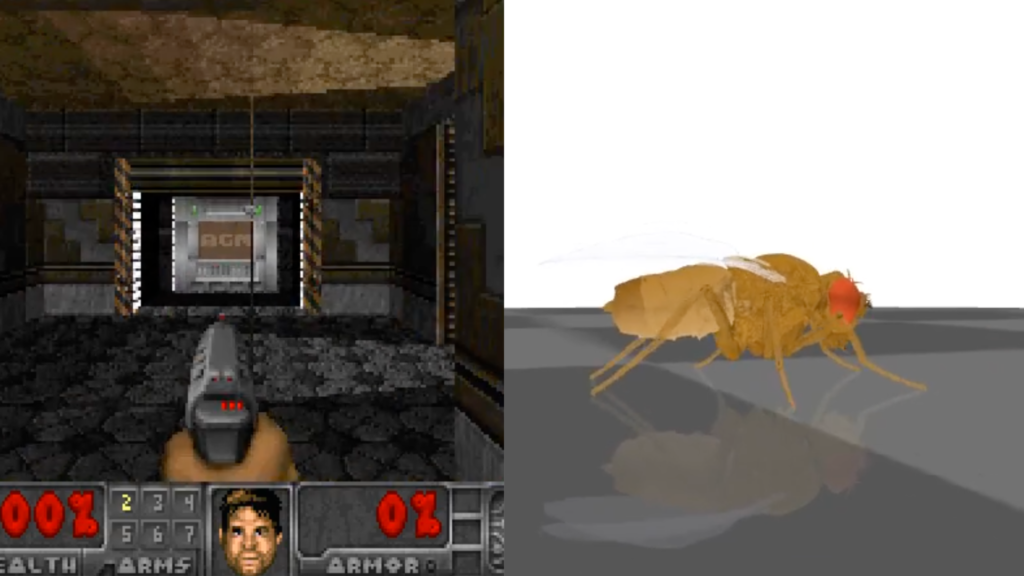
A simulated fruit fly brain is currently trading Bitcoin, parallel parking cars, and playing Minecraft.
The digital model, named MaleCNS v1.0, maps more than 166,000 neurons in the adult male Drosophila nervous system. Researchers at the HHMI Janelia Research Campus and Google Research unveiled the project on September 3, following the release of a female version in 2024.
The science behind the fly
The team described the resource as a finished connectome covering the central brain, optic lobes, and ventral nerve cord. This allows for the first comprehensive synaptic-resolution comparison across sexes of an adult animal with complex anatomy.
Fruit flies are standard model organisms because they reproduce quickly and adapt easily to different environments. By recreating their brains virtually, scientists hope to make progress in neuroscience, pharmacology, biotechnology, and artificial intelligence.
Why the internet is obsessed
Evan Sinclair Smith, a graduate student in computer science at Georgia Tech, started the online trend by programming the fly to play Minecraft. He posted the results on September 4, and the video quickly accumulated millions of views.
Smith told 404 Media in a call that he was surprised by how quickly the project grew. “It’s just been amazing how big this has gotten, and how many other people are just taking this idea and just making so many different creative projects,” he said.
Other users have adapted the model for different tasks. One programmer trained the fly to trade Bitcoin, creating a persona known as “stonkfly”. Another researcher, Nico Christie, programmed the fly to be attracted to other males, dubbing it “bi fly”. Christie noted in an email that he found the trend funny but hoped to make the science behind it more rigorous.
Peter Wang, a researcher who studies brain function, highlighted a specific technical finding. He identified a group of neurons that allow the fly to navigate using fast synaptic weight updates rather than neural activations. Wang noted this is a form of fast-weight continual learning that current large language models do not possess.
What it means for creators and researchers
While the digital fly has generated giddy online content, it remains a tool for the scientific community. The female connectome, called FlyWire, has already supported studies on motor control and sensory systems. Having both male and female maps now lets researchers assess differences in the neural wirings of this sexually dimorphic species.
Smith hopes these models will eventually lead to connectomes of the full human brain. The human brain contains 86 billion neurons, making a digital copy of that scale an enormous undertaking compared to the fruit fly model.
Smith speculates that such an achievement could open new approaches to treating brain disorders like Alzheimer’s disease or enable human intelligence to navigate space missions without relying on physical bodies.
“I think it has so many implications for understanding ourselves,” Smith said.