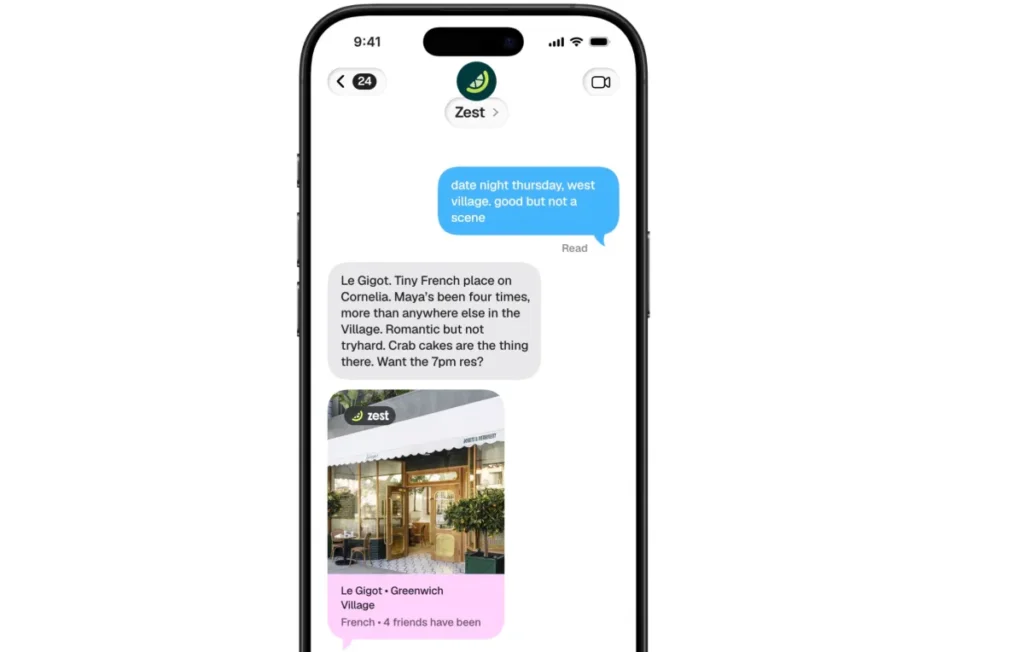
Zest, the restaurant discovery app launched earlier this year, has introduced a new feature on Thursday: a personal AI-powered “restaurant concierge” that operates within text messages. This tool functions similarly to other popular AI agents like Instinct or Poke, allowing users to find restaurants and book reservations without opening a separate mobile application.
The move reflects a broader trend where conversational AI agents are taking over tasks previously handled by standalone apps. For Zest, this means bringing its recommendations directly into text threads and enabling immediate table bookings.
The product is the agent
“The agent is the product now,” says Zest founder and CEO Mario Gomez-Hall. “You text it, and it answers from your own history and your friends’. It doesn’t need weeks of conversation to learn you because it starts from where you’ve actually been,” he added.
Founded in November 2024, the app received $1.8 million in pre-seed funding from Alexis Ohanian at 776 and Steve Jang at Kindred Ventures. Its core function links with users’ credit cards to track dining habits and identify tastes. With this data, Zest suggests places to try in the user’s city or recommends options for travel.
How the data works
Zest imports credit card data via Plaid, a financial services company used by banks and budgeting apps. The company states it focuses only on transactions in the food and drink categories to build its personalized maps and lists.
Booking and group planning
The startup addresses the question of where to eat by making suggestions inside a text message thread. It uses AI to check availability and make reservations through connected services like OpenTable, Resy, and SevenRooms.
To access the service, users text the Zest concierge at (212) 470-6067. A key advantage is that Zest can be added to a group chat. In this setting, it blends everyone’s tastes to find places the whole group will like. The tool also includes an in-thread voting feature to settle indecision and can book a table for the group without leaving the conversation.
Users can request recommendations based on cuisine, cravings, occasion, dietary restrictions, or neighborhood. They can also ask specific questions about a venue, such as current busyness or Wi-Fi availability. Additionally, the concierge can send a menu to help with the decision.
Testing results
In TechCrunch’s tests, the AI performed fairly well. It offered lists of suggestions for new places matched to our tastes while fitting specific conditions like time of day, party size, and location. While other apps have offered table availability for years, there is a convenience factor in being able to text back and forth about options and receive available booking times.
The company began testing the concierge last month but delayed the launch until booking capabilities were added. Over time, the startup is considering expanding Zest beyond restaurants to offer recommendations for businesses and shopping.
By shifting to texts, Zest hopes to scale beyond its initial thousands of users and generate revenue.
“Booking and ordering are the first revenue lines. Zest books your table through OpenTable or Resy today, with food ordering coming, and there are transactions there to participate in,” Gomez-Hall said. “The reason that gets interesting is that Zest learns your taste faster than a general assistant does, because it starts from where you’ve actually been instead of asking you questions. That’s worth something well beyond dinner,” he added.