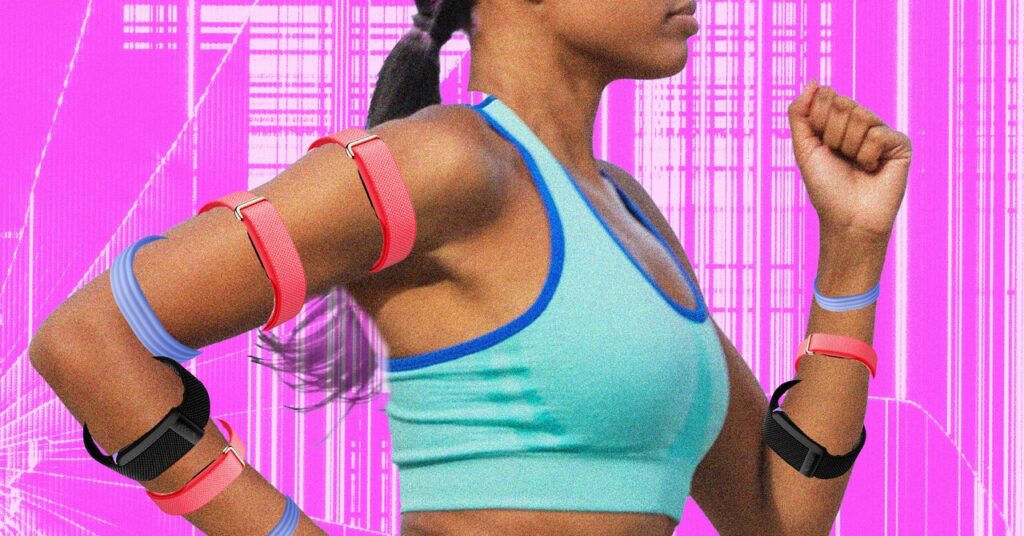
A new class of gadget is arriving on shelves that you are expected to ignore ninety-nine percent of the time. These are screen-free wearables that demand attention only when their battery is low. You will rarely look at them or touch them, yet they collect health statistics day and night for you to view later in an app, whenever you find the time.
Interest in these devices is growing rapidly, with more models expected to launch in the coming months. The promise is that they will require less of your attention once you own one. Current options include the Garmin Cirqa, Google Fitbit Air, Polar Loop, the Amazfit Helio Strap, and the Whoop series, which pioneered the category. Apple is reportedly considering its own version of the concept, according to Bloomberg. The reason for this shift is simple: many people are tired of technology that hoards their attention and realises it is doing them no good.
I have reviewed wearables since they became mainstream with the early Fitbit models in 2009. This new generation feels like a return to those days. When I used the Fitbit Ultra, a 2011 tracker that clipped to jeans, I paid so little attention to it that two days passed before I realised I had lost it on the streets of Zagreb, Croatia. While I fell for the sub-Tamagotchi cartoon faces on the 2012 Fitbit Zip’s screen, that device was never meant to be checked more than a couple of times a day, much like the Fitbit Air.
Over the last few years, however, I have referred to a Garmin, Samsung, Fitbit, or Coros dozens or hundreds of times a day. Messages and emails buzz on their little screens and my wrist reflexively raises to see what is up. When I wear a Garmin watch, I am lulled into the rhythm of checking evening and morning reports, and I look at my sleep score as soon as I wake up. We should not even discuss move alerts, an eye-rolling nag that wearables have had for years.
What Wearables Have Become
Part of the selling point for these new devices is that they are, in some ways, the opposite of what other watches have grown into. Fitness watches are more like smartwatches than ever. OLED screens are now common even on health trackers. Hardcore running wearables let you communicate with AI assistants. This is happening even though smartwatches have never really fulfilled the original promise of a life-changing app or feature beyond what people used the first Apple Watch for back in 2015: not much.
Apple Watches may have saved a life or two, but that is not necessarily what you are buying them for. I waited years to report on smartwatch apps that would change things and instead saw entire wearable app ecosystems wither like neglected houseplants. Screen-free wearables want to hit reset on the entire category.
The most interesting factor is not that bands like the Fitbit Air exist now, but why this is happening in 2026. These wearables are largely a case of design subtraction. They are much like a normal fitness tracker with a heart rate sensor, battery, accelerometer, Bluetooth transmitter, and whatever other sensors are packed in, but with the display excised.
Whoop has made screen-free wearables since its first proper release in 2015, but the shift in what Whoop considers itself to be about mirrors the change we see in the wider market. Today a Whoop band is made for just about anyone with the spare cash to pay for its $199 annual subscription. It is a system to help you improve how you sleep, train, and feel, starting day one. This could not be further removed from the self-serious way Whoop described itself in 2015, as a performance optimization system exclusively designed for elite athletes and teams. What a change a decade makes.
Even if Whoop has always been grounded in the now-common concept of training readiness, things have altered drastically. While it is tempting to say Google’s Fitbit is playing catch-up with Whoop, that is not quite it. It has homed in on the low-distraction lifestyle selling point just as the other bigger tech companies have.
On at least three fronts this can be attributed to AI, to some extent.
AI as the Good and Bad Guy
AI is a way for these wearable companies to upsell and make money, and on the other side, a major contributor to why a lot of us feel like we need low-distraction tech these days in the first place. While virtually every Whoop rival says it can be used without a subscription, some of these companies lean heavily on AI as an upsell.
Take Google and the Fitbit Air. Without a subscription, the app looks cute enough but is fairly spare. You get stats and charts, but if you want chatty explainers of what any of it means, you need Google Health Premium at $10 a month. Numbers and graph lines become paragraphs that reference specific quirks or events of the day because, to steal a line from humorist and podcaster John Hodgman, specificity is the soul of narrative.
And this is just the beginning. The use of AI in monitoring and guiding health and wellness is still at the early stage of development but will likely become significantly more advanced as AI matures, says Peter Richardson, vice president and cofounder of Counterpoint Research.
I find Google Fitbit’s chatbot ramblings quite annoying, with not-that-rare dips into the condescending, and I may even prefer the subscription-free experience. But my job has pushed me through the unenviable task of learning what VO2 Max actually means, what heart-rate variability trends indicate, and so on: not the norm.
AI could solve that long-standing issue with wearables—people glazing over data as soon as they see anything more than their daily step count. This AI use will be better represented on the phone than the watch screen, too, making the lack of screen a strength. It lets the AI shine.
Technostress
The most important influence of AI here is on the other side of the equation, though, as just the latest stage in the tech-ification of our daily lives. I have heard from multiple friends about how their recent work appraisals focused on higher-ups demanding greater AI use within their personal workflow. Perhaps you have had a similar experience.
Elizabeth Marsh, a doctoral researcher at the University of Nottingham who studies the dark side of the digital workplace, finds that digital tools consistently trigger a familiar cluster of harms: technostress, information overload, constant interruption, and blurred work–home boundaries.
These appear to have become the predictable by-product of environments where the volume and pace of digital demand has risen faster than people’s capacity to absorb it, Marsh tells WIRED, noting that information overload and FOMO correlate strongly with lower well-being and higher strain.
It is a good argument for not having notifications and alerts pop up on your wrist, phone, and work PC, and wherever else your to-do list of responsibilities takes on a digital form.
Participants described them in visceral terms, one said the notifications make me feel sometimes on edge and it does make me feel anxious and it affects my mental health, another described feeling angry at the sender for taking their time, while simultaneously feeling bad for not replying immediately, Marsh says about her study on digital workplace technology intensity.
But she found simply cutting off notifications was not necessarily a solution either, as people worried they would miss something. Screen-free wearables are a parallel development to this kind of tech cold turkey of banishing wearables from your wrist entirely. You can still get your sleep scores and step count, but without it being advertised consciously through the day. With a Garmin Cirqa, you can even see maps of runs and walks without ever having tapped a start workout button. Nothing needs to buzz away or, at a simpler level, require the daily charge coddling of an Apple Watch.
This is perhaps the key. So many tech companies are making these low-distraction wearables because so many of us are close to wanting to opt out altogether, at least in the areas of tech in which we can.
Digital Mindfulness
Marsh’s suggested strategy for dealing with tech strain is what she calls digital mindfulness, which is all about having an awareness of how you engage with technology, rather than operating on autopilot. That mindless social media feed scrolling? In most cases, you won’t convince anyone that is a digitally mindful practice. Marsh says it involves three things.
Intention, having a clear purpose for picking up the device in the first place, rather than reaching for it reflexively and then wondering where twenty minutes went. Attention, staying with what you’ve chosen to do and resisting the pull of whatever else is competing for your attention. And attitude, responding to yourself with a bit of kindness and patience when it goes wrong, as self-criticism about our own tech habits tends to make the relationship worse rather than better.
Buying a screen-free tracker like a Fitbit Air is not digital mindfulness in itself. But it is more intuitively compatible with adopting that mindset than a notification-spewing, buzzing smartwatch.