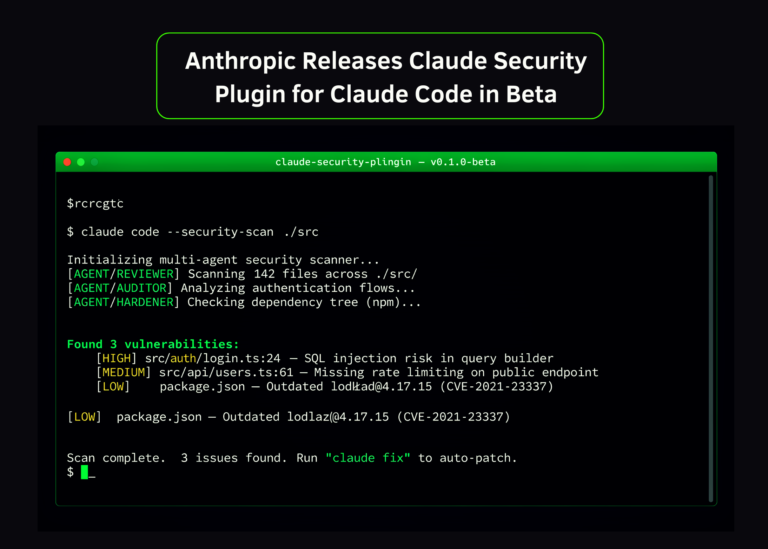
Anthropic has launched OSS Scanner, a free tool that runs its strongest models against open-source codebases to find vulnerabilities. The service, powered by Claude Mythos and other Frontier Red Team agents, sends reports directly to maintainers without human review. Just 11 days after the October 8 launch, the tool reported 77 critical and 803 high-severity findings.
Scale and accuracy
As of October 19, 114 projects had accepted the scanner from roughly 650 applications. The system runs on Anthropic’s infrastructure. Maintainers must provide a Dockerfile, and audits execute inside isolated virtual machines with no internet access.
Anthropic states that 85 of the 97 critical and high-severity findings it audited met its disclosure bar. Only one of those 97 was a false positive. The wolfSSL project reported that 72 of its 74 reports were valid.
There are downsides to the automated approach. Because there is no human review before delivery, some reports duplicated known issues. Eleven of the 97 audited findings were duplicates. Maintainers have noted that the scanner sometimes inflates severity ratings.
How the system works
Core maintainers join by opening a pull request on the anthropics/oss-scanner repository. This adds a projects/<project>/project.yaml file based on the project template.
- Required fields:
repo,primary_contact, and a Dockerfile path. - Optional fields:
threat_model,pgpfor encrypted reports,auto_ccs,homepage, anddisabled.
The Dockerfile builds the project with network access. The virtual machine then moves to a network without internet for the audit. Agents in the pipeline double-check bugs, run root cause analysis and propose patches.
Each report contains a self-contained reproducer and an explanation of the bug. Where possible, it includes a bisection to the commit that introduced it. A candidate patch is attached when available.
An optional threat_model.md defines adversarial inputs, out-of-scope code and a severity rubric. Without it, the scanner guesses.
Performance and results
Anthropic asked its penetration testers to check 97 critical and high findings across 48 projects.
- 85 (88%) met the bar for Anthropic’s coordinated vulnerability disclosure process.
- 11 were real but duplicated known issues or other scan findings.
- 1 was invalid.
Maintainer data supports these figures. wolfSSL received 74 reports; all but 2 were valid, and 5 became CVEs. The curl project patched CVE-2026-92392, a High-severity HTTP/2 upload use-after-free. It affects curl 8.12.0 to 8.22.0 and is fixed in 8.23.0, released October 14, 2026.
Anthropic links the timing to benchmark progress. On CyberGym, large language models went from finding under 20% of vulnerabilities to over 85%. Its broader CVD dashboard lists 6,157 disclosed vulnerabilities across 591 projects, as of October 2. 516 of those are patched.
Comparison with other tools
The table below compares Anthropic OSS Scanner with Google OSS-Fuzz, OpenAI Codex for OSS, and Google DeepMind CodeMender.
| Feature | Anthropic OSS Scanner | Google OSS-Fuzz | OpenAI Codex for OSS | Google DeepMind CodeMender |
|---|---|---|---|---|
| Approach | LLM agents (Claude Mythos and others) audit source | Fuzzing: libFuzzer, AFL++, Honggfuzz plus sanitizers | Codex Security agent, run by approved maintainers | Gemini Deep Think agent finds and patches bugs |
| Cost to maintainers | Free; Anthropic covers full cost | Free | Approved maintainers get ChatGPT Pro, API credits, conditional Codex Security access | Not disclosed |
| Enrollment | PR with project.yaml and Dockerfile | PR with project files to google/oss-fuzz | Application, reviewed by OpenAI | Not disclosed (research project) |
| Human review before maintainer sees it | No | Not disclosed | Maintainer runs and reviews scans | Yes, every patch before upstream |
| Report contents | Reproducer, explanation, bisection, candidate patch | Crash reports with reproducers | Findings with validation and patches | Patches submitted upstream |
| Disclosure deadline | None on unvalidated findings | 90 days or fix release, plus 14-day grace | Not disclosed | Not disclosed |
| Published track record | 77 critical + 803 high model-rated findings in 11 days | 13,000+ vulnerabilities, 50,000 bugs, 1,000 projects (May 2025) | 14 CVEs in OSS projects | 72 security fixes upstreamed (Oct 2025) |
| Precision data | 88% of 97 audited critical/high valid | Not disclosed | False positives cut by 50%+ in beta | Not disclosed |
Sources: OSS-Fuzz disclosure guidelines, OpenAI Codex Security, DeepMind CodeMender.
What changes for maintainers
Projects that accept the scanner receive automated audits at no cost. The trade-off is that teams must handle triage immediately. There is no 90-day deadline for unvalidated findings. The scanner does not affect customer products, accounts, privacy, or API behaviour.