For years, the tech world has treated Apple as the laggard in the artificial intelligence sprint. Critics have long claimed that the absence of a defined roadmap has eroded its competitive advantage, while Wall Street fretted that this lag might eventually dent iPhone revenue.
Now, the Cupertino giant has unveiled what it describes as its most significant AI push to date: a revamped Siri. This update embeds new automated functions, powered by a collaboration with Google Gemini, directly into the core of its operating system.
Is this sufficient to silence the narrative that Apple is falling behind?
To be frank, no one can say for certain. However, the question itself might be flawed. A more pertinent inquiry is whether users will actually adopt these capabilities, and if they do, whether it translates into tangible business growth for Apple.
Before addressing that, it is worth noting a telling remark from Craig Federighi, Apple’s senior vice president of software engineering, made during Monday’s event.
“Some appear to be racing forward, seemingly pursuing AI for the sake of AI, without clear regard for the people, all of us, that it’s ultimately meant to serve,” Federighi stated. “At Apple, our mission has always been to turn the potential of advanced technology into helpful and intuitive products for everyone.”
This subtle defiance serves a dual purpose: it acts as a rebuttal to the “behind on AI” criticism while acknowledging the deep ambivalence, and according to some polls, growing negativity, that many consumers feel toward the AI sector. It is also a shrewd positioning move at a time when Americans are anxious about AI stealing jobs and dulling intellects. Apple is framing itself as the tech company that is genuinely on your side.
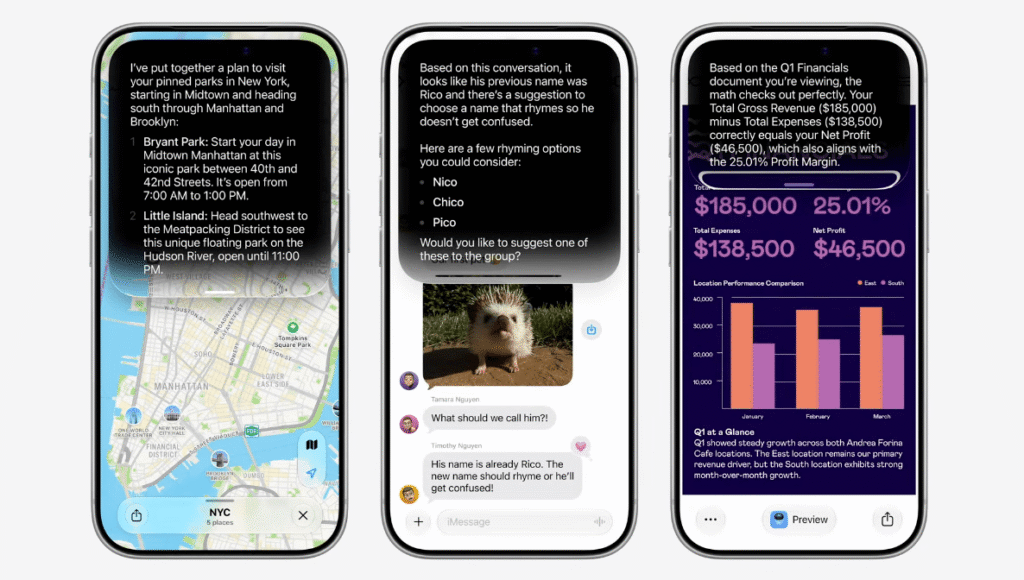
The demonstrations from Monday suggest this positioning has some weight. Siri can now retrieve information buried in your inbox or text history, offering relevant suggestions based on that context. It utilises what Apple terms onscreen awareness to provide context about what you are viewing. Furthermore, leveraging Gemini, it can fetch near-instantaneous, up-to-date information from the web and deliver it straight to your device.
Siri is also engineered to operate seamlessly across the Apple ecosystem, granting users greater flexibility. Like other AI chatbots, it retains conversation histories, allowing users to revisit past chats.
By integrating AI capabilities into its disembodied assistant, Apple has the potential to undermine competitors whose apps rely solely on the App Store for distribution. For those rivals, having Apple’s AI embedded at the operating system level represents a significant threat to their distribution advantage.
The crucial caveat is that this version of Siri will not reach consumers until later this year, initially as a beta.
A final judgment must wait, but it is evident that Apple is courting its audience, regardless of whether they embrace the features. As a hardware company, these updates are designed to make devices incrementally more user-friendly and convenient, encouraging users to keep their hardware for a bit longer.
The contrast with rivals is instructive and perhaps the most critical signal regarding where the industry is heading. Consider OpenAI; despite shipping updates at a relentless pace, it has struggled to define its target market, oscillating between consumers and enterprises. Or Meta, which is pouring enormous sums into AI without a clear explanation of how it connects to its core advertising business.
Apple’s more measured approach is starting to look optimal by comparison, and more financially prudent. For the most part, Apple has not needed a high-octane AI strategy. It posted record iPhone sales last quarter. As questions mount over AI’s profitability and real-world utility, Apple is spending significantly less than its competitors, roughly $14 billion in capital expenditure planned for this year, against a cumulative $900 billion committed by other tech giants, while still generating massive revenue. That revenue has partly come from the AI industry itself via taxes on AI companies utilising its App Store to distribute their apps.
In short, Apple is spending less, making more, and has launched a suite of AI features that, for many iPhone users, will feel indistinguishable from other AI applications available through the App Store. If that does not exactly count as “winning the AI race,” it may be the smartest way to run it.
Key takeaways
- Apple is repositioning itself as the consumer-focused alternative to competitors who prioritise speed and scale over utility.
- By integrating AI at the OS level, Apple threatens the distribution advantages of apps that rely solely on the App Store.
- Financially, Apple is outspending rivals on AI by a massive margin, spending roughly $14 billion against $900 billion from competitors.
- While the full impact remains to be seen, Apple’s strategy focuses on retaining hardware users rather than chasing abstract AI dominance.