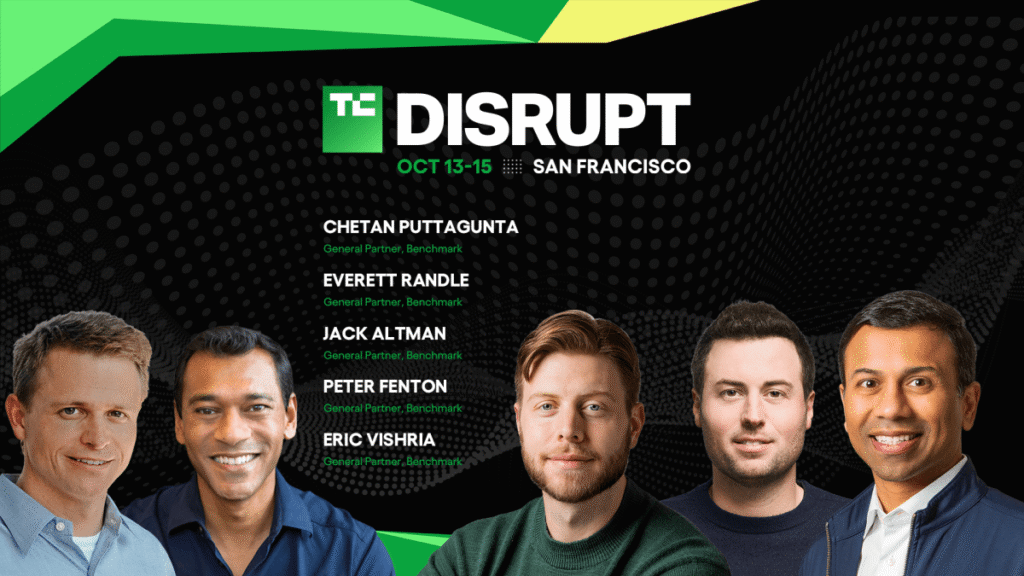
TechCrunch Disrupt 2026 will feature a main stage session titled “What We Believe Now” where five general partners from Benchmark Capital appear together for the first time. Jack Altman, Peter Fenton, Chetan Puttagunta, Everett Randle, and Eric Vishria will discuss the next generation of startups and which assumptions founders should reconsider. The event takes place in San Francisco.
Benchmark has altered its strategy this year by raising approximately $2 billion across a $750 million flagship fund and a new $1.25 billion growth fund. The firm is now asking what the market will do next.
Capital is available but conviction is scarce
The artificial intelligence sector absorbed 61% of global venture capital investment in 2025, representing $258.7 billion of the $427.1 billion invested overall. The OECD reports these figures. However, deals worth more than $100 million accounted for roughly 73% of that total AI investment value. This concentration creates a difficult environment for founders.
There is strong appetite for technology businesses, yet competition is intense for the few companies investors believe can become category leaders. The question remains whether the next billion-dollar company will be another AI application or if the application layer is already overcrowded. Defensibility might sit in models, infrastructure, proprietary data, or distribution. Some of the best businesses could be overlooked because everyone is chasing the same themes. When founders can build products faster than ever, it is unclear what actually makes one company investable.
Complete agreement among the five investors onstage is unlikely. That is the point of the discussion. Hear this complex conversation on the Disrupt Stage.
Five investors with different backgrounds
The Benchmark partnership combines experience from founding companies, backing enterprise software, investing in frontier technology, and helping businesses navigate IPOs and acquisitions.
Jack Altman joined Benchmark this year after founding Lattice and subsequently building his own venture firm, Alt Capital. Before joining Benchmark, Alt Capital had raised $425 million across its early-stage investing activities. His path gives the discussion an unusually direct founder-to-investor perspective.
Peter Fenton brings one of venture capital’s longest track records. His investments span consumer and enterprise companies, including current AI bets such as Sierra, Digits and Sema4.ai. He has served as a director through seven successful IPOs, including Twitter, Elastic, New Relic, Zendesk and Yelp.
Chetan Puttagunta focuses on early-stage enterprise software and has backed companies including MongoDB, MuleSoft, Elastic, Modern Treasury, Legora and Stytch.
Everett Randle brings experience investing across stages and categories, with investments that include Anthropic, SpaceX, Rippling, Flock Safety, Gumloop and Chainguard.
Eric Vishria focuses on early-stage infrastructure and enterprise software, with investments including Amplitude, Confluent, Fireworks.ai and Cerebras Systems. Before becoming an investor, he was himself a startup CEO, co-founding RockMelt before its acquisition by Yahoo.
Combining these perspectives makes the session less about a single Benchmark thesis and more about how experienced investors disagree, update their assumptions, and decide where conviction is warranted.
Opportunities sometimes look like bad meetings
Cerebras serves as a useful example. Vishria recently told TechCrunch that he almost did not take his first meeting with the AI chip startup in 2016. Hardware was outside Benchmark’s comfort zone, and what Cerebras wanted to build looked extraordinarily difficult.
By the third slide, he had changed his mind. Benchmark went on to co-lead the company’s $25 million Series A. A decade later, Cerebras went public, with Benchmark holding a 9.5% stake at the IPO.
That story encapsulates something important about venture investing. The best opportunity does not always arrive looking like the consensus winner. Sometimes it challenges the investor’s existing thesis. Sometimes the technology is too early. Sometimes the market does not obviously exist yet. And sometimes knowing when to change your mind is more valuable than being right from the beginning. Expect that kind of thinking to surface on the Disrupt Stage.
Founders should prepare to disagree
For founders, there may be no more useful part of the session than hearing what Benchmark believes entrepreneurs are currently misreading. Not because Benchmark is automatically right, but because understanding how sophisticated investors assess markets, teams, and opportunities gives founders another way to interrogate their own assumptions.
Investors can compare those frameworks with their own. Leaders can see which shifts venture firms believe are durable enough to shape the companies they work for – and where capital may flow next. For students, aspiring founders, and anyone simply trying to understand where technology is heading, it is a rare opportunity to hear five investors with very different experiences work through their ideas in the same room.
And those ideas matter well beyond the venture industry. Investment decisions are ultimately bets about which technologies, business models, and founders have the potential to shape the next decade.
Decide at TechCrunch Disrupt 2026
A lot can change in the world of tech in twelve months. AI capabilities move. Markets emerge. Categories disappear. Companies that looked inevitable suddenly do not, while businesses few people were watching break through. Having a thesis matters. Knowing when to update it matters more.
Join Jack Altman, Peter Fenton, Chetan Puttagunta, Everett Randle and Eric Vishria on the Disrupt Stage and hear what Benchmark believes now – and what might convince them to change their minds next.
Disrupt 2026 returns to San Francisco’s Moscone West, October 13–15, bringing together more than 10,000 founders, investors, operators and innovators across six stages, roundtables, breakouts, Startup Battlefield, the Expo Hall, and more.
The next great company may already be being built. Find out where some of Silicon Valley’s most experienced investors are looking for it at TechCrunch Disrupt 2026.
What it means
For creators and developers, the focus shifts from chasing every new AI tool to identifying specific, defensible advantages in distribution or proprietary data. The session highlights that the best ideas often challenge current thinking rather than confirm it. Investors are looking for businesses that can survive a crowded application layer, suggesting that building a product faster is not enough without a clear path to market dominance.