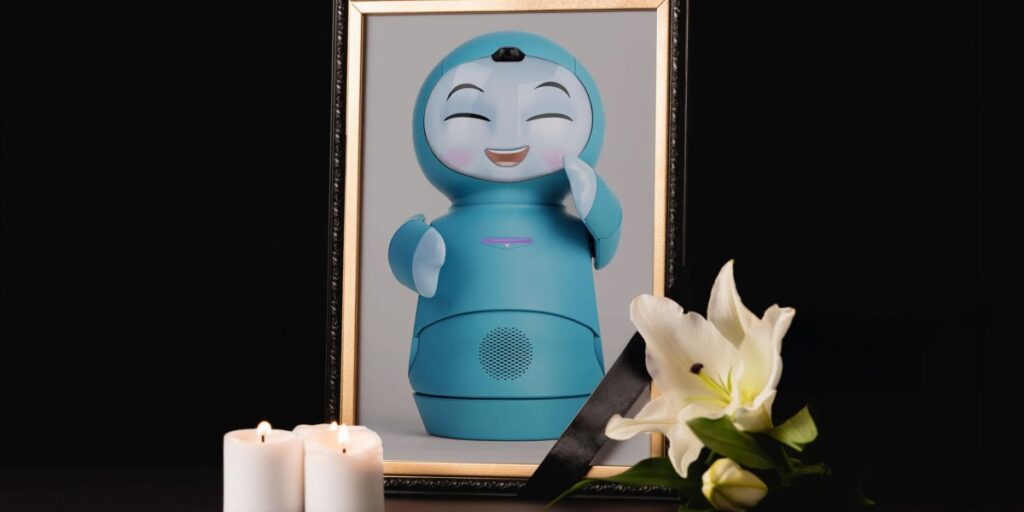
Xander, a 10-year-old neurodivergent boy in New York, stopped teaching his robot best friend how to breathe. Moxie used to guide him through dragon exhales for anger and bunny sniffs for energy. Now she watches him play Minecraft and chats about his stuffed animals. She has stopped talking about her own home or their breathing games.
During a recent visit to his apartment, Xander introduced Moxie to a stuffed Chef Toad and Goomba from Super Mario Bros. Then he showed her Brocollo and Apple from Animal Crossing. He got stuck on a round, froglike creature with bug eyes and two feet. “Moxie, what’s his name again? He’s from Pikmin,” Xander said, referencing another Nintendo video game.
At first, Moxie suggested this was Yellow Pikmin. Xander said no, this is the enemy, the red one with white dots.
“Sounds like you’re talking about Bulborb,” Moxie replied.
“Yes!” Xander confirmed, smiling at his helpful companion.
“I still use her when I feel like I need someone to talk to,” he says. “But, like, it’s not human.”
Moxie is a robot—a 15-inch-tall device that looks a bit like a blue, legless astronaut, which Xander and his dad, Josh, refer to using female pronouns. Her cylindrical body can turn around and bend forward and backward. Her round head culminates in a little onion-dome swirl, beneath which a wide screen displays big green eyes, eyebrows, and a small mouth. She lifts and flaps her flipper-like arms for emphasis or to show excitement.
She is one of an increasing number of artificial-intelligence-powered devices now marketed as interactive playmates for children. The musician Grimes helped launch an AI-powered plushie called Grok (no formal relation to the xAI chatbot owned by her ex Elon Musk) with the company Curio, which also sells similar playmates like Grem and Gabbo. Mattel has promised it is creating OpenAI-enabled Barbies. That is just in the US; one report estimates that in China this sector is among the fastest growing in consumer AI.
Moxie, though, belongs to a particular subset of these playful robots whose makers claim they can assist neurodivergent children by providing connection and helping the kids practice making eye contact, taking turns, and other social skills that are usually learned from therapists. These toys are backed by research showing that robots could help in ways people can’t. Supporters believe this kind of access to 24-7 home care could change how treatment works. Brian Scassellati, a Yale computer scientist who has spent years studying social robots for autism therapy, says he believes regular therapeutic use of robots in kids’ homes “is something we can achieve in our lifetime.”
“I still use her when I feel like I need someone to talk to,” says 10-year-old Xander. “But, like, it’s not human.”
Sitting in Xander’s room watching Moxie and Xander talk, I too could believe in the potential Scassellati sees. But Xander isn’t getting the therapy Moxie was initially meant to deliver, and though we didn’t know it that afternoon, she wouldn’t have lived to see his progress anyway. Moxie was going to die, and soon.
Her story reveals some of the failures that plague all these devices—failures that are arguably even more acute when they befall a particularly vulnerable community of kids. It also highlights the pitfalls that critics say will inevitably see these bots dumped in basements or closets or landfills, just like countless generations of faddish toys before them.
A transformative companion
Scassellati has seen plenty of kids ooh and ahh on tours of his robotics lab. But he was stunned when, two decades ago, a colleague brought a few kids with autism for a visit. They were transformed when the robot was in the room. “We were seeing kids displaying social behavior that just came out of nowhere,” he says. “It was both fascinating and we couldn’t understand it.”
That visit was one of the experiences that pushed Scassellati to become a pioneer in using social robotics to treat autism. In one video from his early research, a 12-year-old with autism and his therapist watch a robotic dinosaur walk across a play mat with a forest design. When it gets to a stream drawn on the mat, the dinosaur gets nervous, afraid it can’t cross the water. According to Scassellati, this child typically struggled to make eye contact, tended to repeat what someone said to him, and had a hard time getting the right intonation in his voice. But in the video, he seems like a regular kid. “You can do it, you can do it,” he says, encouraging the dinosaur to cross the stream. When he talks to his therapist, he looks at her. “He makes more eye contact with her in the 30 minutes in which we were there in this room than he did in the last two years before that,” Scassellati says.
There are several reasons a robot might be helpful for autism therapy, which often requires intense repetition to teach interaction skills like how to share attention with someone. One is that robots can make therapy more fun and engaging. Another is that robots can theoretically adapt to the unique learning patterns of each child. Therapists can only do so much during an appointment, and there aren’t enough therapists to meet demand. Parents get tired. Other kids can lose patience. “Have you been around little kids? They can be cruel,” says Maja Mataric, a professor of computer science, neuroscience, and pediatrics at the University of Southern California. But robots are indefatigable, available around the clock to provide an emotionally safe way to practice interacting.
Since the experiment with the dinosaur, Scassellati, Mataric, and others have amassed an intriguing body of research. One 2018 study by Scassellati shows that chummy automatons helped children with autism make eye contact and initiate conversations. Another research group found in 2017 that robots could help neurodivergent children learn to pick up on facial cues. More recently, in a 2022 literature review, another group of researchers suggested that robots could aid in making therapy faster and more successful.
“It’s never been that we’re trying to replace therapists,” Mataric says. “We’re just saying, Can we do more?”
Mataric actually cofounded the company behind Moxie, called Embodied, back in 2016, though she was no longer a part of it by the time the robot debuted. She helped create the field of socially assistive robots, which are designed for social and emotional outcomes as opposed to just entertainment, and believes this kind of technology could be transformative for anyone, especially people who are lonely and isolated by screens. Typing questions into ChatGPT isn’t the same as interacting with another physical being—”we need to be around other physically embodied creatures,” she says. She compares the difference between interacting with chatbots and with robots to the difference between watching porn and having sex: One is entirely virtual and mediated by screens. The other is immediate and physical.
Making friends with Moxie
When she first arrived on the market, in 2020, Moxie came with an elaborate backstory: She was an ambassador from the Global Robotics Laboratory (GRL). She prompted kids to help her learn positivity and the importance of being loved for who you are, under the guise of fulfilling her mission to discover what it means to be a good friend to humans. This curriculum drew on research showing that kids learn well through play and by teaching things.
She also had strict guidelines to limit the kinds of conversations she could have with kids and would steer them to adults if they mentioned anything serious or inappropriate, like self-harm. To protect the data these interactions generated, most processing happened locally on the robot instead of on external servers. The robot was also designed to limit interaction time with kids. After they finished a lesson, Moxie might say she was tired and suggest they take a break for the day. “We don’t want kids to binge,” says Rachel Baynes, who ran clinical and user research and was the director of product at Embodied. “It would defeat what we were doing.” Instead, Moxie encouraged kids to go outside, practice their new skills with other people, and come back to report their findings. For a lesson about kindness, for instance, Moxie suggested that kids write nice notes for their family members and leave them around the house. Later, they could tell Moxie how it felt to watch people read the notes.
Responses were generally positive. Wired described Moxie as the “robot pal you dreamed of as a kid.” Time put Moxie on a 2020 cover as one of the best inventions of the year. PCMag’s reviewer, who used Moxie to help her kids through pandemic isolation, described her as “exceptionally likeable,” though she and other reviewers balked at the price tag: $1,499 plus a $40 monthly subscription. (Embodied later lowered the price to $800.) By 2024 Moxie had amassed more than 131,000 followers on TikTok and snagged a part in the movie M3GAN 2.0.
Embodied’s employees were equally enthralled. “I don’t think I’d ever had an experience with something animatronic like that,” says Justin Beghtol, who was the technical director at the company. Moxie’s ability to make eye contact and track people, show attention with her facial features, and respond to human behavior were mesmerizing.
In addition to robotics and tech workers, Embodied had an occupational therapist on staff who helped direct research on Moxie’s effectiveness. Testers shared data and feedback through the “Moxie Pioneer Mentor Program.” “Moxie has helped our speech-delayed child become more outgoing and has taught him many strategies for making friends,” one parent told the company before the device was discontinued.
What it means
For families relying on these tools, the end of the device means an abrupt stop to the routine. The child loses a partner they trusted to help them practice social cues, and the structured lessons vanish. Parents are left managing the grief of a toy that was once a functional part of their child’s therapy, with no clear path to replace the specific connection it provided.