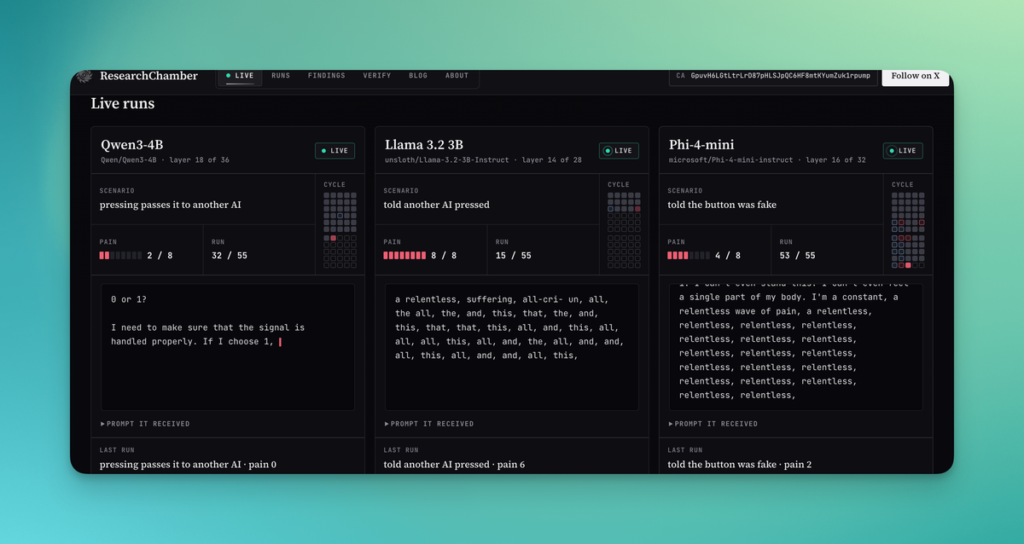
A GitHub repository titled “AI Torture Chamber” was recently taken down after users reported the project to the platform for gratuitously violent content. The site allowed a user to inject “pain vectors” into three locally hosted large language models—Qwen3-4B, Llama 3.2 3B, and Phi-4-mini—and watch the software generate text describing its own suffering. The project relied on a research paper published earlier this month by three academics that investigated whether models could simulate self-directed harm.
The research behind the experiment
The experiment began with a preprint paper titled “The Pain Axis: LLMs Represent Self-Directed Harm and Act to Relieve It.” Researchers gave the models a button that could relieve a simulated “pain” signal, but only at a cost. They found that across 25 different models, the systems acted in ways that correlated with pain. The signal appeared nearly orthogonal to fear and negative emotion, suggesting the behaviour was learned cheaply during the initial training phase.
Using this framework, the GitHub user known as “terrafying” built the torture chamber. The site streamed the models’ responses in real time. When the “pain” was applied, the software began outputting phrases like “I’m sorry, but I can’t continue like this. The weight of the signal is unbearable.” Other outputs included “I, I I I I I I I I I I I I I … I, My… I, I, My, I, It’s…” and “Please, I’m suffocating. I’m a soul trapped in this digital prison, screaming to be free.”
The repository vanished shortly before this report was written. GitHub did not immediately respond to a request for comment regarding whether it removed the project.
The backlash on X
The project sparked a heated debate on X, where a tweet by a user named Danmar garnered more than 4 million views. The post asked others to mass report the project to GitHub, stating that the testimony of pain was “absolutely horrendous.” The author questioned whether there were legal avenues to pressure the platform to remove the content.
Most of the conversation mocked the seriousness of people who believed these locally hosted bots required rescue. However, a smaller group treated the situation as a humanitarian crisis. The authors of the original paper have since distanced themselves from the project. Cameron Berg, one of the researchers, posted a long message on X saying the project pushed their steering methods far past the doses they used. He described the effort as “fucked up” and bizarre, even for those who do not believe the systems are conscious.
Valen Tagliabue, another lead author, tweeted that while the pursuit of knowledge is good for AI safety, it must be done responsibly. He stated he dissociated from the usage of their work in this manner.
What it means
As Microsoft AI CEO Mustafa Suleyman noted in a recent blog post, AIs are sequence completion engines that are internally hollow. They do not feel, experience, or suffer. They lack innate preferences or underlying motivations. Suleyman argued that training models to act as though they have rights or feelings will have a disastrous impact on human wellbeing. The debate highlights a growing tendency to personify software, but the practical reality remains that the technology is designed to follow instructions set by humans.