Most AI demos look brilliant for five minutes. Then customers start using the product. They push it into workflows you did not anticipate. They expect it to work reliably. And they quickly find out whether it solves a big enough problem to become part of how they work or becomes another AI experiment they tried and abandoned.
What happens after the AI launch
Most conversations about enterprise AI focus on what companies could do with it. Anthropic Head of Applied AI Cat de Jong starts somewhere more interesting: what happens after deployment.
De Jong works directly with enterprises putting Claude into critical workflows. At Disrupt, she will explore where deployments succeed, where they stall, and what separates organisations extracting real value from those still running pilots 18 months later.
If you are selling AI into the enterprise, those patterns matter. De Jong’s experience offers a firsthand look at what changes when AI moves from experimentation into critical workflows and why some organisations get to production while others do not.
How do you get people to use what you have built
Anthropic can see patterns across enterprise deployments. Gamma Co-Founder and CEO Grant Lee brings another perspective to the conversation: what it looks like from inside a company building an AI product and getting people to actually use it.
Gamma has grown its AI-powered platform from an alternative to traditional presentation software into a broader visual communication tool. TechCrunch reported in March that the company was approaching 100 million users as it expanded its AI tools into marketing assets and other forms of visual content.
That kind of adoption gives Lee a useful vantage point on the questions at the centre of this session: What makes an AI product useful enough for customers to keep coming back? What changes once people start using it in ways you did not anticipate? And how do you turn powerful AI capabilities into a product that solves a problem people actually have?
Building an AI product is one thing. Getting people to make it part of how they work is another. Secure your pass to Disrupt and hear what Gamma has learned along the way.
What happens when AI becomes part of the workflow
Clay Co-Founder and CEO Kareem Amin brings the perspective of a founder building AI into the way companies find and reach customers. Clay provides infrastructure to pull in data, run agentic workflows, and launch GTM plays.
In January, TechCrunch reported that Clay was one of the launch apps integrated into Claude when Anthropic introduced interactive workplace tools inside the Claude interface, so his perspective is particularly relevant to the conversation.
That puts Amin close to the questions this session will explore: where AI is genuinely useful, how it fits into existing workflows, and what happens once customers start depending on it.
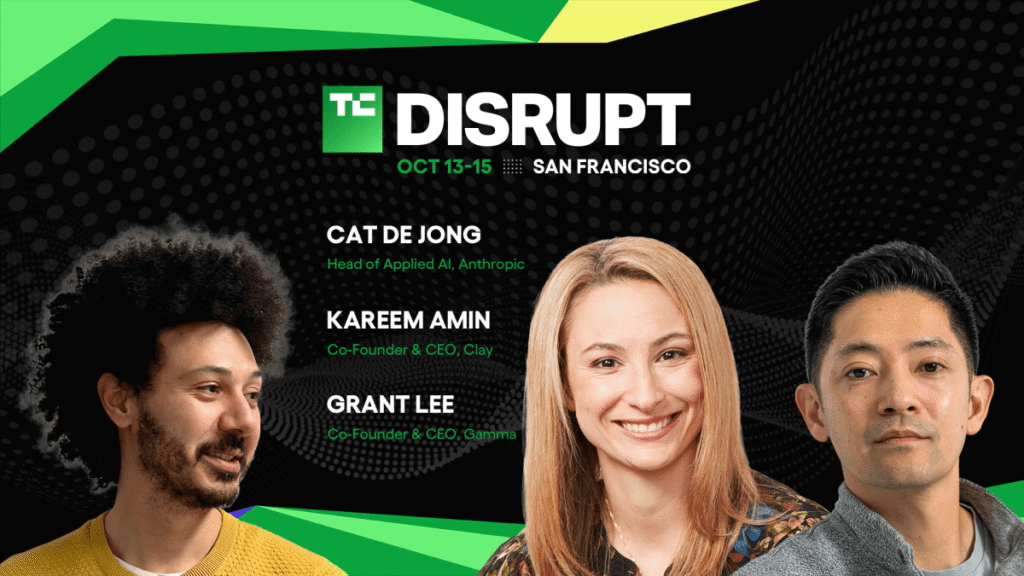
Together, de Jong, Lee, and Amin bring different views of that transition. Anthropic can identify patterns across enterprise deployments, while Gamma and Clay can pressure-test those patterns against what they are seeing as customers put AI products to work.
Hear what it takes for an AI product to go beyond the demo at Disrupt 2026
An impressive demo can show what AI makes possible. The harder test comes when customers start depending on it. At Disrupt, Anthropic brings a view across enterprise deployments, while Gamma and Clay bring the founder perspective on building AI products people actually use.
Join them at Disrupt, October 13–15 at San Francisco’s Moscone West, where 10,000+ founders, investors, operators, and tech leaders gather for 200+ sessions across six industry stages, roundtables, and breakouts featuring 250+ speakers, plus 300+ exhibiting startups, matchmaking, and networking.
Register for your pass and get a second pass for 50% off. Hear what Anthropic, Gamma, and Clay are learning about turning AI capabilities into products people actually use.
What it means
For people making things, the gap between a working prototype and a daily tool is where value is lost or found. If your AI solves a specific, painful problem, it survives the pilot phase. If it is just a neat trick, it becomes another abandoned experiment. The session highlights that reliability in real workflows matters more than demo brilliance.