New data from the DESI survey shows cosmic structures persist over 3.26 billion light years
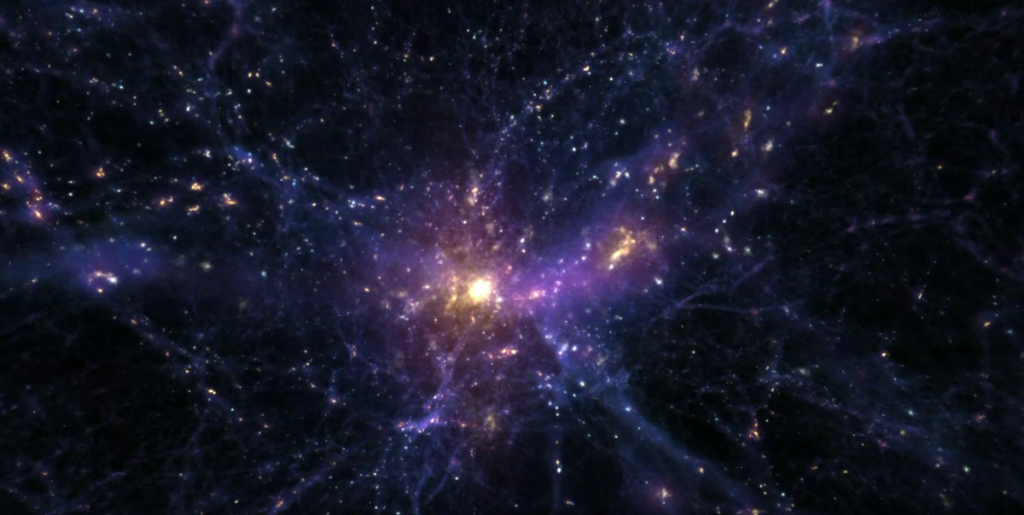
A study published in Nature on Wednesday reports that the cosmic web connects galaxies over distances far larger than the standard model of cosmology allows. The research, led by Francesco Sylos Labini and Marco Galoppo, finds these patterns remain coherent out to at least one gigaparsec. That is a distance equal to 3.26 billion light years.
The Lambda cold dark matter (ΛCDM) model predicts the universe is homogeneous and isotropic on large scales. This means matter should be distributed evenly when viewed from a distance. Small variations exist on scales of thousands or millions of light years, but they should smooth out into a uniform pattern across the cosmic web.
Recent observations suggest galaxies cluster in preferred directions instead. These anisotropies appear even across vast distances. The new analysis confirms these distinct patterns persist to the gigaparsec scale. The authors state this finding signals a need to update modern cosmology.
“The structures observed in the real Universe are significantly larger and more persistent than those formed in state-of-the-art simulations based on the standard model of cosmology,” said Labini and Galoppo in an email to 404 Media.
“The key advance of our analysis is that it allows this difference to be quantified,” they added. “By measuring the spatial extent and coherence of the observed structures and comparing them directly with theoretical predictions, we found that the discrepancy is statistically highly significant. In other words, the largest structures in the real Universe appear to be substantially larger than expected in standard models of galaxy formation.”
The cosmic web emerged from small density fluctuations in the early universe. It gradually developed into large-scale filaments and nodes made of dark matter. These structures gravitationally attract gas, galaxies, and other forms of matter.
Last year, the Dark Energy Spectroscopic Instrument (DESI) released the largest high-resolution 3D map of the universe. The survey operates from Arizona. This data allowed scientists to test theories against observational evidence.
Labini and Galoppo used statistical tools to analyse the DESI release. They applied the Angular Distribution of Pairwise Distances (ADPD). This method is effective for detecting and characterising large-scale anisotropies in the dataset.
“The idea was to try to really test whether the idea that isotropies reached very large scales is now supported by data,” said Galoppo in a follow-up call. “Even just five or ten years ago, we didn’t really have the data to test on gigaparsec scales. But now, we had a chance, so we decided to take it.”
“What we are able to do is to characterise how large are the largest structures inside this sample” of DESI observations, added Labini.
The results show large-scale structures create preferred directions of galaxy distribution. This contrasts with expectations derived from the cosmic microwave background. The oldest light in the universe suggests directional correlations should fade rapidly at large scales.
“In the standard model, it’s not that there aren’t structures,” said Galoppo. “It is just that they are supposed to be smaller and less persistent than what we found. That’s the crux of the matter.”
DESI is expected to release a new batch of observations within a year. Similar datasets will arrive from Europe’s Euclid space telescope and the Vera C. Rubin Observatory in Chile. These new views will help scientists determine the full extent of these large-scale structures and their impact on our understanding of the cosmos.
“At present, there is no simple or widely accepted modification of the ΛCDM framework that naturally explains structures of this size while remaining consistent with the observed uniformity of the cosmic microwave background,” Labini and Galoppo wrote. “That is precisely why these observations are so interesting: they point to a potentially important gap between theory and observation that deserves further investigation.”
“If future surveys continue to find coherent directional structures on even larger scales, the implications for cosmology would be profound,” they concluded.
What it means
Scientists making maps of the universe now have to account for structures that defy current theory. The data suggests our current models underestimate how far the cosmic web stretches. Future surveys will test whether these directional patterns hold up over even greater distances. If they do, physicists may need to revise the fundamental rules describing how the universe formed.