
Figma is expanding its design canvas to handle code, animation, and 3D effects as competitors like Anthropic and OpenAI offer tools that generate interfaces directly.
At its annual conference in San Francisco, the company rolled out updates that turn the workspace into a hub for motion, depth, and AI agents. Figma states that 95 percent of Fortune 500 companies build their products there.
Generating interfaces has become cheap. Human attention has not. Standing out requires going beyond what models trained on average internet content can produce. The new features give designers more tools to do that without giving up control over the result.
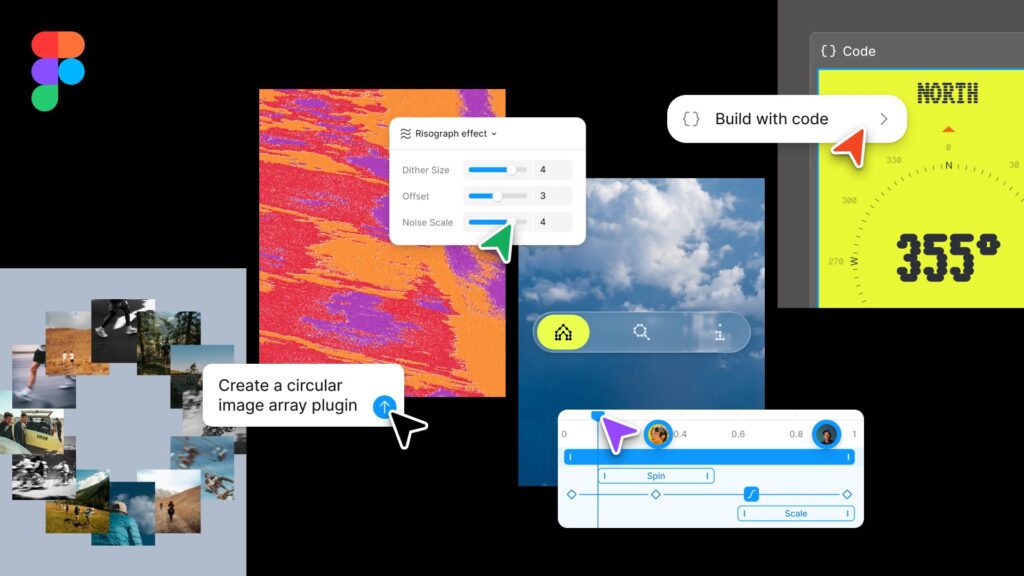
Code, motion, depth, and shaders on a single canvas
It starts with code. Last year, Figma brought code onto the canvas with Figma Make. Now Make pulls in a team’s production code and applies changes through branches, commits, and pull requests, all without a terminal. The feature is rolling out in beta.
With the new Code Layers, design and code live side by side in the same space. Users can generate code from a design, prompt it through an agent, or import a repo from GitHub. From a code layer, they can drag out editable design layers, tweak them directly, and convert them back to code. Figma says the speed matches how designers already iterate through variations with design layers.
Motion is the second element coming to the canvas. Animations, transitions, and timelines that used to require external tools are now part of the design system. They can be edited collaboratively, generated through an agent, and pushed all the way to production via Dev Mode and MCP.
Separately, Figma is adding a depth layer with 3D transformations. Until now, spatial depth in interfaces was mostly faked with stacked shadows. Now designers can shape perspective directly.
The new shader feature uses WebGPU for effects like dithering, pixelation, and various types of blur, plus surfaces that look like frosted glass or polished chrome. This used to require graphics programming knowledge. Now users describe the effect they want, and an agent generates it along with adjustable controls.
The idea across all these features is the same. AI should not just spit out a finished result you either accept or re-prompt. It should give you a tool you can keep tweaking. Results can be shared across the team.
Finally, Figma integrates Weave, the workflow system it acquired last year, as what it calls an “AI material.” Weave lets teams combine multiple models and image sources into a cohesive design direction, say, for a campaign.
Starting this week, over 20 Weave tools are available on the canvas. Figma calls this a first step. Full integration is expected later this year. The goal is to give brand and product teams a shared workspace.
Shared prompts, skills, and custom tools
The second half of the announcement is about collaboration. AI has made solo work easier but teamwork harder. Teams get bogged down in reviews and lose track of shared progress.
Figma’s fix focuses on the prompts themselves. Every interaction with an agent produces a workflow and a prompting technique. Users will be able to search through the work done by teammates’ agents and reuse it as a starting point. Found a good way to solve a problem? Share it with the team.
Frequently used workflows can be saved as skills and deployed team-wide, like checking a design’s regulatory compliance. Skills like these are standard in agent products. Agents can also pull in extra context through third-party connectors, web searches, and file attachments.
Generative Plugins let users build their own reusable tools through prompts, no dev environment needed. Figma gives the example of a fintech designer who regularly needs certain diagrams and can create a custom tool for that. The company says it has been using this feature internally for several months.
Rented intelligence, your own risk
This year’s Config comes at a tense moment. With Claude Design, Anthropic can generate a clickable, reasonably polished interface from a prompt in minutes. “Vibecoding” tools like that challenge the basic premise of Figma’s business, that a digital product starts with a design file. And Claude Design comes from Anthropic, one of the model providers whose AI Figma uses in its own features. The supplier is building the competition.
Code Layers, Motion, Shaders, and Weave workflows are Figma’s answer. They bring AI generation onto the canvas so it happens inside Figma rather than around it. If you are going to build your interface through prompts anyway, Figma wants to make sure you do not cut it out of the process.
The supplier becomes a competitor
That dependency has a price. Figma’s AI runs on rented models from OpenAI, Anthropic, and Google, and it hits the margin directly. Gross margin fell from about 92 to 86 percent over the course of 2025, with the decline tied to large-scale AI inference costs. Every new AI feature that drives engagement adds to the bill.
One of those suppliers is also a competitor, and that now worries shareholders. Activist investor Findell Capital demanded a governance review of the board’s ties to Anthropic after Claude Design launched. A few days before the release, Anthropic’s head of product, Mike Krieger, had stepped down from Figma’s board.
In-house models? Sort of
The media briefing featured CEO Dylan Field and Chief Design Officer Loredana Crisan, who moved from Meta to Figma in 2025. When THE DECODER asked whether Figma trains its own foundation models and how it views its dependence on API providers, Field dodged. The company had trained models at various points, he said, but most were small models built to improve efficiency.
“We’re in a place where we’re set up to benefit from all of the innovation in the market when it comes to models and to train our own,” he said.
Figma is not trying to replace frontier models, just avoid getting locked into any single provider. Weave, which chains together any image models in sequence, is exactly that safeguard. Canva is taking the opposite route, training its own models to break free from API providers.
To fight margin pressure, Figma banks on more efficient usage rather than model ownership. CodeConnect links the design system to the matching code, so the AI has less to regenerate. In specific, measured cases, this cuts inference costs by about 30 percent.
Field also took a shot at the economics behind some of the AI hype. When someone brags about an AI-generated design, he likes to ask how long it took and how many tokens it burned. Measured against human labor time, the result is “sometimes completely irrational.”
The bet on human judgment
The machine makes creation cheap. The judgment about it should stay human. AI is a tool and a material, Crisan said, but not the only way to bring an idea to life.
Field went deeper and ended up spotlighting the weaknesses of the very models Figma relies on. They solve high-level math and coding problems, he said, but they cannot handle “div centered” and do not understand aesthetics, UX, or simple judgment calls. He was unusually blunt about a downside of fast adoption. In dialogue with AI, designers often got near-sycophantic praise, latched onto a single idea, and quietly gave up on exploring more broadly.
Figma went public in the summer of 2025, and its stock jumped to just under $143 on the first trading day. Around the launch of Claude Design in April 2026, the stock slid to new annual lows. The 52-week low now sits at $16.60, about 88 percent below the all-time high. It currently trades around $19.
The product is still growing. Revenue recently rose 46 percent, and in fiscal year 2025, Figma crossed the billion-dollar mark. But the growth driver is eating into margins and comes from companies competing for the same market. At Config, Figma showed off a canvas that can do everything. The intelligence powering it just does not belong to Figma.
What it means
Designers can now keep more control over the output, but the cost of running the intelligence that helps them work remains an external expense. The company is trying to offset that by making the tools more efficient, yet the core technology powering the experience is owned by rivals.