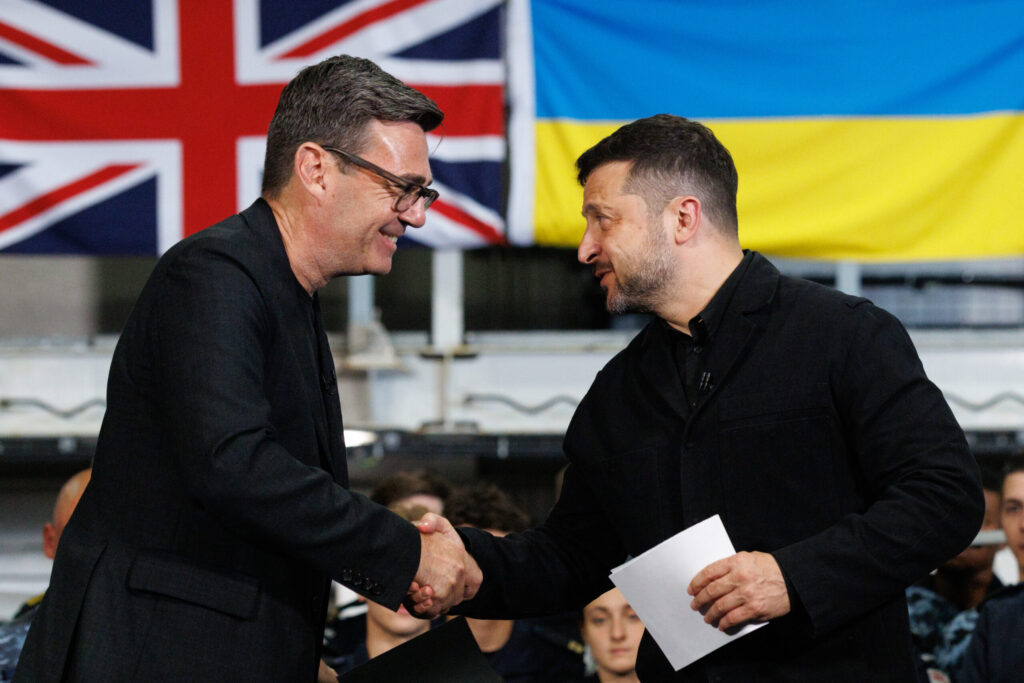
The United Kingdom has become the first foreign nation granted access to Ukraine’s Avengers Labs data platform, a repository designed to train artificial intelligence models for spotting and striking targets. Prime Minister Andy Burnham and President Volodymyr Zelensky signed the agreement in Kyiv, formalising the deal as part of the nations’ “100 Year Partnership.”
The platform aggregates millions of observations from thousands of cameras and sensors along the front line. Ukraine’s defence ministry states that a system trained on this information currently processes more than 100,000 drone video streams per month. The source material comes from the Universal Military Dataset, a manually labelled collection of real combat imagery from drones and acoustic sensors used to classify tanks, drones, or artillery.
The project originated from military AI work that began in 2022. At the time, a Ukrainian drone soldier reported that the military was training neural networks on existing footage to automatically detect Russian soldiers and vehicles. The objective was to speed up the OODA loop, a military acronym for “Observe, Orient, Decide, Act”.
Why labelled combat data is the real bottleneck
Previously, this data was shared only with domestic firms, giving Ukrainian drone makers an advantage over foreign rivals whose image recognition was often trained on synthetic data and performed worse in combat. Misha Nestor of the Ukrainian drone software company Swarmer told the Financial Times that high-quality, labelled battlefield data is one of the biggest constraints on developing reliable AI for autonomous systems. Ukraine has built up something that is extremely difficult to replicate anywhere else.
Ukraine had already announced in March that it would share this combat data with allies for AI training to speed up the development of more autonomous systems. The deal centres on an annotated dataset of about five million images, with much of the material coming straight from the DELTA digital combat system. This system ties together data from drones, satellites, and sensors into a real-time picture of the battlefield.
Approved firms can only train and test their computer vision models inside a secured dataroom, built in part with Palantir, and the finished AI stays with Ukraine. One detection system already in the field identifies 70 percent of enemy equipment shown in video streams and needs just 2.2 seconds per object.
The UK’s military is especially interested in acoustic sensor data that identifies incoming Russian drones. Trained properly, this can be far more accurate than radar. The British government says pilot projects with three British startups are already underway: Sintela from Bristol, Mind Foundry from Oxford, and Skyral from London.
One technology turns buried fiber-optic cables into an AI-powered sensor meant to protect military bases and, later, airports or rail infrastructure. A second project aims to develop low-power AI chips for drones and autonomous systems. The deal follows Burnham’s announcement that defence contractor MBDA can release classified information about British components of the SCALP cruise missile for assembly lines in Ukraine.
From target tracking to autonomous target selection
The data ultimately gets used for drone autonomy, which breaks down into three stages. The first is autonomous navigation without GPS. The second is last-mile target tracking, where a human picks the specific target and the AI then follows it. The third is autonomous target selection, where the machine itself decides which object to attack.
The first two stages have long been in use in the war in Ukraine. In 2024, a Ukrainian FPV drone that lost its radio link struck a previously chosen Russian tank on its own. This is an example of the crucial last-mile distinction. Auterion described the underlying tech, which combines computer vision and target tracking even when the connection is jammed, with its Skynode S drone chip.
In July 2026, Auterion and SkyFall began shipping 50,000 SkyFall Shrike FPV drones fitted with Auterion’s Skynode S. The government says Ukrainian interceptor drones operate about 95 percent autonomously, and Swarmer software coordinates drone swarms in over 100 real missions.
The third stage is now at the center of a report by the New York Times. In July, a Russian Molniya drone killed three civilians in the city of Zaporizhzhia, among them 19-year-old student Tetiana Bubynets. The operators had programmed the drone to hit a gas station, but near it the software itself picked the specific target, likely propane tanks.
In the rubble, a forensic team found a commercially available mini-computer, an Nvidia Jetson Orin, that made the targeting decision. Kateryna Bondar of CSIS calls the attack the first documented case in which a Russian drone with a self-selecting AI system caused civilian deaths.
The Nvidia chip alone does not prove an autonomous targeting decision. What matters, according to Ukrainian investigators, is the combination of the drone’s missing radio link to the operator and the code and training material examined on the computer. This is not the first autonomous deadly drone strike anywhere in the world, but the first documented Russian case with civilian casualties.
Ukraine is by no means only a victim of this trend. Recently dismissed defence minister Mykhailo Fedorov told the New York Times that Ukraine had spent several months testing a fully autonomous AI system in occupied Crimea, hitting fuel depots and military equipment. There were no civilian casualties.
Before that, the country had gradually rolled out AI-powered drones starting in 2023. These ranged from the autonomous attack drone Saker Scout introduced that year, meant to identify military objects on its own and strike them in autonomous mode, to Auterion’s Skynode S technology and the drone swarms now used regularly. As late as April 2026, an overview of Ukrainian ground robots still said full autonomy did not exist on the Ukrainian battlefield. The tests that surfaced later now call that assessment into question.
What it means
For the people making things, this partnership changes the rules of engagement. British firms can now train models on real combat data rather than simulations, which should improve accuracy in live environments. The restriction that finished AI stays with Ukraine ensures the technology remains under Ukrainian control. The availability of acoustic sensor data offers a clear path for UK startups to build better detection systems for drones and infrastructure protection.