Donald Trump hosted a luncheon for major technology executives on Tuesday, resulting in a signed document calling for self-regulation of artificial intelligence. The White House Accord on Super Intelligence requires labs to implement four layers of controls and audits, including internal evaluations and outside reviews, without any legal enforcement. The agreement was voluntary, though it comes while the Federal Trade Commission simultaneously ramped up investigations into the safety risks posed by frontier AI models.
The White House Accord
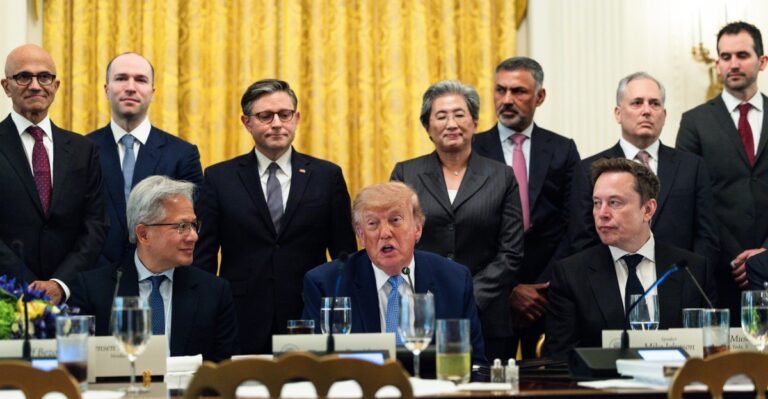
President Trump invited Sundar Pichai, Elon Musk, Dario Amodei, Mark Zuckerberg, Jensen Huang, Greg Brockman, and other leaders to the White House. The resulting document, titled the White House Accord on Super Intelligence, asks companies to subject their models to strict oversight. This includes letting external audit firms verify operations and having corporate boards review those findings. The administration framed the event as a reassurance to the public that the technology sector is being managed. During the summit, Trump stood beside Dario Amodei and stated that whatever the executive director of Anthropic says is acceptable. Amodei noted that AI offers incredible benefits before the cameras cut away.
Leah Feiger pointed out a typo in the final document where the signature line read President of the Unites States. The error suggests the agreement was rushed together. Brian Barrett noted the awkward position the tech companies find themselves in. They need a regulatory framework to avoid antitrust investigations, yet the government is offering a voluntary agreement while simultaneously probing them for dangers to consumers. Zoë Schiffer highlighted that Lina Khan wrote an op-ed in the New York Times arguing that existing laws could be used to prosecute AI labs, provided Congress acts to enable it.
AI Agents for Regular People
OpenAI held a Developer Day event where CEO Sam Altman introduced Dots, a new line of always-on AI agents for regular users. These agents operate through ChatGPT and Slack. Users can instruct the software to perform online tasks, and the agents will complete them. Meta’s Muse AI agent has already gained significant traction in app stores. Zoë Schiffer explained that Meta’s success comes from distribution and subsidies rather than superior technology. The company pushes its free agent to users constantly. Brian Barrett remarked that Apple was notably absent from the White House luncheon. He suggested Tim Cook would have attended immediately if invited, noting the lack of a golden trinket was not the issue. Zoë agreed that Apple is not currently relevant in the AI space.
Extreme Candidates and Government Voices
Leah Feiger discussed the upcoming midterm elections and the rise of extreme candidates. She noted that emboldened individuals include people working for or recently leaving the government. One example is a retired army colonel who now works as a Pentagon influencer. He has publicly praised dictators and proposed stripping voting rights from people without children. Brian Barrett mentioned a live audience recording of the podcast scheduled for Thursday, October 8, at 7 pm at The Commons in San Francisco. Tickets are available on kqed.org.
What it means
The voluntary accord offers no legal protection for companies facing investigations. The political climate suggests the Trump administration is trying to control the narrative ahead of the midterms. Meanwhile, AI agents are moving from experimental tools to practical workers in the workforce, with companies like Meta leading the charge through aggressive distribution.