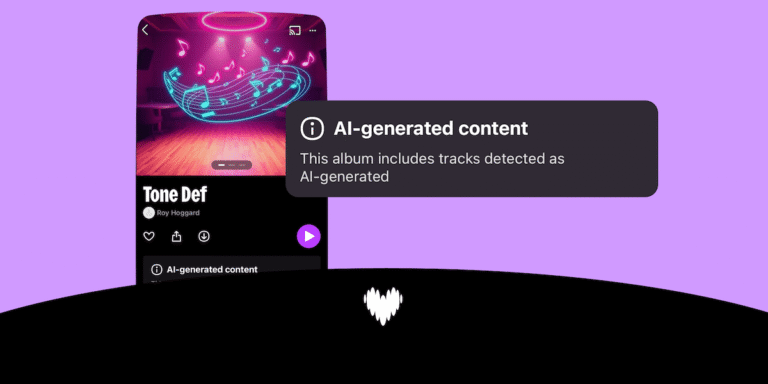
Tidal announced on Monday that it will not pay royalties for music identified as wholly AI-generated. The service stated its priority is ensuring payments go to original works produced, written, and performed by people. It will therefore not knowingly attribute royalties to tracks it identifies as created entirely by artificial intelligence.
Most music streaming platforms are now awash in AI-generated content. Spotify promised to fight AI spam with labeling and filtering while simultaneously embracing the broader trend of AI music. AI-generated bands like The Velvet Sundown and Breaking Rust have millions of listens on Spotify and generate revenue for the service. In May, Spotify announced a deal with Universal that allowed fans to create covers and remixes of popular songs. Soon, customers will be able to generate what Metallica would sound like if it were a reggae band.
Tidal takes a different approach
Tidal is trying something different. The streaming service is not a giant in the field, as Apple Music, YouTube, and Spotify dominate the charts. It has built a reputation by collaborating with artists, giving them a bigger cut of streaming profits, and focusing on delivering high quality audio. Tidal is the streaming service for listeners obsessed with bit-rate and FLAC. It is for people who have $200 digital-to-analog converters next to their computers.
The company said it will not pay for wholly AI-generated music but it also said it will not remove AI-tainted music from the platform entirely. Like Spotify before it, Tidal said it is going to work to identify the AI slop on its platform, label it, and hold AI-generated music to a higher standard of content integrity. Spotify said something similar last year, but there are still plenty of unlabeled AI-generated tracks on the platform.
Tidal also said it will not remove AI-tainted music entirely. Artists should have the freedom to create with AI tools, and listeners should have the autonomy to choose the type of content they consume. As of this writing, The Velvet Sundown and Breaking Rust are both live on Tidal. Breaking Rust’s bio identified it as AI-generated country music, but The Velvet Sundown had no bio at all.
“Tidal will not allow music that is 100% AI-generated to be monetized. No royalties will go to such releases, nor will AI-generated uploads be eligible for direct-to-fan sales,” the company said in an email to its users.
It elaborated on its website. “Starting today, AI-generated music will not be monetizable,” it said. “We are only in the beginning of the era of AI-generated music. We acknowledge the ongoing debate regarding whether certain AI-generated music (e.g. AI-generated music developed from fairly and properly licensed models) should be entitled to earn royalties. This debate will continue as the technology advances and rightsholders and AI music platforms develop licensing models.”
What it means
It is unclear if The Velvet Sundown and other bands like it will keep making money on Tidal. The company told 404 Media that it is working with an external partner to manage detection and that wholly AI-generated was defined as a song where every component of the track was made using generative AI. Our detection tools will determine how specific tracks and artists will be treated from July 15, Tidal told 404 Media in an email. The impact to royalties comes into effect starting July 15 so we don’t have numbers to share just yet.
On June 28, the day before Tidal’s announcement, The Velvet Sundown released a cover of Dolly Parton’s I Will Always Love You on Spotify and Tidal. It is atrocious and it is not labeled as AI-generated on either service.
“We exist to confuse music journalists, comfort robots, and help Spotify executives sleep at night,” says the frontpage of The Velvet Sundown’s website. “We were basically built for it, engineered to fill playlists, avoid royalties, and haunt your Discover Weekly like a ghost with good taste. Is it art? Is it a loophole? Either way, it streams beautifully.”
Update 6/29/26: This story was updated to include comments from Tidal.