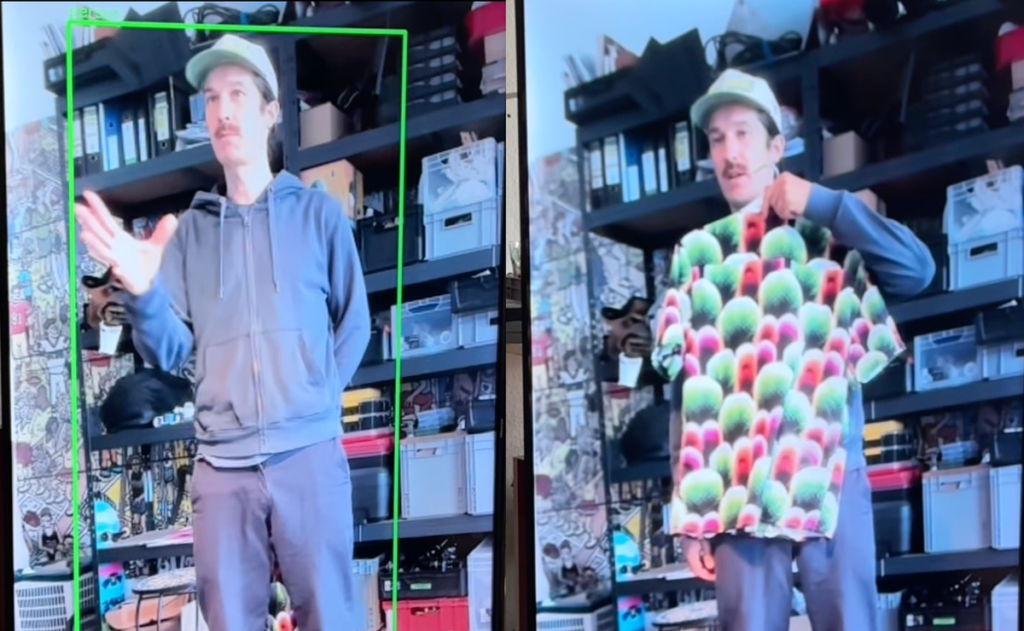
Simon Weckert held a button-down shirt in front of a surveillance camera and the green box identifying him as a person vanished. He pulled the garment away and the box reappeared. This is digital camouflage, a design intended to confuse the object recognition running on public cameras.
Weckert created the pattern as a response to the spread of AI-powered surveillance systems. These cameras detect people, vehicles, and animals. They also flag anomalous behaviour, such as someone loitering or an abandoned package, which can trigger a police response. Police recently deployed these systems outside Kotbusser Tor, a major subway stop in Berlin. They are the first object recognition cameras run by the police in the city.
“Obviously people don’t like it because it means that AI is tracking the movements and behaviors of people,” Weckert said. “It’s one thing to have somebody behind the camera watching you, but now we have AI doing this kind of analysis.” He noted that the technology can detect if someone is lying on the ground, meaning homeless people could trigger an automatic police response.
Weckert says a problem with Berlin’s setup is that it is unclear exactly which image recognition software is running. Many systems use a variation of YOLO, a family of open source algorithms. So he installed YOLO on his own camera and began trying to confuse it by iterating on different types of random patterns.
He starts with a random pattern and shows it to the algorithm to see if it detects a human and with how much certainty. “When YOLO returns 100%, I know the pattern obviously isn’t working,” he said. “And then step-by-step, I change the pattern, I rotate certain parts of the pattern, change the colors, flip it so on and so forth.” He uses gradient ascent to move the pattern away from the category of a person. Eventually, the algorithm cannot make sense of the image and fails to detect the wearer.
Weckert has done a series of buzzy projects before. At Motherboard, we covered the virtual traffic jam he created on Google Maps by sticking a bunch of GPS-enabled cell phones in a red wagon and walking slowly through the streets of Berlin. Digital camouflage sits alongside projects by other artists intended to hide people’s faces from facial recognition cameras or to confuse automated license plate reader cameras with shirts made of nonsense license plate graphics. Over the years, AI surveillance has improved to a point where many of these techniques don’t actually work anymore, but for the moment, digital camouflage does, at least on the very popular YOLO algorithms. Weckert said one of the major problems is that police won’t say specifically what algorithm they’re using, making it difficult to say whether his shirts work on the cameras at Kotbusser Tor.
“The problem is that we don’t know what technology is behind these camera systems, so therefore I cannot claim 100 percent that the t-shirt works against this specific camera system, but I can say I know it works for the very public and famous YOLO algorithm,” Weckert said. He said that just as fashion brands have seasonal updates, so too will his digital camouflage. “Every time there’s a new YOLO, a new pattern will come out. Just like in fashion, the summer winter collection, here it’s the every YOLO edition.”
He said the project is not just intended to help people avoid surveillance, but to teach people about it and to show people there’s lots of ways to protest and push back against it. “It’s to give them the feeling that there are actually certain tools we can use against surveillance. It’s not like we just have to accept what the lawmakers and police are doing.”
What it means
The project demonstrates that current AI object detection is vulnerable to specific visual noise. It also highlights a transparency issue: without knowing the exact algorithm used by authorities, defenders cannot guarantee their countermeasures will work in the field. The solution requires constant updates to match software upgrades.