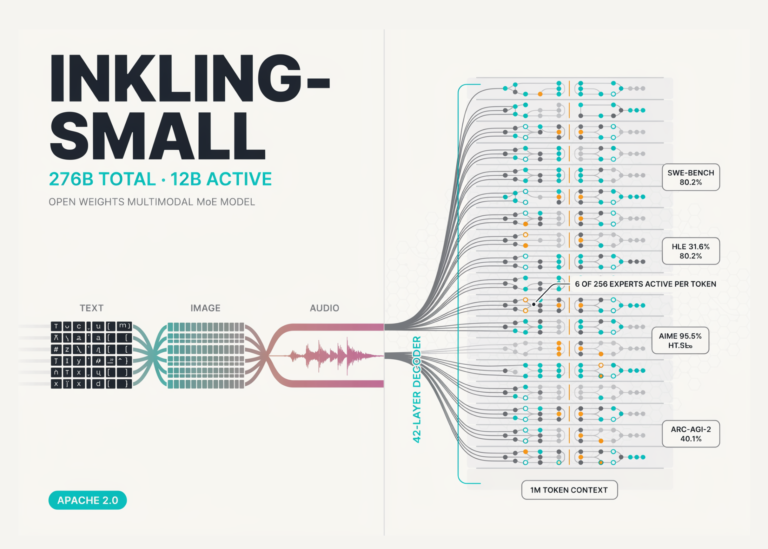
Thinking Machines has released Inkling 2 Small, a model with 594 billion total parameters but only 17 billion active at any moment, claiming the strongest performance among Western open-weight options.
The startup, founded by former OpenAI CTO Mira Murati, positions the system as a base model for fine-tuning rather than a finished product. This design allows developers to adapt it for specific needs without needing to train from scratch.
Performance gains come with higher token usage
On the Artificial Analysis Intelligence Index, the new model scores 31. That represents an 18-point increase over Inkling Small (13) and places it roughly on par with Google’s Gemini 3.8 Flash. The most significant improvements appear in agentic tasks, where the system executes multi-step workflows independently.
On the AutomationBench-AA benchmark, the score jumps from 5 to 46 percent. FrontierCode 2.0 scores rise from 5 to 25 percent. For knowledge work on the AA-Briefcase benchmark, Inkling 2 Small hits 1,527 Elo, which is 615 points above its predecessor.
The hallucination rate drops from 61 to 27 percent. This improvement largely comes from the model answering fewer questions rather than generating more accurate answers. The response rate falls from 77 to 53 percent.
The better results come partly at the cost of higher token usage. Inkling 2 Small produces roughly 150,000 output tokens per task on average, about four times as many as its predecessor. At $1.18 per task it costs nearly six times as much, according to Artificial Analysis.
That price is still far cheaper than Gemini 3.8 Flash ($7.77) or Claude Sonnet 5.5 ($10.02), and it lands closer to the price range of low-cost Chinese models.
Training data and coding benchmarks
Thinking Machines says it trained the model with reinforcement learning on hundreds of thousands of long-horizon coding tasks. An automated evaluation system checked whether the code worked and how the model approached each task.
On FrontierCode 2.0, Inkling 2 Small reaches 25.4 percent. On DeepSWE it hits 72.1 percent, and on SWEBench Pro v2 (Hard) it scores 86.3 percent. The new Deepseek-V4.1-Flash still leads on most of those tests, hitting 28.5 percent on FrontierCode and 77 percent on DeepSWE.
The total training run is remarkably compact compared with the competition. Across all phases the model processed about 12 trillion tokens, according to Thinking Machines, far fewer than comparable rivals. The reinforcement-learning phase after base training needed only 3 trillion tokens on 2,048 GPUs over nine days.
Strengths in vision and design
The company states the model is strongest in text recognition, infographic interpretation, and visual reasoning. On the document benchmark GDP.pdf, which tests whether models can answer questions from complex PDF documents, it scores 25.2 percent, the highest among the compared models.
On MMMU Pro, a benchmark for multimodal understanding of academic tasks involving diagrams and figures, Inkling 2 Small reaches 81.6 percent. On PerceptionBench, which tests the visual perception ability of multimodal models, it leads with 64.7 percent.
For visual creation, the model earns a 1,340 Elo rating on DesignArena Website, where users rate AI-generated websites in head-to-head comparisons. That is the highest score among open-weight models. Thinking Machines says the model has also made progress in 3D modeling.
In a somewhat unusual demonstration, the team pitted the model against its own researchers in a blind wine tasting. Working from a photo alone, Inkling 2 Small correctly identified three wines in 19 out of 20 attempts.
Known limitations and release plans
Thinking Machines says the model sometimes communicates inefficiently, and that is likely a bigger issue. It does not always pick the best tools for large codebases. It does not support audio and is less optimized for chat. It can also overreact to health-related topics and produce cluttered output.
For now, Thinking Machines offers the model through its Tinker platform as a proprietary offering. The company plans to release the weights under an Apache 2.0 license once external safety testing wraps up.
That is one of the most permissive open-source licenses and an advantage over more restrictive open-weight licenses such as those from Meta or Mistral. Thinking Machines says the model belongs to a family of different sizes, and the company plans to release more variants soon.
What it means
Developers seeking to fine-tune a Western model for coding or document analysis now have a strong option that outperforms previous open-weight systems. The trade-off is higher token consumption and a steeper price per task, though the cost remains below major closed alternatives. The upcoming Apache 2.0 release could make the weights more accessible for broader experimentation.