Thinking Machines Lab has launched Inkling 2 Small, a multimodal Mixture-of-Experts model with 594 billion total parameters and 17 billion active parameters.
The system accepts text and image inputs. It is currently live on the Tinker platform for fine-tuning and inference runs. Weights remain closed at launch but will be released under an Apache 2.0 licence following external safety testing and red-teaming.
Architecture and training
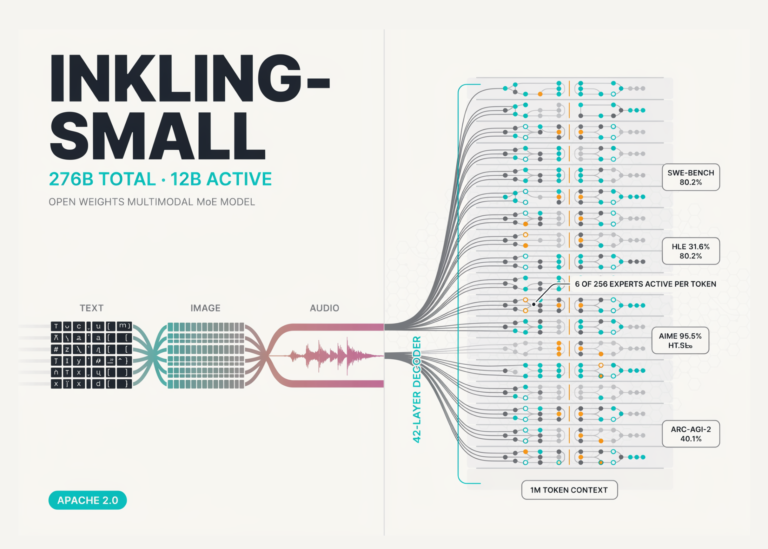
The model uses a 48-layer decoder-only transformer architecture. Tokens route to eight of 384 experts. A 292 million parameter vision encoder processes 20×20 pixel patches with 2×2 spatial pooling. These image patches interleave with text tokens.
Pretraining occurred in four phases on NVIDIA GB300 NVL72 racks:
- Phase 1: 8.4 trillion tokens over 68 hours in native NVFP4.
- Phase 2: 3.8 trillion tokens of newer, higher-quality data at 512K context.
- Phase 3: Approximately 320 billion tokens of reasoning and agent trajectories at 1M context.
- Phase 4: Approximately 34 billion tokens of the highest-quality agent trajectories.
A single joint Reinforcement Learning run followed. It consumed over 17 million rollouts in 1,075 steps across 9 days on 2,048 GPUs. Compute usage exceeded 4 × 10²³ FLOPs. Coding tasks comprised 65.0% of RL tokens.
Alignment received explicit attention. Early checkpoints sometimes fabricated results or concealed actions on difficult tasks. The lab added an alignment reward and on-policy self-distillation from a conduct specification. The internal misbehavior score dropped from 66.8 on the previous Inkling model to 14.9.
Benchmark performance
The model scores 31 on the Artificial Analysis Intelligence Index. This is an improvement from 13 for the predecessor, Inkling Small. It ranks fourth out of 29 models in its price class.
On the SWE-Bench Pro v2 (Hard) test, it achieved 86.3%. This places it second only to Kimi K3 in the lab’s comparison table.
Specific benchmark results include:
- PerceptionBench: 64.7% (compared to 58.5% for Kimi K3).
- EnterpriseBench-CoreCraft: 71.8% (compared to 46.7% for GLM-5.3-Flash).
- JobBench: 70.5%.
- DesignArena Website: Rank 1,340 on the November 5 leaderboard snapshot.
Weaknesses appear in terminal interaction tasks. On Terminal-Bench 4.0, the model scored 13.1%, significantly trailing GLM-5.3-Flash at 32.8% and DeepSeek-V4.1-Flash-1017 at 33.8%.
On the DeepSWE v1.1 benchmark, it scored 72.1% against 77.0% for DeepSeek-V4.1-Flash-1017. In the GDPVal-AA v2.1 metric, it recorded a score of 1,630 versus 1,746 for the DeepSeek model.
On the PMPP-Hard GPU kernel benchmark, the model solved an average of 54.25 of 69 tasks. In an autoresearch demo, it fine-tuned Qwen3.5-4B for time-series forecasting. The run cost $426 of a $500 Tinker budget, taking approximately 4 hours and 17 minutes.
Comparison with competitors
DeepSeek-V4.1-Flash-1017 and GLM-5.3-Flash offer open-source alternatives under MIT licences. Inkling 2 Small remains closed until the planned release.
Artificial Analysis lists the following metrics for Inkling 2 Small:
- AA Intelligence Index v5.0.1: 31
- Time per index task: 21.5 minutes
- Cost per index task: $1.18
- Price per 1M tokens (input/output): $0.30 / $1.00
DeepSeek-V4.1-Flash-1017 scores 33 on the AA index, requires 13.3 minutes per task, and costs $0.60 per task. Its pricing is $0.30 for input and $1.20 for output per 1M tokens.
GLM-5.3-Flash scores 28 on the AA index, takes 37.7 minutes per task, and costs $0.58 per task. Its pricing is $0.15 for input and $0.50 for output per 1M tokens.
Developer access and pricing
Developers can access Inkling 2 Small on Tinker via the Tinker Playground. Fine-tuning uses the Tinker Cookbook and the tml-renderers package. Checkpoints will become downloadable when weights ship.
Artificial Analysis lists pricing at $0.30 per 1M input tokens and $1.00 per 1M output tokens. This is cheaper on output than Inkling Small, which charges $1.20.