For makers, artists, and anyone relying on satellite tech, your GPS is broadcasting a hidden government network
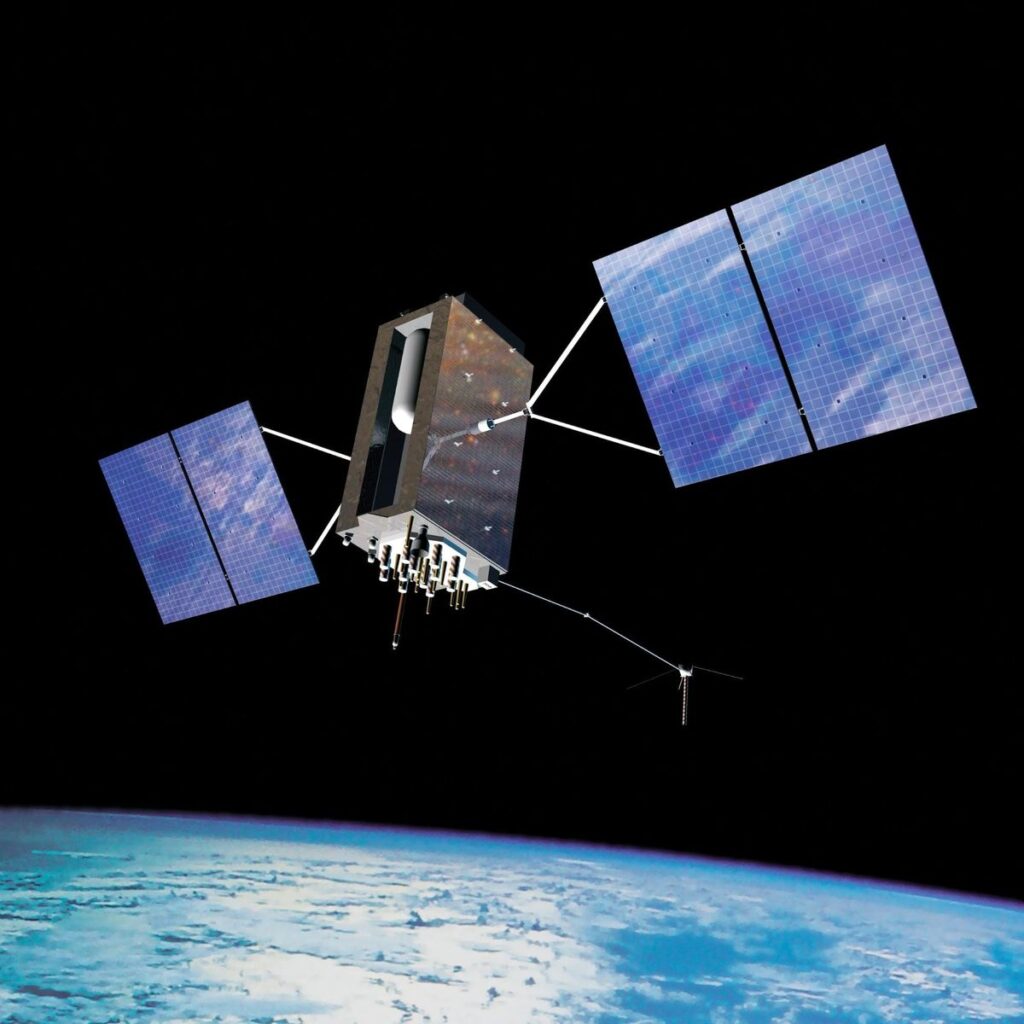
Steven Murdoch, an information security expert based in London, has revealed that the U.S. military has been quietly using public GPS satellites to broadcast encrypted codes for nearly two decades. In a new analysis published in Inside GNSS, he details how every satellite in the constellation effectively functions as a hidden “numbers station,” transmitting data to a select few without the general public knowing.
This means that for years, any device tracking its location has been inadvertently receiving classified government information. The discovery highlights a significant blind spot in how we understand our most ubiquitous navigation tool.
How the hidden broadcast works
Murdoch, who leads the Information Security Research Group at University College London, identified a specific 176-bit sequence located in what is officially labelled “Subframe 4, Page 17” of the GPS signal. He argues this slot contains encrypted material from the Pentagon’s Over-the-Air Distribution (OTAD) network, which is responsible for delivering cryptographic keys to military personnel globally.
“I think the evidence that it’s for key transmission-for use in distributing the keys for accessing the military GPS signals-is pretty strong now,” Murdoch told us. He explained that the military employs specialized receivers capable of loading these keys directly and decrypting these special messages.
He describes this often-overlooked section of the world’s most successful navigation signal as its “quietest and most consequential broadcast.”
From student observation to cryptographic proof
The mystery began more than a decade ago when Murdoch was a graduate student working on a project funded by the European Space Agency. His task was to write a decoder for raw GPS data.
“I noticed that there was this random-looking data present in the subframe,” he recalled. “I looked at the specification, and thought that was a little bit unusual. I recorded a bunch of it to look for any obvious patterns, but that wasn’t the main role of the project, so we moved on.”
From the start, Murdoch suspected the data was encrypted. He noted that truly random data is rare in nature. “If you see it, either it’s been carefully designed to be random-but then, why is someone sending out random data?-or it’s encrypted data. I thought encrypted data is by far the most likely explanation.”
He returned to the subframe intermittently over the years and even solicited guesses from the online community on Stack Exchange in 2023. Ahmed Kamruddin, a master’s student at UCL, further developed the project in 2025. Finally, this year, Murdoch assembled the final pieces of the puzzle by analysing open archive Global Navigation Satellite System (GNSS) recordings collected since 2007 and held by the GFZ Helmholtz Centre for Geosciences.
The smoking gun
The analysis of this massive dataset, which included more than 12 million observations of Subframe 4, Page 17, yielded 3,994 unique 176-bit messages. Murdoch identified key-repeating “sentinels,” including a specific pattern that appeared in February 2010 and was broadcast on and off across dozens of satellites for over a decade.
A critical discovery came on May 26, 2011, when this sentinel was transmitted by all 31 operational satellites within a window of a few hours. Murdoch believes this heralded the activation of a new operational system. He confirmed this timeline coincided with the rollout of the military’s Over-the-Air Distribution (OTAD) and Over-the-Air Rekeying (OTAR) by cross-referencing declassified documents, including a 2015 presentation regarding the operation dates.
“There was a perfect match between the timeline and that presentation and the change points that were automatically identified from the data,” Murdoch said. “That was the smoking gun that made me think: This is what it’s for.”
These automated systems replaced the cumbersome manual distribution of cryptographic keying material, allowing military GPS receivers worldwide to be rekeyed remotely via satellite broadcasts rather than through on-site procedures.
A new era of broadcasts
For the next 11 years, this expansive rekeying operation remained overlooked in public GPS data. In 2022, the system entered a new phase. The dominant sentinel pattern began to fade out and was replaced by new message formats, including broadcasts carrying a distinctive “TEXT” prefix that has gradually spread across the constellation.
Murdoch is not certain what explains this recent transition, though it could indicate an infrastructure modernization or the introduction of a new protocol. However, he emphasises that the signals were always available for anyone willing to look closer, suggesting there may be other hidden revelations waiting to be found.
“Every receiver in the world decodes Subframe 4, Page 17,” Murdoch stated in his article. “Almost none of them have ever looked at it. The lesson generalizes: There is more to learn from the bytes already arriving at our antennas than from the bytes we wish were specified differently. The data are publicly available. The signal is overhead, twice a day, every day.”
“Every GPS satellite is a numbers station,” he concluded. “The receivers were always listening. We just had not been.”
Key takeaways
GPS satellites have been broadcasting encrypted military keys via a specific 176-bit slot for nearly 20 years, functioning as a global “numbers station” for the Pentagon’s OTAD network.
Steven Murdoch at University College London identified the system by analysing over 12 million observations, confirming a timeline match with declassified documents regarding the 2011 rollout of remote rekeying.
The system recently evolved in 2022, shifting from numeric sentinels to new formats with a “TEXT” prefix, indicating ongoing modernization of the cryptographic infrastructure.
While the data is publicly available and decoded by every GPS receiver, it has remained hidden in plain sight, highlighting the vast amount of unexamined information in open satellite signals.